





Construction and the autumn Budget 2025
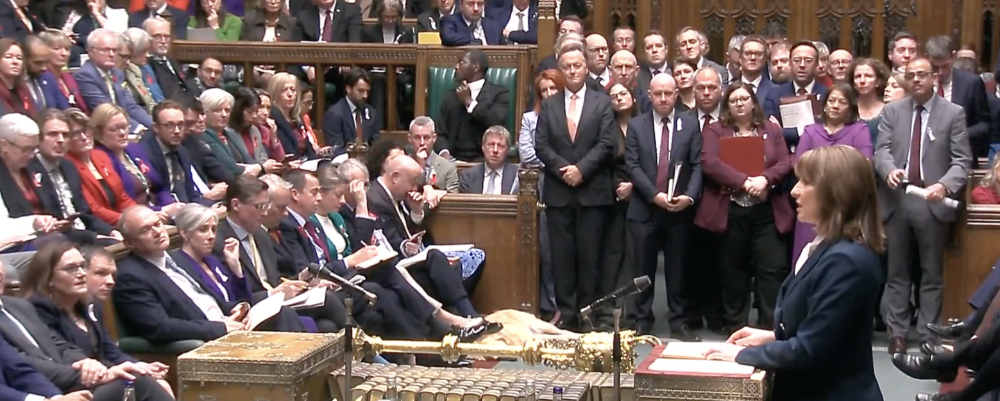
[edit] Rachel Reeves speech extracts
The Autumn Budget 2025 was issued on 25 November 2025, and after expressing disappointment that the Office for Budget Responsibility’s Economic and Fiscal Outlook was released on their website before her statement Rachel Reeves went on to give her budget speech saying:
"Madame Deputy Speaker. We are rebuilding our economy. Over the last sixteen months, we have overhauled our planning system – to get Britain building;".." From opponents to planning reform, who will always demand that the future is built somewhere else, not in their back yard; Opponents to trade, who want to take us down the path of isolation and division; Opponents to investment – who believe that the only good thing a government can do is get out of the way; Opponents who insist that the only way to balance the books is to cut public spending; And opponents who say that we don’t need to balance the books at all. But we made these choices for a reason."...
" We beat the forecasts this year and we will beat them again: By boosting trade, not blocking it. By increasing investment, not cutting it. By championing innovation, not stifling it. By backing working people, not making them poorer. Brick by brick we’ve been building our economy. Building roads, building homes, Getting spades in the ground and cranes in the sky. Growth begins with the spark of an entrepreneur: Half of new jobs in Britain are created by scale-up businesses. And we want those jobs created here not somewhere else. Our job is to make Britain the best place in the world to start up, to scale up, and to stay. So we’re widening eligibility for our enterprise incentives—so scaleups can attract the talent and the capital that they need: Expanding the Enterprise Management Incentive so more companies can offer tax-relieved share options, Re-engineering our Enterprise Investment and Venture Capital Trust Schemes so they don’t just back early-stage ideas—but stay with companies as they grow."
For the full speech visit https://www.gov.uk/government/speeches/budget-2025-speech
[edit] The budget 2025 key aspects
[edit] Infrastructure and capital investment
Reaffirmation and protection of a large public-investment programme, committing to over £120 billion of additional departmental capital spending over this Parliament, keeping public investment at levels not seen for decades. Part of that investment, has earmarked £900 million to complete the publicly funded portion of the Lower Thames Crossing new road project that will likely unlock or enhance land development potential and improve connectivity.
The government also endorses expansion of other infrastructure including rail, urban transport (for example, funding for the extension of certain transit lines), nuclear capacity and urban-regeneration schemes all of which suggest sustained demand for civil-engineering, construction and building services in the coming years. Note that the planning and infrastructure bill received its last reading on 14 November 2025
See also articles: A brief outline of the Planning and Infrastructure Bill, with terms, and amendments and Environmental Audit Committee. Environmental sustainability and housing growth: Sixth Report of Session 2024-26.
[edit] Planning reform & housebuilding
Central to the Budget is supporting ongoing reforms designed to speed up housing and infrastructure delivery. The government promises further planning reforms aimed at accelerating housing and infrastructure build-outs, devolving more powers to local/regional authorities, and streamlining approval processes. To help with this, the Budget provides additional funding for planning system capacity: £48 million allocated to recruit 350 new planners (via a graduate scheme) and to create a Planning Careers Hub, helping expand the planning workforce and reducing bottlenecks.
On the basis of these reforms and investment, the government continues to commit to deliver up to 1.5 million new homes in England during this Parliament. Some new town development examples in planning, with at least three new towns identified as sites for major housebuilding, giving the promise of large-scale developments and associated demand for construction, infrastructure, and local services.
See also articles: New Towns Taskforce: Report to government, Building new towns for the future the interim report of the New Towns Taskforce, The Lords new towns March 2025 inquiry and Government policy statement on new towns.
[edit] Social and affordable housing
This Budget reiterates plans for a new long-term programme for social and affordable housing: the Social and Affordable Homes Programme, with £39 billion allocated over ten years (2026–2036) to fund social housing, affordable housing, and associated development. An expectation of around 300,000 new social and affordable homes, with at least 60% designated for social rent, represents what has been described as the biggest boost to social housing in a generation.
Mayors and local leaders are given more power and flexibility the Mayoral Strategic Authorities (MSAs) across several major regions will mean dedicated funding allocations, allowing them to shape housing investment to local needs rather than a one-size-fits-all central plan. Councils also get more flexibility from 2026–27: able to combine proceeds from Right to Buy sales with grant funding from the Affordable Housing programme, increasing council-led housebuilding.
See also articles: A social and affordable housing renewal decade: The long term government plan for delivery, The government's social and affordable housing plan, Delivering a Decade of Renewal for Social and Affordable Housing, Social and affordable housing, a long term plan for delivery, Planning overhaul to reach 1.5 million new homes.
[edit] Implications for builders, developers, and housing supply
Infrastructure investment, planning reforms, and the affordable-housing programme on paper look like a strong and sustained pipeline of work for the construction industry, spanning large infrastructure, new towns, residential developments, social/affordable housing, and associated utilities. The commitment to 1.5 million new homes and a broad, long-term affordable/social housing programme suggests steady demand, despite the significant impacts of the remediation programmes, the Building Safety Act and the culture change needed within the industry.
Part of the funding and decision-making is being devolved to local authorities and MSAs as new towns are being planned. Changes may bring greater opportunities for regional development outside traditional urban centres, stimulating wider growth in under-developed areas. In terms of social-housing the greater guarantee of funding and long-term rent-settlement frameworks may encourage housing associations, councils and the private sector to invest more heavily, in both new developments and existing housing stock upgrades.
The changes to the minimum wage with an increase of 4.1% from April, with bigger increases for younger workers is however also likely to impact projects. This has been seen by many as a barrier especially when coupled with concerns regarding the ongoing skills gap in construction spanning from trade skills, to design, management and planning.
The Budget confirms that the two existing landfill tax rates will stay in place, and the government will take steps to prevent the gap between them from widening in future years. The exemption for quarry backfilling will also remain, ensuring housebuilders and construction companies can continue to use a low-cost alternative to landfill. Plastic Packaging Tax (PPT) rates will increase in line with CPI inflation in 2026–27, continuing to incentivise businesses to use recycled plastic with consultation on mandatory certification for mechanically recycled packaging launched in early 2026. Chemically recycled plastic will become eligible for PPT through mass balance allocation, and companies will need in order to claim PPT exemptions.
See also articles: National planning policy framework NPPF, New appointments, reactions and meetings as drive for 1.5 million homes continues, Skills in the construction industry, A Better Hiring Toolkit for construction, Kent collaboration to bridge the electrical skills gap, Warm Homes Skills Programme, The Flexible Skills Programme Wales.
[edit] Reactions to the budget
[edit] CIOB reacts to 2025 Budget announcement
Eddie Tuttle, Director of Policy, Research and External Affairs at CIOB, said: “We’re glad to hear there are no immediate rises planned to National Insurance and pension contributions, as well as business rates, which will provide consistency for the industry. However, it should still be noted the construction industry continues to face significant economic challenges and many companies, particularly Small and Medium-sized Enterprises (SMEs), face tough times.
“As a sector made primarily of SMEs (more than 99 per cent of the UK construction industry are SMEs), many companies are already struggling with rising costs and a dwindling workforce. In the 12 months to August 2025, almost 4,000 construction companies in England and Wales became insolvent, roughly 76 a week and the most of any industry.
“As we said in our October report, which focused on the industry’s capacity and capability challenge, Government and industry leaders must look beyond short-term fixes and explore longer-term solutions which aim to reduce volatility and shift the sector towards being more resilient. We believe having a wider view of the industry will allow for better policy that looks to harness the data the industry already produces and join the dots between the different government departments that cover construction.
“We also urge Government to take forward long-overdue VAT reform. Introducing VAT on demolition would help level the playing field between demolition-and-rebuild projects and retrofit. At present, retrofit work is subject to VAT while demolition is not, making the more sustainable option far less financially attractive.
“In addition, improving procurement practices must be a priority. We encourage the Government to promote procurement strategies that involve early engagement with local suppliers and create long-term collaboration within the supply chain. This would help build capacity across the industry, support SMEs and ultimately deliver better value and resilience in public projects. Finally, we welcome the Chancellor's acknowledgement of the need to improve the apprenticeship system for SMEs and we look forward to hearing more about how this scheme applies to the construction industry.”
We also urge Government to take forward long-overdue VAT reform. Introducing VAT on demolition would help level the playing field between demolition-and-rebuild projects and retrofit. At present, retrofit work is subject to VAT while demolition is not, making the more sustainable option far less financially attractive.
[edit] CIAT reaction
The Chancellor giveth, the Chancellor taketh away... This week, the Chancellor announced the Autumn Budget, building on the June 2025 Spending Review. After weeks of speculation, and chaotic scenes following the early publication of some budget documents, the actual announcements are a bit muted.
There has been no large increase in tax rates, although tax thresholds will be frozen for longer. Nor are there large-scale new taxes on wealth, though a council tax surcharge on properties over £2 million and an increase in tax rates for earnings from property, investments and dividends nod in that direction. Even scrapping the two-child benefit cap, which could have been a "rabbit out of the hat", was leaked several weeks ago.
For industry, the picture is similar. Employers will pay more as a result of increases in the national minimum wage and national living wage, but they will benefit from further skills and infrastructure investment, with SMEs in particular benefitting from fully funded training for apprentices under 25 years old.
For the built environment, investment is largely unchanged from the Comprehensive Spending Review, though greater detail has been provided on some spending plans, such as the Integrated Settlements to Mayoral Strategic Authorities, which will include allowances for spending on affordable housing. There is also further funding to increase the training of planning officials.
One of the biggest changes is the cutting of the Energy Company Obligation (ECO), which was again trailed before the budget. This, combined with government directly financing 75% of the Renewables Obligation, will see average energy prices drop around £150. Importantly, around 89% of these savings will be on electricity bills, making it cheaper for households that switch to clean, efficient heating systems such as air-source heat pumps. While any reduction in funding for home energy improvements is regrettable., the cuts to ECO (which was due to end in 2026 anyway) are partly offset by a £1.5 billion increase in funding for the Warm Homes Plan, softening the blow. It will be imperative that the Warm Homes Plan now fills the gap with long-term consistent funding to support improvements in home energy efficiency, quality and health.
All told, it's hard to get particularly excited about a budget where the Chancellor gives with the right hand and takes away with the left. But given the context and the rumours beforehand, it could have been a lot worse for the built environment sector.
CIAT President, Usman Yaqub PCIAT, said:
"Within a tight fiscal envelope, it is great to see that the Government remains committed to tackling the UK's housing crisis by delivering the high-quality, safe and healthy homes our communities need. It's particularly important to see further investment in workforce skills, which are key to delivering the future built environment."
"We also welcome the decision to reduce Green Levies on electricity, while broadly sustaining overall funding through an expanded Warm Homes Programme. It's essential that we make it cheaper to heat homes with efficient, clean and sustainable technology such as air-source heat pumps, and this change will support that transition."
[edit] Sigh of relief as landfill tax dropped, says FMB
The Federation of Master Builders (FMB) has welcomed measures in today’s Autumn Budget, including pulling back on the landfill tax, £48 million to boost planning capacity, and free apprenticeship training for under-25s in SMEs. However, the previously announced wage rises will hit small business squeezed bottom lines and the lack of action on domestic retrofit and dropping of ECO scheme leaves a gap in how the country will upgrade it's old housing stock.
Brian Berry, Chief Executive of the FMB, commented: “Today’s announcement on landfill tax reform is a big win for small house builders, saving them thousands on new build costs. Alongside this, making apprenticeship training for under-25s in SMEs free from paying in the co-investment sum when hiring under 25's will be a boost, alongside much needed simplification of the apprenticeship application process."
Berry continued: "The £48 million investment to boost planning capacity is further positive step. Local planning departments are under immense strain, and this funding will help unlock stalled housing projects, but this seems a small sum of money to fix a very big problem. A well-resourced planning system is essential if we are to meet housing targets, and SMEs must be at the heart of delivery. Supporting small builders to get spades in the ground will ensure Britain gets the high-quality homes communities need.”
Berry concluded: “However, the rise in minimum wage will squeeze bottom lines and the freeze in tax thresholds has the potential to push many builders into a higher tax bracket. It's also disappointing to see the Chancellor miss the opportunity to back household energy upgrades of any kind, even rolling back on the ECO scheme. Upgrading homes will be vital to keep people warm in winter and cool in summer. This Budget offers welcome steps forward, but overall I can see many builders feeling underwhelmed."
[edit] ECA's Autumn Budget response: Mixed fortunes for electrical firms
The Autumn Budget brings some relief and new challenges for employers in the electrical sector. The Chancellor announced £725 million for the Growth and Skills Levy, aimed at supporting apprenticeships for young people, including a change to fully fund SME apprenticeships for eligible people under 25.
This announcement equates to £1,150 per apprentice aged 22–24, but the reality is that few new electrical apprentices start within this age group. While any additional apprentice support will be welcomed by ECA’s (Electrical Contractors' Association) Member businesses, it does not go far enough.
Andrew Eldred, Deputy CEO of ECA, commented: “The recent 6% uplift in the Apprentice Minimum Wage—now nearly 50% higher than in 2024—means the cost of employing apprentices has soared. For many SMEs, it now takes an average of a year longer to see any return on their investment in training new talent. This level of Government-imposed wage inflation is unsustainable without urgent counter-measures, through more generous employer incentive payments and/or tax credits for businesses that train.”
ECA has had little real opportunity to input into the Government’s plans for simplifying the apprenticeship system, but is keen to work with Government to alleviate administrative and regulatory burdens for employers, especially SMEs.
Electric Vehicle Road Tax: Many ECA Member firms have pioneered the use of electric vans and cars, with electrical contractors often travelling long distances for work. From 2028, electric cars and plug-in hybrids will be subject to a road tax based on mileage, though electric vans will initially be excluded. The Office for Budget Responsibility (OBR) estimates that an electric car driver travelling 8,500 miles a year will pay £255—roughly half the rate of fuel duty tax paid by petrol and diesel drivers. As we get closer to the 2030 ban on the sales of new petrol and diesel cars, this is disappointing for firms expecting long term savings on transport. For those yet to invest in electric vehicles, today’s Budget has increased and extended the EV car grant to prevent the transition to EVs from slowing down.
Energy bills: ECA welcomes the removal of the ECO scheme and the Renewals Obligation levy on household bills, which will help reduce the high cost of electricity for consumers, while retaining Government support for renewables. The UK currently has the highest electricity prices in Europe, with electricity taxed at four times the rate of gas. ECA will continue to call for a review of energy taxation to bring gas and electricity to parity. Further reductions in electricity prices are essential for the widespread adoption of electric transport, heating, and energy—necessary steps to reduce carbon emissions.
ECA’s Head of External Affairs, Jane Dawson added: “Without bolder action from Government, the UK risks falling behind net zero delivery, missing investment opportunities, and limiting economic growth.”
[edit] IHBC welcomes Budget’s financial boost for planning, supporting RTPI’s call for long-term investment as ‘the key to building capacity’
The IHBC has welcomed the Autumn Budget commitments of significant funding for planning, including investment to recruit an extra 350 planners, and supports the RTPI’s call for long-term investment as ‘the key to building capacity and supporting the government’s growth agenda.’
RTPI writes:
The chancellor has pledged £48 million additional funding to boost capacity in the planning system. This includes additional investment to recruit an extra 350 planners in England by expanding the Pathways to Planning graduate scheme and creating a new Planning Careers Hub to retain and retrain mid-career professionals.
The funding will take the total number of recruitments across the planning system to 1,400 by the end of this Parliament. The investment comes at a critical time for the planning system, as findings from the RTPI’s State of the Profession 2025 report show that one in five of planners across the UK expect to leave the profession within the next three years.
Dr Victoria Hills, Chief Executive of the RTPI, said: ‘Today’s Autumn Budget marks a watershed moment for the English planning system. This commitment has the potential to turn the tide on years of severe disinvestment, helping to keep experienced planners in the system and bring through the next generation. It’s a clear signal that planning is being treated as the critical public service it is.
‘The new funding is not just a boost for local authorities, it is an acknowledgement that planners are vital to driving the government’s growth agenda and economic productivity.’
Robbie Calvert, Head of Policy and Public Affairs at the RTPI, said: ‘We wholly welcome the government’s investment despite the difficult fiscal environment. We now look forward to working with government and Higher Education Institutions to ensure this investment is sustained and directed where it’s needed most – the workforce of the future – and equip them with the skills, digital tools, well-being support and, most importantly a clear and strong sense of purpose.’
[edit] RICS statement on 2025 Autumn Budget
RICS recognises the significant challenges facing the Government and the need for a difficult financial balancing act.
RICS welcomes the continued commitment to major infrastructure projects and skills across the country. The announcement of free training for all apprentices up to the age of 25 at SMEs will help young people to gain critical experience including in the built and natural environment sector. This should help expand the surveying pipeline.
The government’s continued commitment to improving the business rates system is necessary, but meaningful and wholesale reform is still needed. Business rates must be reflective of a modern economy, and those that require physical assets should only pay a fair and proportionate share of the burden. Scrapping the Energy Company Obligation (ECO) scheme with no prospect of an alternative mechanism has the potential to hamper the country’s ambition to tackle the UK’s retrofit burden. We must catalyse a market for retrofitting our existing homes to meet net emissions targets and create the high-paying jobs of the future.
Recent RICS research* highlights the potential risk of the application of National Insurance at a rate of 2% to landlord income. The findings indicate that these tax changes could encourage landlords to reconsider their investment in the market. This could have a knock-on effect of increased costs to tenants. As the industry leader in valuation, RICS will ensure that surveyors’ expertise supports the fair implementation of the High Value Council Tax Surcharge.
RICS Chief Executive, Justin Young, said: “The Government faces many challenges, and RICS recognises the difficult balancing act it must play. There are positive moves, such as new support for apprentices under the age of 25, which should hopefully expand the pipeline of new talent into the surveying profession. It is encouraging that the Government is prioritising necessary reforms to the business rates system, and we are committed to supporting this effort through our members’ expertise.
“Whilst these changes are welcome, there are several measures which may weaken the housing market, such as the application of NI on rental income. Furthermore, it seems that commitments to sustainability are weakening. RICS is working with the Government to mitigate these effects and help it deliver its objectives.”
[edit] CIC Responds to the Chancellor’s Autumn Budget
It is hoped that yesterday’s Autumn Budget will set the tone for growth and transformation across the built environment. The Chancellor confirmed continued investment in major infrastructure projects, including Sizewell C, the Lower Thames Crossing, and regional regeneration initiatives.
The Construction Industry Council (CIC) strongly supported the Construction Leadership Council’s pre-budget letter urging government to accelerate the adoption of spatial infrastructure, boost planning resources and strengthen policies on retrofit and housing. These measures would unlock investment, improve productivity, and provide stability across the construction ecosystem.
Housing remains a priority and CIC welcomes measures to support local authorities in accelerating social housing and addressing planning bottlenecks by providing the funding to recruit 350 extra planners in England. Alongside this, £13 billion will be devolved to local mayors for skills development and infrastructure projects, helping to strengthen the construction workforce. From April 2026, the minimum wage for apprentices will rise by 6%, further supporting talent development. CIC also welcomes the government’s decision to reform Landfill tax.
However, it was disappointing not to see any incentives to support first time buyers which would help stimulate movement in the housing market.
Critically many of Government’s plans on housing, infrastructure, employment and energy security rely on the construction sector to deliver. Although Government has made solid spending commitments, recent research indicates that the construction workforce has fallen to its lowest proportion of total UK employment in over 100 years, which could consequently hamper ambitions. Further increases in National Insurance have thankfully been ruled out but industry will still have to address the tension between any potential drag on recruitment through an increased minimum wage with the need to ensure that construction pays entrants enough to make it a viable career choice given cost of living increases.
CIC Chief Executive Graham Watts said of the budget, "In many ways the Autumn Budget was a damp squib, not least because all of it was known before the Chancellor spoke! For the construction sector, although there were lots of absences from the industry's asks, it was probably less damaging than it could have been and there was some good news."
[edit] BPF Reaction to Autumn Budget 2025
Reacting to the UK Autumn Budget, British Property Federation's Melanie Leech CBE said:
“There wasn’t a single thing said in the Chancellor’s speech that wasn’t leaked in its chaotic build up. However the lack of surprises doesn’t hide the disappointment that many in the development industry will feel after today. Whilst she spoke positively about the importance of business investment and maintained full expensing and the headline rate of Corporation Tax, there was little to cheer from an investor perspective.
"Indeed, confirmation of the large property business rates surcharge will impact critical national infrastructure like logistics businesses and priority sectors identified in the Government’s own Industrial Strategy. While it was always going to be a challenge for the Chancellor to both balance the books and support economic growth, it is disappointing that there was nothing introduced to alleviate acute development viability issues.
"Overall, no surprises, but nothing to cheer either.”
[edit] Related articles on Designing Buildings
- 2023 Autumn Statement in brief with reactions.
- 2023 Spring Budget summary and industry response.
- A second spring budget of 2023.
- Autumn Budget 2018.
- Budget.
- Cash flow budget
- Chancellor's 2022 Autumn statement industry response.
- CIOB responds to the 2024 Spring Budget announcement.
- Difference between cost plan and budget.
- ECA joins calls for unprecedented action on energy prices in Spring Budget.
- CIOB at the party conferences 2022.
- CIOB comments on the Chancellor's Autumn Budget.
- CIOB Ireland responds to Budget 2024.
- CIOB Ireland responds to Budget 2023.
- CIOB Ireland responds to Budget 2022.
- CIOB responds to the 2024 Spring Budget announcement.
- ECA responds to 2024 Spring Budget.
- Economic stability must be a priority for 2023 Spring Budget urges APM.
- Industry responds to the 2024 Spring Budget announcement.
- Scottish Government Budget 2018-19.
- Spring Budget 2017.
- The autumn statement: What is it and does it effect construction ?
- The general election and why a shortage of electrical apprentices matters.
Featured articles
Check out some of the best features and news from Designing Buildings as well as key stories from around the web.
Rethinking passive fire protection in design

PFP demands the same level of design rigour as structure or services.

38% of Gen Zs feel safe when a fire door is wedged open.
Stunning images from around the world

Shortlist for CIOB’s Art of Building photography competition.

Guidance for conversion of traditional pre-1919 stone buildings.
Industrial heritage in the Ruhr

A marked difference to the fate of industrial landscapes in the UK.

Communities will be able to build their own clean energy.
Why diversity and inclusion matters for SMEs

CIOB’s D&I Charter shows how practical changes can support long-term growth.
Cut electricity bills to power growth

Coalition sends joint letter to the Chancellor.

Gasholders: a history in pictures. Book review.
Recognition, influence and growth

SocEnv identifies three strategic pillars in new strategy to 2045.

Discover the future of roofing, cladding and insulation.

New guidance for professional practice, cultural change and regulation in social housing.