





User talk:Archiblog
[edit] Archiblog's articles on Designing Buildings
- AD: A great little mag!
- Anticipatory Design
- Archiblog's Ordering
- Architecture: Doubt, Delight, and Change
- ATOM: A generating system designed by Cedric Price
- Beeching cuts: The railway network in Nottinghamshire
- Bucky's Ordering
- Cedric Price
- City Cluster, City of London
- City Cluster, Kit of Parts
- Co-operative Housing
- Disaster Planning
- Disaster Planning: North Staffs
- Disaster Planning: Notts
- Disaster Planning: School Buildings
- DOMESTIKIT: World-Wide Dwelling Service
- DOMESTIKIT: UK
- Dukeries Thinkbelt
- EDUKIT: World Educational System
- EDUKIT: UK
- Generator
- Geographic Information Systems: QGIS
- Housing in the UK
- Housing in the UK: Datasets
- HOUSING IN THE UK: Further ongoing research
- Housing Research by Cedric Price
- Hudson Yards: Manhattan
- Miners' Strike
- Miners' Strike: The coal industry in Nottinghamshire
- Norman Fellows
- Potteries Thinkbelt
- Potteries Thinkbelt study
- Potteries Thinkbelt study: Further ongoing research
- QGIS "What about Learning More?"
- The Commons
- The Commons: City of London
- The Commons: Manhattan
- The shadow institution
- The Shed
- Varsity Line
[edit] TEMPORARY TALK - PLACEHOLDER FOR ARTICLE ON ARCHITECTURE

• Collage of covers from Cedric Price Works 1952–2003: A Forward-Minded Retrospective. Source: CCA / Architectural Association
- "(Cedric Price) worked from the premise that in order to establish a valid equation between contemporary social aspirations and architecture it is essential to add to the latter "Doubt, Delight and Change" as design criteria." [1]
|
|
[edit] Abstract[edit]'De architectura', written by the Roman architect Vitruvius around 30–20 BC, is considered the earliest known treatise on architecture. The initial purpose of this article is:—
However, this article assumes:—
The ultimate purpose of this article is therefore:—
|

[edit] Synopsis (or abstract-level summary):
- Functions as a self-contained precis of the entire thesis.
- Presents the core argument, methodology, scope, and findings in condensed form.
- It’s what a reader (or examiner) could use to grasp the essence of your research without reading the full document.
- Typically 300–800 words, depending on institutional format.
| Central research question | ...from Vitruvius to CP and beyond |
|
Theoretical premise or hypothesis In 1996, Cedric Price wrote:—
|
A theoretical premise is a foundational idea or proposition that serves as the basis for a theory or argument. It is assumed to be true and is used to support further reasoning or conclusions. [edit] Definition of Theoretical PremiseA theoretical premise is a foundational idea or proposition that serves as the basis for a theory or argument. It is assumed to be true and is used to support further reasoning or conclusions. [edit] Characteristics of Theoretical Premises[edit] Nature of Premises
[edit] Importance in Arguments
[edit] Examples of Theoretical Premises[edit] Common Usage
[edit] Implicit Premises
Understanding theoretical premises is crucial for evaluating the strength and validity of arguments in various fields, including philosophy, science, and logic. |
|
Methods or analytical framework modus operandi was to question. |
| Key case studies or material (e.g., IFCCA entries) |
| Core findings or conclusions |
| Contribution to architectural knowledge |
|
Synopsis might include:
In 1996, Cedric Price wrote:— "To establish a valid equation between contemporary social aspirations and architecture it is essential to add to the latter doubt, delight and change as design criteria." According to the Canadian Centre for Architecture:—
modus operandi - to question |
Notes A thesis synopsis is a concise summary of your research proposal. It serves as a roadmap for your study and typically includes:
|
[edit] Introduction (first chapter):
- Serves as the entry point to the thesis.
- Builds the narrative, situating your research within theoretical, historical, and disciplinary contexts.
- Explains why the research matters, how it fits in architecture’s discourse, and what structure the reader can expect.
- Usually 2,000–5,000 words or more in a thesis on architecture.
|
Introduction might include:
|
Notes The introduction of a thesis sets the stage for your research. It should include:
|
The oldest surviving thesis on architecture appears to have been written over 2000 years ago, namely:—
This thesis ...
- ... that Vitruvius' thesis is out of date.
In De architecture, written in the first century BC, Vitruvius framed architecture around three principles, namely:—
This article evidence
- .. that Vitruvius' ordering ...
In Time ... , given in 2001, Cedric Price acknowledged Vitruvius' definition of architecture as "firmnness, commodity and delight".
However,
Thus this article argues:—
- ... that Vitruvius (1st century BCE) and Cedric Price (20th century CE) bookend a paradigm shift in architectural thinking.
If so, then the (research) question is:—
- What comes next?
[edit] Vitruvian Ordering[edit]
Vitruvius in De Architectura frames architecture around three famous principles:
But beyond that triplet, his notion of ordinatio and dispositio refers to proportion, arrangement, and harmony — architecture as an art of ordering form, material, and function into a coherent, legible system. It’s classical ordering:—
|
|
 • Ground Plan • Ground Plan
|
 • Section on Long Axis • Section on Long Axis
|
 • Section on Short Axis • Section on Short Axis
|

• Table showing drawings of Vitruvius' Basilica at Fano. Source: Russell Taylor
[edit] Leon Battista Alberti
According to Alberti:—
- "It is the task and aim of concinnitas to compose parts that are quite separate from each other by their nature, according to some precise rule, so that they correspond to one another in appearance."
|
• English title page of the first edition of Giacomo Leoni's translation of Alberti's De Re Aedificatoria (1452). Source: Heidelberg University |
• Drawings of San Sebastiano, Mantua, Italy. Source: Marco Introini |
• Gallery of Marco Introini's photographs of San Sebastiano, Mantua, Italy. |
 
|


• Table indicating influence of Vitruvius on Leon Battista Alberti in the 15th century
[edit] Palladio
 • Front page of I quattro libri dell'architettura (The Four Books of Architecture) (1642 edition). Source: Manfred Brückels • Front page of I quattro libri dell'architettura (The Four Books of Architecture) (1642 edition). Source: Manfred Brückels
|
 • Drawings of Villa Capra, Vicenza, Italy. Source: Banister Fletcher • Drawings of Villa Capra, Vicenza, Italy. Source: Banister Fletcher
|
  • Gallery of Atelier XYZ's photographs of Villa Capra, Vicenza, Italy. • Gallery of Atelier XYZ's photographs of Villa Capra, Vicenza, Italy.
|
  • Church-of-San-Giorgio-Maggiore-Venice-Andrea Palladio. Sources: Theubald (top); Didier Descouens (bottom) • Church-of-San-Giorgio-Maggiore-Venice-Andrea Palladio. Sources: Theubald (top); Didier Descouens (bottom)
|
• Table indicating influence of Vitruvius on Andrea Palladio in the 16th century
[edit] Inigo Jones
"(Inigo Jones) the first to employ Vitruvian rules of proportion and symmetry in his buildings." Can you find a reliable source for this claim?
 • Andrea Palladio was one of Jones’s most important sources. This 1601 edition of Palladio’s Quattro libri di architettura shows Jones reconstructing the proportional design methods used in the domed temple of Minerva Medica in Rome, referred to by Palladio as ‘Le Galluce’. Jones was evidently attracted to the complexity and internal harmony of the plan, which is formed from concentric and interlocking circles. He used his dividers to seek out the principal ratios and then pricked the scored arcs with his pen, to create dotted outlines. 30: Worcester College, Oxford • Andrea Palladio was one of Jones’s most important sources. This 1601 edition of Palladio’s Quattro libri di architettura shows Jones reconstructing the proportional design methods used in the domed temple of Minerva Medica in Rome, referred to by Palladio as ‘Le Galluce’. Jones was evidently attracted to the complexity and internal harmony of the plan, which is formed from concentric and interlocking circles. He used his dividers to seek out the principal ratios and then pricked the scored arcs with his pen, to create dotted outlines. 30: Worcester College, Oxford
|
 • Pages from Inigo Jones’s copy of Andrea Palladio’s I Quattri libri dell’architettura, 1601, with annotations by Inigo Jones (Worcester College, Oxford) • Pages from Inigo Jones’s copy of Andrea Palladio’s I Quattri libri dell’architettura, 1601, with annotations by Inigo Jones (Worcester College, Oxford)
|
|
 • Rolls Chapel and Rolls House, now part of Maughan Library, King's College London. Source: Paravene • Rolls Chapel and Rolls House, now part of Maughan Library, King's College London. Source: Paravene
|


[edit] Christopher Wren
According to Parentalia (1750):—
- “About the thirtieth year of his age he turned his studies to Architecture; and, taking Vitruvius for his guide, together with the designs of Inigo Jones, he soon made himself a master of that noble science.”
|
• The Chapel of Pembroke College, Cambridge, England, seen from the east. Source: Steve Cadman According to Pembroke College:— "The Chapel is not only Christopher Wren’s first work, but almost the first English church or chapel in the Classical style, preceded only by Inigo Jones’s church of St Paul, Covent Garden, now rebuilt after a fire in 1795." [*} |
• St Paul's Cathedral. Source: The Warden and Fellows of All Souls College, Oxfrord |


[edit] Pricean Ordering[edit]
Price’s architecture resists permanence and hierarchy. His ordering often reflects:
- Flexibility & Indeterminacy: e.g., the Fun Palace (1961) is conceived as a changeable framework — no fixed form, just scaffolding for events.
- Time-based Ordering: architecture as a process, not a static outcome.
- Social Utility > Monumentality: Price privileged adaptability and accessibility over symbolic or aesthetic permanence.
- Systems Thinking: ordering through cybernetics, networks, and feedback loops rather than symmetry and proportion.
[edit] Fun Palace
- "...a short-life public urban skill and delight 'toy' for random usage by all on a disused riverside site." [*]
|
|
|
 • Axonometric view of interior. Source: Cedric Price • Axonometric view of interior. Source: Cedric Price • Diagrammatic section: Source: Cedric Price • Diagrammatic section: Source: Cedric Price • Typical plan. Source: CPA/CCA • Typical plan. Source: CPA/CCA
|
  • Views of mode. Source: CPA/CCA • Views of mode. Source: CPA/CCA • Helicopter view. Source: CPA/CCA • Helicopter view. Source: CPA/CCA
|


[edit] Potteries Thinkbelt
- "...an alternative to university, employing varying means of exchange in the industrial U.K. Midlands..." [*]
|
• Facsimile. Source: Norman Fellows fonds, courtesy of CCA |
|
|
Finding Aid. Source: Norman Fellows fonds, courtesy of CCA |


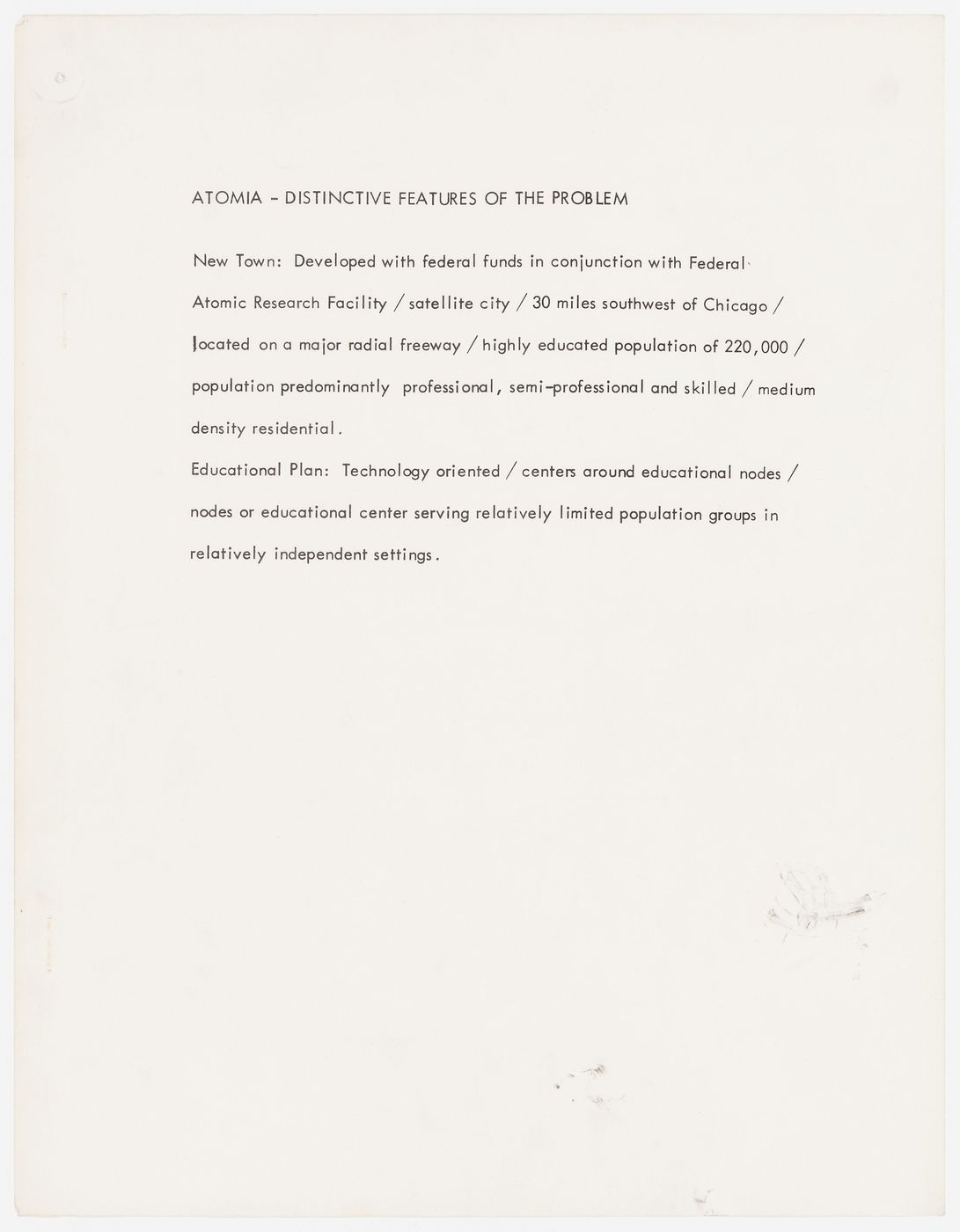
[edit] Atom
- "...a hypothetical location and program for a new town along with its educational needs and asked to create an 'educationally integrated' community." [*]
|
|
|
|
|


[edit] Housing Research
- "The published research examines housing's "life patterning" potential within broader social, economic, and historical contexts. " [*]
  • 24 hour Living Toy. Source: CPA/Norman Fellows fonds • 24 hour Living Toy. Source: CPA/Norman Fellows fonds
|
 • Expediency. Source: CPA/Norman Fellows fonds • Expediency. Source: CPA/Norman Fellows fonds
|
 • Axonometric for housing unit. Source: CPA/CCA • Axonometric for housing unit. Source: CPA/CCA
|
  • Views of models for a prefabricated house. Source: CPA/CCA • Views of models for a prefabricated house. Source: CPA/CCA
|
[edit] Inter-Action
- "A similar (to Fun Palace), 20 year life, was built in a densely populated area of London for a Trust creating a range of activities." [*]
 • Inter-Action Centre. Source: CPA/ Architectural Review, January 1973. • Inter-Action Centre. Source: CPA/ Architectural Review, January 1973.
|
 • Elevations and sections. Source: CPA/CCA • Elevations and sections. Source: CPA/CCA • Plans. Source: CPA/CCA • Plans. Source: CPA/CCA
|
|
 • Installation of a cabin. Source: CPA/CCA • Installation of a cabin. Source: CPA/CCA • Aerial view. Source: CPA/CCA • Aerial view. Source: CPA/CCA
|


[edit] Generator
- "...enabled individual and group activities to be realised and changed by both computer and mechanical means." [*]
|
• Generator. Source: CPA/ Architectural Review, January 1980. |

|
 • View of model. Source: CPA/CCA • View of model. Source: CPA/CCA
|
|


[edit] Magnet
- "Magnets are located in and around Central London and invest city movement not only with convenience and interest but also Delight." [*]
|
|
 • Arch, Thurrock Lakeside (top), Platform, St Giles Circus (bottom). Source: CPA/the Architects' Journal • Arch, Thurrock Lakeside (top), Platform, St Giles Circus (bottom). Source: CPA/the Architects' Journal
|
|
 • Stratford Box, Regent's Park, North Circular Road. p.33 Source: CPA/the Architects' Journal • Stratford Box, Regent's Park, North Circular Road. p.33 Source: CPA/the Architects' Journal  • Annotated sketch and model, p.39 Source: CPA/the Architects' Journal • Annotated sketch and model, p.39 Source: CPA/the Architects' Journal
|


[edit] IFPRI
 • Message (fax) from Cedric Price addressed to the IFCCA Prize Coordinator. Source: CPA/CCA • Message (fax) from Cedric Price addressed to the IFCCA Prize Coordinator. Source: CPA/CCA
|
|
|
 • View of site with proposed structures (laser transmission tower, Hudson Sleeve, Javits Convention Center South Extension and City Sleeve). Source: CPA/CCA • View of site with proposed structures (laser transmission tower, Hudson Sleeve, Javits Convention Center South Extension and City Sleeve). Source: CPA/CCA • View of the Hudson Sleeve near the Jacob K. Javits Convention Center. Source: CPA/CCA • View of the Hudson Sleeve near the Jacob K. Javits Convention Center. Source: CPA/CCA
|


[edit] Archiblog's Ordering
- "You see it's like a portmanteau—there are two meanings packed up into one word. `I see it now,' Alice remarked thoughtfully..."
- Carroll, L. (1871) 'Through the Looking-Glass'

|
[edit] Notes
In an article in New Statesman entitled 'People's Palaces' Reyner Banham wrote:—
- "What sticks in my gullet is the second-rate acceptance of a second-hand building as good enough for the job. At least you cannot say this about Joan Littlewood’s Fun Palace project. She thinks the ‘people’ deserve all-new tackle, and if she believes this for reasons as sentimental as Wesker’s (ever see her in a pub trying to make the local slag come on gay and spontaneous?) a lot of the people aren’t going to argue too hard about her motives. But what is unsentimental—and why the Fun Palace gets my vote—is that she and her architects and tech-men aren’t offering any kind of monument, new, second-hand or any-wise. It really is a kit of parts, and for months now Cedric Price, the architect involved, has been driving architectural journalists mad by steadfastly refusing to release any pictures of what the FP will actually look like. He may well not know, but that doesn’t matter because it is not the point. Seven nights of the week it will probably look like nothing on earth from the outside: the kit of service towers, lifting gantries and building components exists solely to produce the kind of interior environments that are necessary and fitting to whatever is going on.
- What matters is that the various activity-spaces inside the FP will not be fossilised in a single architectural schema that may become functionally out of date in five years and is out of fashion already, like Centre 42’s theatre-in-the-roundhouse. They have been assumed to be functionally out of date the moment they are built, and can therefore be changed—not by sliding screens, parish-hall fashion, but by the complete removal and rearrangement of all enclosing surfaces (floors and ceilings as well as walls) and since change is regarded as the normal condition, the largest single installation will probably be the means of change, the gantries that make it possible to lift anything and put it somewhere else. Since there are no exterior walls, the actual enclosed volume of the FP is expected to vary wildly but since it is also to be the first building in Britain with full (not token) mechanical services and environment controls, it is quite possible that many activities will need no more enclosure than a roof over their heads.
- Sorry, the word ‘building’ got in there by mistake (old cultural habits die hard). There probably isn’t going to be any building in the normal scope of the concept at all. What there will be—if any current concept really covers the FP proposition—is a gigantic version of the three-dimensional chess they play on long interstellar voyages in science fiction, only any number of unspecified and random players, individuals or groups, can play, competing for optimum environments for whatever kind of knees-up they have in mind. So it may turn out more like one of those vast and inscrutable social games in Van Vogt’s Null-A novels.
- It is all a wild, mod dream, no mistake about it, and this is precisely what gives it its meaning." [*]
[edit] Introduction[edit]
Many theorists have defined architecture in terms of ordering, though the interpretation depends on the tradition one draws from.
Some perspectives:
- Classical tradition: Vitruvius’ triad (firmitas, utilitas, venustas) implies that architecture is the ordering of form, function, and beauty into a coherent whole. [1]
- Rationalist / Structuralist view: Architecture is an ordering system of space, material, and structure — making raw elements legible and inhabitable. Think of Alberti’s emphasis on concinnitas (harmonious ordering). [2]
- Modernist view: Le Corbusier often framed architecture as “the masterly, correct, and magnificent play of masses brought together in light” — i.e., ordering form through proportion and rhythm. [3]
- Phenomenological / Experiential view: For someone like Norberg-Schulz, architecture is an ordering of space and place to create meaningful dwelling. [4]
- Systems / Contemporary view: Architecture can be described as the ordering of relations — between humans, environments, technologies, and information networks. This resonates with Cedric Price, Reyner Banham, or Nicholas Negroponte, who pushed architecture beyond static buildings. [5]
Thus this article argues:—
- ... that Vitruvius (1st century BCE) and Cedric Price (20th century CE) bookend a paradigm shift in architectural thinking.
If so, then the (research) question is:—
- What comes next?
[edit]
[edit] References[edit]
https://www.pem.cam.ac.uk/college/about-pembroke/chapel/chapel-history
https://archive.org/details/onartofbuildingi0000albe/mode/2up
https://archive.org/details/onartofbuildingi0000albe/page/n9/mode/2up
https://rtarchitects.co.uk/2023/04/25/vitruvius-basilica-at-fano
https://texnh.tumblr.com/post/184716351146/leon-battista-alberti-san-sebastiano
https://doi.org/10.11588/diglit.1557#0004
http://www.marcointroini.net/architecture/architects/architects_a_b/alberti/sebastiano/
https://smarthistory.org/banqueting-house
[edit] 1 Developing a Central Research Question[edit] 1.1 Identifying my focusThis thesis starts with a broad topic of interest, namely:—
The preliminary readings I conducted in order to understand the existing research and identify distinct themes are listed in the Bibliography... They matter because ... [edit] 1.2 Narrowing down the questionThe general equation can be narrowed down to a specific one, namely:—
[edit] 1.3 Clarifying terminologyThe key terms used in the question are therefore 'aspirations' and 'architecture'.
The central research question may therefore be expressed provisionally as:—
why incomplete? |
|
|
2. Theoretical premise or hypothesis In 1996, Cedric Price wrote:—
Message (fax) from Cedric Price addressed to the IFCCA Prize Coordinator (document from the IFPRI project records)
|
Notes A theoretical premise is a foundational idea or proposition that serves as the basis for a theory or argument. It is assumed to be true and is used to support further reasoning or conclusions. [edit] Definition of Theoretical PremiseA theoretical premise is a foundational idea or proposition that serves as the basis for a theory or argument. It is assumed to be true and is used to support further reasoning or conclusions. [edit] Characteristics of Theoretical Premises[edit] Nature of Premises
[edit] Importance in Arguments
[edit] Examples of Theoretical Premises[edit] Common Usage
[edit] Implicit Premises
Understanding theoretical premises is crucial for evaluating the strength and validity of arguments in various fields, including philosophy, science, and logic. |
|
3. Methods or analytical framework modus operandi was to question. |
| 4. Key case studies or material (e.g., IFCCA entries) |
| 5. Core findings or conclusions |
| 6. Contribution to architectural knowledge |
[edit] Introduction (first chapter):
- Serves as the entry point to the thesis.
- Builds the narrative, situating your research within theoretical, historical, and disciplinary contexts.
- Explains why the research matters, how it fits in architecture’s discourse, and what structure the reader can expect.
- Usually 2,000–5,000 words or more in a thesis on architecture.
| Context and motivation (why this topic, why now) |
| Definition of key terms (e.g., “progressing architecture”, “adaptive environments”) |
| Literature and precedent review (evolution of discourse since 1972) |
| Identification of the research gap |
| Research questions and objectives |
| Methodological positioning (comparative, historical, theoretical) |
| Thesis structure overview (how the argument unfolds) |
[edit] Notes
|
Notes A central research question is a specific question that guides a research project, focusing on a particular issue or problem that the study aims to address. It helps narrow down a broad topic into a manageable area of study and influences the research methodology and analysis. [edit] Understanding Central Research QuestionsA central research question is a key element of any research project. It guides the study and helps to focus the research efforts. Here’s how to develop one effectively. [edit] Steps to Develop a Central Research Question
Start with a broad topic of interest. Conduct preliminary readings to understand the existing research and identify distinct themes.
Refine your broad question into a more specific one. Ensure it is neither too broad nor too narrow, allowing for significant contributions to the field.
Define any key terms used in your question to avoid ambiguity. [edit] Characteristics of a Good Central Research Question
[edit] Examples of Central Research QuestionsTopic Central Research Question To what extent do findings on urban agriculture in North America apply to Dutch cities? How has the introduction of tolls influenced traffic distribution and employment accessibility in Cape Town? Policy Implementation What factors define interactive policy, and how do they affect the implementation of spatial plans in municipalities? These examples illustrate how to frame a central research question that is relevant and researchable. |
[edit] Earlier draft of Synopsis
[edit] 1 Developing a Central Research Question[edit] 1.1 Identifying my focusThis thesis starts with my continuing interest in a broad topic, namely:— The preliminary readings I conducted in order to understand the existing research and identify distinct themes included:—
A copy of these readings entitled 'Borrowed Titles" was enclosed with my letter to Cedric Price dated 15 October 1977 (see reply - right). They matter because they provided a basis for this thesis. [edit] 1.2 Narrowing down the questionThe broad topic of architecture can be narrowed down to a specific one, namely:— [edit] 1.3 Clarifying terminologyThe key terms used in the question are therefore 'Architecture' and 'Anticipatory Design'.
The central research question may therefore be expressed provisionally as:—
|
• Facsimile of letter from Cedric Price. Source: Norman Fellows fonds [edit] 1.4 Recognising a formative exchangeIn 1977, a brief letter from Cedric Price advised me to “concentrate rather on aims than objects.” The correspondence also noted my “interest” — a term whose ambiguity has, in retrospect, proved instructive. Whether it referred to the my curiosity or to a shared field of attention, this moment established the double perspective that continues to guide the present research, namely:—
|

[edit] Outtakes
the incomplete equation between human aspirations and the inanimate identified by Cedric Price. [1]
- the need to establish a valid equation between contemporary social aspirations and architecture. [2]
- dated 8 November 1977 [2] St Johns
a term whose ambiguity has, in retrospect, proved instructive.
For example:—
- If taken as my interest, the phrase is courteous acknowledgment.
- But if read as Cedric's own (his continuing interest in similar questions), then it signals a reciprocal awareness — a recognition of shared intellectual territory.
therefore 'interest' — which CP appeared to share -
- 'interest'
- 'it'
- '
which can be interpreted in the letter as a shared intellectual territory.
CP
"it"
However, the letter contained Cedric's advice, namely:—
- ...concentrate r
this extract from CP's response to my request for help:—
- "Cedric has asked me to write to you saying he has noted your interest. As it is so wide he thinks you should concentrate rather on aims than objects and then investigate the validity of the resulting objects." [3]
[edit] Re-writing my Synopsis
[edit] 1 Developing a Central Research Question[edit] 1.1 Identifying my focusThis thesis starts with a broad topic of interest, namely:—
The preliminary readings I conducted in order to understand the existing research and identify distinct themes began in August 19677 They matter because Cedric Price's entry to the IFCCA project ... the concept of architecture as part of the commons. 1.2 Narrowing down the question The broad topic above can be narrowed down to a specific one, namely:—
[edit] 1.3 Clarifying terminologyThe key terms used in the question are captured in Cedric Price's letter (figure 2). However, they are ambiguous. Thus the focus of this thesis is the resolution of the ambiguities od the terms used by CP in his letter. |
The central research question may therefore be expressed provisionally as:—
|
[edit] Re-writing
[edit] Further reading
[edit] Related articles on Designing Buildings[edit]
Featured articles
Check out some of the best features and news from Designing Buildings as well as key stories from around the web.

38% of Gen Zs feel safe when a fire door is wedged open.
Stunning images from around the world

Shortlist for CIOB’s Art of Building photography competition.

Guidance for conversion of traditional pre-1919 stone buildings.
Industrial heritage in the Ruhr

A marked difference to the fate of industrial landscapes in the UK.

Communities will be able to build their own clean energy.
Why diversity and inclusion matters for SMEs

CIOB’s D&I Charter shows how practical changes can support long-term growth.
Cut electricity bills to power growth

Coalition sends joint letter to the Chancellor.

Gasholders: a history in pictures. Book review.
Recognition, influence and growth

SocEnv identifies three strategic pillars in new strategy to 2045.
Discover the future of roofing, cladding and insulation.
New guidance for professional practice, cultural change and regulation in social housing.
The heritage of nuclear and conventional power stations.