





Competency codes, standards and frameworks for construction product manufacturers

[edit] 2018-2019
[edit] Industry Competence Steering Group (ICSG)
In 2018 in response to the Hackitt Review following the Grenfell Tower tragedy, the Industry Competence Steering Group (ICSG), originally known as the Competence Steering Group (CSG), was set up by the Construction Leadership Council (CLC). It was set up to address competence issues in the built environment and indication is that it has since been restructured and is now a formal working group of the Industry Competence Committee (ICC), a statutory body under the Building Safety Regulator (BSR). It is Co-Chaired by Hanna Clarke of the Construction Products Association and Gill Hancock, Association for Project Management.
ICSG was set up to enable culture change in relation to competence across the built environment. It does this by providing the UK built environment industry access to appropriate competences, so they may safely contribute to the creation and use of built environments and can demonstrate their competence to others. Through its restructuring it includes sector-led groups, key topic groups, and working groups, bringing together contributions from over 60 professional and trade bodies and 1500 individuals in the built environment, with membership of the sector led groups still growing.
[edit] Construction Products Association Marketing Integrity Group (CPA MIG)
Also in 2018 and also to address the findings of the Hackitt report, the Construction Products Association (CPA) established a Marketing Integrity Group (CPA MIG) made up of marketing and technical experts representing different types of building materials, experience, trade bodies as well as representation from government. To ensure that the group not only responded to the conclusions of the Hackitt Report, but also more detailed input from industry, the MIG launched a Call for Evidence on Construction Products Information.
[edit] Raising the Bar and Grenfell Tower Inquiry Phase 1 Report
In August 2019 the Interim report of the Industry response group; steering group on competence for building a Safer future 'Raising the Bar' was published. In October 2019 the results from the CPA’s Marketing Integrity Group’s Construction Products Information Survey, were published in collaboration with NBS 'Construction Product Information: Our Initial Findings'. Finally, on 30 October the Grenfell Tower Inquiry Phase 1 Report was published.
[edit] 2020-2021
[edit] Setting the Bar
In October 2020 the second and final report of the Competence Steering Group (CSG) 'Setting the Bar' was published as an update the Interim Report, Raising the Bar. The report proposed an overarching system of competence made up of four key elements: A new competence committee sitting within the Building Safety Regulator, A national suite of competence standards, including new sector-specific frameworks developed by 12 working groups. Arrangements for independent assessment and reassessment against the competence standards. And a mechanism to ensure that those assessing and certifying people against the standards have appropriate levels of oversight.
[edit] National Regulator for Construction Products (NRCP)
In January 2021, the government announced it would establish the National Regulator for Construction Products (NRCP), from April 2021 the Office for Product Safety and Standards (OPSS) began leading the effort to set up the NRCP with it finally having full operational power once the Building Safety Act and corresponding secondary legislation came into effect in 2022. NRCP will ensure construction products meet safety, quality, and performance standards, monitoring compliance, conducting inspections, and enforcing regulations to protect consumers and support a safe, reliable built environment.
[edit] Core criteria for building safety in competence frameworks
On 30 April 2021, the British Standards Institution (BSI) published BSI Flex 8670 v3.0 2021-04, a freely available code of practice titled “Built environment. Core criteria for building safety in competence frameworks.” The BSi flexible standard aimed to define core competence principles for professionals involved in building safety. Various bodies the ICSG included aimed to produce competence frameworks mapped to the BS 8670 series as well as guidance and implementation programs to enable culture change in relation to competence across the built environment.
[edit] Code for Construction Product Information (CCPI)
During this time the CPA MIG launched an industry-wide consultation into a new proposed Code for Construction Product Information (CCPI), following the publication of findings from its initial survey in 2019. The aim of this consultation was to gather the views prior to the formal launch of the CCPi and the results of the consultation were published by the CPA in August 2021 under the title 'Code for Construction Product Information Industry Consultation: Results'.
The eleven point Code for Construction Product Information (CPI), now referred to as the Code for Construction Product Information (CCPI), was officially published on September 21, 2021. CCPi at the time of publication said: "The Code has been developed as a direct response to Dame Judith Hackitt’s independent review of Building Regulations and Fire Safety in the wake of the Grenfell Tower disaster. The Code promotes urgent positive culture and behaviour change in the approach and management of product information by the construction product manufacturing industry. The Code offers manufacturers the opportunity to demonstrate a progressive approach through their willingness to provide assurance for their product information, and recognition for their efforts to prioritise product safety. It aims to ensure that disingenuous marketing practices and the provision of misleading product information becomes a thing of the past, so that those using products in the construction and maintenance of buildings – including specifiers, architects, consultants and contractors, as well as the ultimate end users of the building – can trust the information provided by manufacturers when making design decisions, installing and using and maintaining verified products."
[edit] Kensington and Chelsea Grenfell contractor policy
In 2021 the Royal Borough of Kensington and Chelsea (RBKC) council imposed an indefinite ban on the contractors and manufacturers involved with the project which included Rydon, Celotex, Kingspan, and Arconic, from bidding on, winning, or being part of any future council contracts, including via sub-contractors or frameworks. See Kensington and Chelsea Grenfell contractor policy
[edit] 2022-2023
[edit] Competence frameworks for designers, contractors and managers
In 2022 based on the BSI Flex 8670, competence frameworks were produced for the development of three related Publicly Available Specifications (PAS) for designers, contractors and managers:
- PAS 8671:2022 – Outlines the competence requirements for Principal Designers, especially those working on higher-risk buildings (HRBs). It covers behaviour, legal compliance, and management of design safety.
- PAS 8672:2022 – Focusses on the competence of Principal Contractors, detailing necessary skills, knowledge, ethics, and additional requirements for HRBs.
- PAS 8673:2022 – Defines competence for managing safety in residential buildings, including guidance for assessing individuals responsible for building safety.
[edit] Building Safety Act
The Building Safety Act was passed into law on April 28, 2022, with supporting legislation at various later stages.
[edit] Proposed construction product competence standard white paper
On the 15 September 2022, as part of the work of the Competence Steering Group, Working Group 12 - Construction Products Competence led by the Construction Products association (CPA) “Built Environment - Proposed construction product competence standard - white paper”; was published. It proposed that the built environment industry unite behind a single approach to construction product competence, it remained a proposal.
[edit] BSi proposed Built environment. Core criteria for construction product competence. Code of Practice
Indication is that on 11 January 2023 a BSi proposal 'Built environment. Core criteria for construction product competence. Code of Practice' was opened, ending one month later. The BSi website as of August, 2025 says: "This British Standard gives recommendations for core criteria and competence thresholds for individuals using or otherwise working with construction products. It also gives recommendations for applying these criteria to sector-specific competence frameworks in a uniform approach. This British Standard is designed to be applicable to all construction products in the built environment. It is not limited to construction products contributing to structure, fire systems or other performance attributes. This British Standard is designed to work alongside BS 8670 to provide additional core requirements for the competence of persons using or otherwise working with construction products in the built environment. Where applicable, both should be used together to map against competence frameworks. It is intended that further development will be required from the different industries of the built environment to make the core criteria specific and appropriate to individuals’ functions, accountabilities and responsibilities."
"The standard is applicable to competence frameworks for individuals performing functions across the entire built environment with all construction products, including but not limited to those:
- Developing, marketing or selling construction products
- Providing technical support for construction products
- Specifying construction products or designing with construction products
- Procuring construction products
- Handling or installing construction products
- Supervising, managing, inspecting or verifying other functions or projects involving construction products
- Exchanging information about construction products
- Owning, maintaining or decommissioning construction products
It is not limited to those working on HRBs."
[edit] Guide to Managing Safety-Critical Elements in Building Construction
On 4 April, 2023 a joint effort by the Chartered Institute of Building (CIOB) and the Royal Institute of British Architects (RIBA) led to the publication of 'The Guide to Managing Safety-Critical Elements in Building Construction'. This was a free, 24-page guide providing a structured approach to identifying and managing high-risk building elements that could lead to serious harm if omitted or incorrectly installed, including features like fire compartmentation, cladding, and fire doors.
[edit] Principal designer and contractor frameworks and registers
On 26 October 2023, the Royal Institute of British Architects (RIBA) opened applications to the RIBA principal designer register an industry first, allowing architects to demonstrate their competence for this crucial new safety role. In April 2024 the Chartered Institute of Building (CIOB) launched the Principal Contractor Competency Certification Scheme (PCCCS) according to a framework, application process and register. The Chartered Institute of Architectural Technologists (CIAT) also published the CIAT Principal Designer Competency Framework, in April which was then followed by the CIAT Principal Designer register launched in May 2024 to record qualified Chartered Architectural Technologists with the appropriate competencies to act as a Principal Designer. In June 2024 the Association for Project Safety (APS) launched the APS principal designer building regulations register.
[edit] 2024-2025
[edit] A Higher Bar
On 29 January, 2024 the third and final report from the Competence Steering Group was published 'A Higher Bar – Achieving a Competence-led Built Environment'. The report set out the significant steps being made across the built environment and fire sectors in improving skills, knowledge, and behaviours to drive culture change and improve the safety of buildings via the CSG working groups described. New standards, competence frameworks, accreditation procedures and learning materials have been developed by the CSG’s Working Groups and taken forward by the BSI and other bodies.
[edit] BSI Flex 8670 superseded
On 30 May 2024 the freely available 'BSI Flex 8670 v3.0:2021-04 Built environment. Core criteria for building safety in competence frameworks. Code of practice' was withdrawn by BSi and replaced by BS 8670-1:2024. This revised version being a chargeable digital document, available at a reduced rate to BSi members, although PAS 8671:2022, PAS 8672:2022 and PAS 8673:2022 continued to be freely available. BSi states "the BSI Flex development process has now come to its conclusion and BSI Flex 8670 will begin transitioning into BS 8670 in 2022. BSI will make BSI Flex 8670 available until BS 8670 is published unless we receive authoritative advice to withdraw it. We ask that the industry keep using BSI Flex 8670 until it is either superseded or withdrawn. Offered as a free-to-use resource, BSI Flex 8670 is intended to inform the development of future competence frameworks (or be used to map against existing frameworks) in the built environment sector."
[edit] Grenfell phase 2 final report
On 4 September, 2024 the Grenfell phase 2 final report was published, including the web of blame, which was described in the closing statement thus "One question remains: who among the core participants has actually admitted that they caused or contributed materially to these deaths? That may be one question too many and too much to expect. Humankind cannot bear very much reality. But in the absence of an answer, the focus of my closing is to map out for you who blames whom and for what, and there are three reasons for doing that: legal , cultural and moral":
[edit] Kensington and Chelsea Grenfell contractor policy adjustments
In November 2024 the Royal Borough of Kensington and Chelsea (RBKC) council announced that it would strengthen its ban on the contractors and manufacturers involved with the Grenfell and expand tit o all companies involved in the project. During a meeting in December 2024, the council leadership formally extended exclusions to include not just the core companies but any associated contractors or products sourced from them, regardless of project type or building height. This included Siderrise, the CEO of which is also the Chair of the Marketing Integrity Group who developed the CCPi, in February 2025, Siderise insulation, which supplied cavity barriers used during the renovation, announced a judicial review challenging its inclusion on the banned list. Siderise argued its products did not meet RBKC’s own criteria and no wrongdoing was found in the Inquiry regarding its conduct. At the time RBKC maintained its position and stood by its decision, but in July the RBKC announced on its website that it was lifting the ban that had been applied to Siderise but retained the rest of the list of companies banned from its procurement.
[edit] Manufacturers Information Hub (HIB)
In January 2025 a consortium headed up by Tata Steel, Saint-Gobain and Kingspan (two of the manufacturers named in the Grenfell Inquiry final report see web of blame), announced that they were developing a product information hub that could address the Grenfell Inquiry’s call for a construction data library. Construction management later reported in its article Construction product manufacturers develop information hub that the group consisted of Tata Steel, Saint-Gobain and Swansea University.The announcement stated that "BAM and Kier are among the major contractors keen to test the hub" Tata Steel digital platforms and innovation lead Alex Small went on to say that he had "presented the hub proposal to several government departments, which are keen on it. Small has secured £50,000 to scope out the requirements and understand the cost, the timeframe and the complexity in building the hub, and he is in discussions with an un-named government department to secure funding to develop an MVP, which if secured quickly enough could lead to an MVP being ready by the summer of 2025."
[edit] Procurement Act 2023
On 24 February 2025, The Procurement Act 2023 became law, changing the rules that shape how public bodies buy goods and services. On the same date the government published 'The Procurement Act 2023: A short guide for suppliers' alongside its establishment of the Procurement Review Unit (PRU) the body with the responsibility for oversight of the new Procurement Act. It will ensure that the changes are embedded within contracting authorities, investigate contracting authorities, to ensure compliance as well as suppliers, for possible addition to the debarment list.
[edit] Phase 2 Report Government response
On 26 February 2025 the 'Grenfell Tower Inquiry Phase 2 Report: Government response' was presented to Parliament by Angela Rayner the Deputy Prime Minister and Secretary of State for Housing, Communities and Local Government. The government has responded piece by piece to the 58 recommendations given by the inquiry in its 11 chapter policy paper, a long awaited and anticipated official acknowledgement of the outputs and steps forward. Within this report the government also confirmed that it was investigating seven of the organisations criticised in the final Grenfell inquiry report with the potential outcome being that they are barred from public contracts.
[edit] Construction Products Reform Green Paper
On 26 February 2025, the government published an open consultation, relating to the "Construction Products Reform Green Paper " The green paper aimed to outline the current situation, the reforms taken, the remaining challenges, and the proposed changes to improve safety, promote economic growth, and support the construction of high-quality homes. Along with many specific details it proposes aligning UK regulations with EU standards to reduce trade friction and ensure a competitive marketplace. The consultation closed on 21 May 2025.
[edit] Debarment investigations
Debarment investigations into seven organisations criticised by the Grenfell Tower Inquiry, relating to their eligibility for public contracts, were announced immediately after the Procurement Act 2023 came into force in February, which gave new powers to do so. The Grenfell Tower Inquiry’s final report laid bare an appalling catalogue of failures leading up to the fire, and the Prime Minister made it clear that there must be full accountability.
On 10 July 2025, the Cabinet Office reported that following information received from the Metropolitan Police, continuing debarment investigations could unintentionally prejudice criminal investigation and future criminal proceedings. At the request of the Crown Prosecution Service and the Metropolitan Police the Cabinet Office therefore paused its separate, non-criminal debarment investigations.
[edit] Guide to Products Critical to Safe Construction
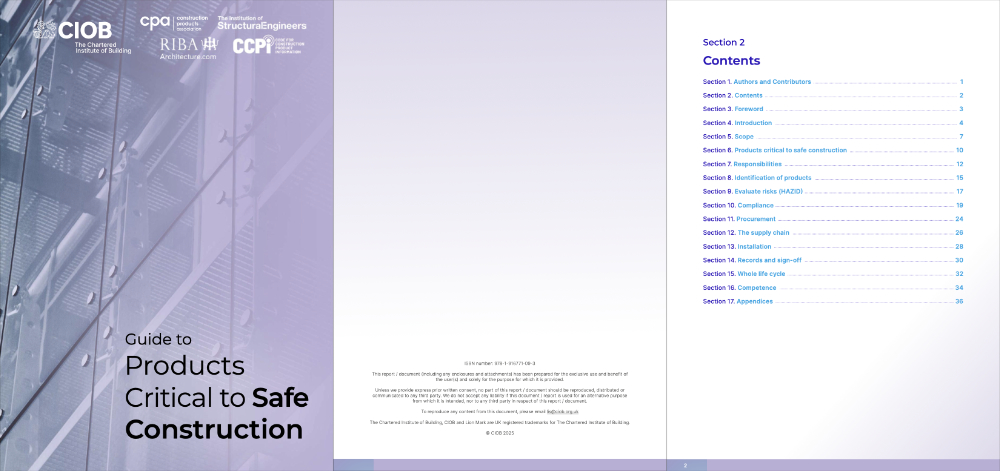
On 12 August CIOB published it 'Guide to Products Critical to Safe Construction' providing designers, specifiers and installers with the information and tools they need to make the right decisions when selecting products and systems, and uses examples and case studies to signpost industry best practice, such as the Code for Construction Product Information. The aim being to ensure that the buildings created, and the products used in those buildings, are safe for those who use them, now and in the future.
--editor
[edit] Related articles on Designing Buildings
- A Guide to Managing Safety Critical Elements in Building Construction.
- Building safety.
- Building safety certificate.
- Building safety act 2022
- Building Safety wiki.
- Competent person.
- Construction Products Regulation CPR.
- Construction Products Reform Green Paper and Consultation.
- CIOB accepted onto register of end-point assessment organisations.
- CIOB articles.
- Construction professional.
- Digital Product Passports DPP.
- Ecodesign compliant products.
- Fire safety bill.
- Fire safety design.
- Flexible courses for lifelong learning.
- Golden thread.
- Government response to the Building a Safer Future consultation.
- Grenfell articles.
- Grenfell Tower fire.
- Grenfell Tower Inquiry.
- Hackitt Review.
- Hackitt review of the building regulations and fire safety, final report.
- Hazard Identification HAZID.
- Health and safety.
- Learning.
- National construction products regulator established.
- Professional Indemnity Insurance.
- Recognised prior learning.
- Revalidation.
- RIBA
- Safety audit.
- Safety briefing.
- Safety management.
- The Building Safety Bill and product testing.
[edit] External links
- BSI Flex 8670 v3.0:2021-04 Built environment. Core criteria for building safety in competence frameworks. Code of practice
- BS 8670-1:2024 – Competence frameworks for building safety – core criteria. Code of practice
- PAS 8671 – Framework for Competence of Individual Principal Designers
- PAS 8672 – Framework for Competence of Individual Principal Contractors
- PAS 8673 – Competence requirements of safety in residential buildings
- Competence Framework for Fire Safety Regulators
- Raising the Bar
- Setting the Bar
- A Higher Bar
- Competence framework for procurement professionals in the built environment
- https://www.constructionproducts.org.uk/our-expertise/technical-and-regulatory/building-safety/competence/
- https://www.constructionleadershipcouncil.co.uk/workstream/people-and-skills/competence/
- https://standardsdevelopment.bsigroup.com/projects/9023-08052
- https://standardsdevelopment.bsigroup.com/projects/2023-02849
Quick links
[edit] Legislation and standards
Fire Safety (England) Regulations 2022
Regulatory Reform (Fire Safety) Order 2005
Secondary legislation linked to the Building Safety Act
Building safety in Northern Ireland
[edit] Dutyholders and competencies
BSI Built Environment Competence Standards
Competence standards (PAS 8671, 8672, 8673)
Industry Competence Steering Group
[edit] Regulators
National Regulator of Construction Products
[edit] Fire safety
Independent Grenfell Tower Inquiry