





Wellbeing and heritage: making a difference
Historic England and others have been investigating how work with the historic environment and place can help promote wellbeing and address wellbeing inequalities.

|
| Participants in the Restoration Trust’s Heritage Link Worker project at Arminghall Henge, Norfolk (Photo: The Restoration Trust). |
Contents |
Introduction
When Historic England published its first three-year Wellbeing and Heritage Strategy in 2022, it was a landmark moment in ensuring that individual and community wellbeing was a lens through which we could see our work. It also provided the catalyst for us to work directly with the heritage sector to explore what was going on, what worked and what else was needed to expand this area of work.
Historic England has been investigating how work with the historic environment and place can help promote wellbeing and address wellbeing inequalities. This has provided new evidence and shown how we need wellbeing to be an essential part of relevant project outcomes and a part of a larger strategic issue within the cultural sector as a whole.
This is not about revolution but about reframing the context in which we are operating, and the differences we can make in places and for communities. This is not a new thing to say. It was 20 years ago that the then secretary of state for culture, media and sport wrote: ‘we need a new language to describe the importance of the historic environment… [we need to] increase diversity in both audiences and the workforce, to capture and present evidence of the value of heritage, to contribute to the national debate on identity and Britishness, to create public engagement and to widen the sense of ownership of the historic and built environment’ (Tessa Jowell, 2005).
Five years after this statement the Office of National Statistics (ONS) began measuring national wellbeing. The year 2015 saw the creation of the Well-being of Future Generations (Wales) Act, and in 2018 the Wellbeing Economy Government partnerships group was launched with Scotland. The new language emerged as one about wellbeing, as it has become more prevalent and relevant within policy and funding contexts.
At the same time, the pressures on the NHS and primary care especially have meant a rethinking in the health sector about what a good response for a struggling individual looks like. Currently almost 20 per cent of GP consultation time is spent on non-clinical issues, which translates to a cost of approximately £400 million to the health service. Although emerging as a concept from the 1980s, social prescribing really took off in the 2010s. The Social Prescribing Network was founded in 2015, and social prescribing was integrated into national health policy in the 2019 NHS Long Term Plan. Social prescribing, now a key element of the universal personalised care approach, relies on collaboration and local community (non-medical) resources.
In 1948 the World Health Organisation defined health and wellbeing as ‘a state of complete physical mental and social wellbeing and not merely absence of disease or infirmity.’ The two shifts identified above – in a policy and a health context – have definitely led us to a place where considering the impact on health and on wellbeing, including the social determinants of wellbeing, are now everyone’s concern.
Intrinsic qualities
Quality of place and the role of the historic environment in this is a deep and broad topic. It can, however, be divided into objective and subjective factors. Objective factors include location (fixed) and provision of local infrastructure such as green spaces and benches (not fixed), and social characteristics of place such as crime rates. Subjective factors include perceptions of safety, social trust and satisfaction with local amenities. These subjective factors, which can be influenced by the fixed and non-fixed factors, can lead to wellbeing-related concepts such as sense of belonging, civic pride, mental health and resilience. The research in this area is a mix of quantitative and qualitative. The former is dealt with in more detail elsewhere in this issue of Context but the evidence in this area includes:
- Recent research by Historic England has shown that a modest but significant boost to our life satisfaction results from living close to cultural heritage. The research controlled for other factors identifying the specific role of heritage in the formation of individual wellbeing.
- Urban green spaces have been shown to reduce morbidity and mortality in urban residents.
- Design and layout of historic towns and cities contribute positively towards levels of physical activity.
- Blue and green spaces – core parts of our historic environment – can make us happier. 5. The built environment – as a source of constancy – plays a key role in the development of individual ontological security.
Freely accessible, quality and safe historic environments are valuable contributors to wellbeing.
Instrumental benefits
As other articles in this issue show, the idea of designing projects using archaeology and the historic environment is not new. Operation Nightingale has been running since 2011 and there are now many wellbeing-orientated projects that use heritage as the catalyst for change. Over time this change has evolved and developed, becoming ever more refined. Some of these projects are designed primarily as wellbeing offers, while others are activities (such as community excavations) that have wellbeing benefits. Here are some key examples of evidence-based ways in which heritage helps mental health and loneliness:
- Historic England’s Project Rejuvenate built – with delivery partners Wessex Archaeology and Isle Heritage – a new model of using archaeology and heritage outdoors to improve the lives of young people experiencing disadvantage, or being disengaged from school or involved in the criminal justice system.
- Research has shown that there are particular wellbeing benefits to volunteering with heritage – core benefits of purpose, being, capacity, sharing, self-nurture and self-actualisation are underpinned by the experiential offer of working to save historic sites.
- Connecting with historic landscapes can create a cycle of transformation that supports recovery of people with complex mental health needs.
- Place-based heritage, creative and cultural activities support people with mental health needs, building their resilience and addressing social isolation and loneliness.
- Heritage-led work can address the drivers and results of loneliness.
- Visting historic sites has clear subjective wellbeing effects due to increasing happiness and reducing anxiety.
By expanding provision and access of these types of projects to a more diverse range of people with specific unmet needs, the sector can address health and wellbeing inequalities. Historic England and the Council for British Archaeology convene a working group on wellbeing and heritage with a community of practice on research and evaluation which is open to anyone. It is a place where we can share knowledge and experience, and look for solutions to common challenges.
Social prescribing as opportunity
Social prescribing is connecting people to activities, groups and support that improve health and wellbeing. Evidence demonstrates that around one in five GP appointments are for nonmedical reasons, such as loneliness, social isolation, housing issues and debt – in other words, issues caused by the wider social determinants of health. The most crucial element of social prescribing is that it is person-centred with social justice at its heart.
It provides an opportunity, and inevitably also challenges, for the heritage sector. As an opportunity it provides a direct referral method to enable organisations to work in areas where there is actual need. It enables us to move away from self-selecting groups and into a mixed economy, including meeting specific needs, as identified not by us but by a GP or other referrer.
There are two kinds of evidence in this area at the moment which seem most relevant to us:
- Reviews from outside the heritage sector on what works and what difference it makes, which show the reduction of pressure on the NHS at primary and secondary care levels.
- Reviews from inside the sector that show what works and provide exemplars. Examples include place-based projects such as the health and wellbeing work as part of the high street heritage action zone in Kirkham, Lancashire; organisation-led projects such as Archaeology on Prescription by York Archaeological Trust, and heritage-site-based offers where local heritage assets become hubs for local wellbeing, such as at Delapre Abbey in Northamptonshire.
It hardly needs to be stated that the challenges include working well with vulnerable people, ensuring good partnerships and referral routes, and funding. The issue of funding the voluntary sector to support targeted interventions is hardly new but the rapid expansion (and with it associated expectations) of social prescribing exacerbates things.
Health decisions on where to spend money are inevitably based on clear evidence that makes sense in a health context and exists within a competitive commissioning environment. At the same time, while we as a sector may feel confident that there is significant public benefit to the historic environment, including cultural assets and green spaces, there is an issue. Despite the general sense of value, local government, which has historically been a significant investor, reduced its spending per capita on arts and culture by around 36 per cent between 2009–2019. Arguably we have a perfect storm: more demand for impactful work that functions to deliver to specific wellbeing agendas and a general trend of significant reduced funding in the cultural and social infrastructure that would provide this.
There are no easy fixes but some ideas emerging from the National Academy of Social Prescribing are attempting to address this, most notably through its proposal for a shared investment fund. This would draw money from a central funder and from all the integrated care boards (founded in 2022) which are responsible, through local partnership, for improving local health outcomes and tackling health inequalities in 42 areas of England.
Historic England and the Council for British Archaeology convene a community of practice on social prescribing which is open to anyone. It is a place where we can share knowledge and experience and look for solutions to common challenges.
The health service talks of place-based approaches all the time, with a focus on working with local community assets. This is language more than familiar to our sector. Using the growing evidence base in this area, we can make the case more clearly for the historic environment as a protective factor for health, enhancing life satisfaction and social trust, and an enabling factor for wellbeing. The current government has set out clear priorities for rebuilding the NHS and focusing on prevention and care through the community. Our sector has an opportunity to work closely with health and voluntary, community, faith and social enterprise sector (VCFSE) partners to ensure that the value of heritage and the historic environment is recognised.
As we get better at this, it will be easy to see how planning decisions themselves, and related archaeological conditions, can be directly linked to preventative health/protective factors and targeted interventions to address local inequalities.
Over the coming year at Historic England we will be producing, among other things, new guidance for social prescribing link workers to ensure that they see the benefits of heritage and understand how the historic environment can be a catalyst for transformation. We will provide further information (working with the sector on the powerful benefits of interventions aimed at mental health and loneliness) and producing advice, in partnership with the Museum of London and Greater London Archaeology Service, on embedding this into planning conditions in London. Alongside these practical steps we will also publish a revised Wellbeing and Heritage Strategy, and a review of wellbeing and heritage evidence to help us (and, we hope, help others) set strategic direction and research priorities for the next three years.
References
- Gradinarova, Desi (2022) Heritage and Social Prescribing, Historic England, Research Report 71/2022.
- Constitution of the World Health Organisation (adopted at the international Health Conference 1946 and entered into force in 1948).
- Colwill, Thomas (2024) Heritage Capital and Wellbeing: examining the relationship between heritage density and life satisfaction, Historic England Research Report 18/2024.
- Egorov, Andrey et al (eds) (2016) Urban Green Spaces and Health: a review of evidence, World Health Organisation (WHO/EURO:2016- 3352-43111-60341).
- Historic England (2023) Heritage Counts: heritage and society: ‘Historic places and healthy lifestyles’.
- WWCfW (2018) ‘Parks for People: the role of historic public parks for wellbeing’, What Works Centre for Wellbeing.
- Nolan, C. (2019) ‘Prehistoric Landscapes as a Source of Ontological Security for the Present Day’, Heritage and Society, Vol. 12, Issue 1.
- Chalmers, Leigh, et al (2024) Project Rejuvenate: evaluating pilots for heritage and archaeology-led wellbeing programmes for young people, Historic England Research report 77/2024.
- Pattison, Julie, et al (2023) ‘Volunteering on heritage at risk sites and wellbeing: a qualitative interview study’ in Health Expectations, Vol. 26, Issue 6, December 2023 (Open Access).
- Drysdale, L. (2018) Human Henge Evaluation Report, The Restoration Trust.
- There are various examples here, but one heritage – and culturally-led one is the Well-City Project in Salisbury by Wessex Archaeology. Historic England funded the first heritage social prescriber in Great Yarmouth as a place-based health orientated pilot: Heritage Linkworker Project: final evaluation report; The Restoration Trust, February 2024, produced by Make an Impact CIC.
- Clarke, Jessie (2024) Heritage and Loneliness, Historic England Research Report 84/2024.
- Sofaer, Joanna and Gallou, Eirini (2022) Places of Joy: the role of heritage during the COVID-19 pandemic, Historic England and the University of Southampton.
- NASP (2024) The economic impact of social prescribing on health service use and costs: examples of local evaluations in practice, National Academy of Social Prescribing, November.
- Collections such as those found in Historic England Research publications: Monckton, L. (ed) (2022) ‘Special issue on wellbeing and heritage’, Historic England Research, Issue 20, and research reviews such as Gradinarova, Desi (2022) Heritage and Social Prescribing, Historic England, Research Report 71/2022.
- Williamson, Toby and Cyhlarova, Eva (2024) ‘Kirkham Futures: Kirkham High Street Heritage Action Zone: final evaluation report of the heritage, health and wellbeing programme’ (Phoenix Rising), May.
- Fahy, K., Alexiou, A., Mason, K. et al (2023) ‘Inequalities in local government spending on cultural, environmental and planning services: a time-trend analysis in England, Scotland and Wales’, BMC Public Health 23.
- NASP (2024) Envisaging a Social Prescribing Fund in England, National Academy of Social Prescribing, December.
This article originally appeared in the Institute of Historic Building Conservation’s (IHBC’s) Context 183, published in March 2025. It was written by Linda Monckton, head of wellbeing in the policy development department at Historic England, and Desi Gradinarova, senior policy advisor for wellbeing and heritage at Historic England, and the national lead for the historic environment at the National Academy of Social Prescribing.
--Institute of Historic Building Conservation
Related articles on Designing Buildings Conservation.
IHBC NewsBlog
IHBC sponsors Gardens Trust event 23-4 Sept 2026
.jpeg)
'Learning from the Past, Shaping the Future’ takes place in Milton Keynes
Renovations to Frank Lloyd Wright's Fallingwater complete
.jpg)
World Heritage Preserved project opens house for tours again
Shakespeare Birthplace Trust places Hall's Croft on HAR Register
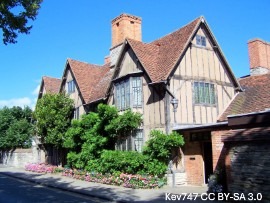
Stratford-upon-Avon home of Shakespeare's daughter is 'At Risk'
Lady Grange’s House repaired on St Kilda
.jpg)
National Trust for Scotland repairs stone cleit with link to famous island resident
Griff Rhys Jones on BBC Radio 4 Today programme
,_Green_Lane,_Derby.jpg)
The Victorian Society’s President unveiled its latest Top Ten Endangered Buildings 2026.
Need a MATE? Book your place now.

IHBC offers free webinars on applying for IHBC accreditation (Full & Associate).
UK Stained Glass Repository finds windows new homes

How are stained glass windows are rescued, stored and repurposed?
APPGEBE report sets high aims for quality
'Government must not sacrifice quality in drive to build 1.5m homes'
New measures protect Historic Shipwrecks from heritage crime

Underwater cultural heritage benefits from new HE guidance
How could the City of London skyline look in 6 years' time?

Visualisation shows approved planning applications as completed buildings
National Trust for Scotland calls for VAT cuts

Heritage neglect is encouraged by current policies
IHBC's 'Context' Issue 186 features Industrial Heritage
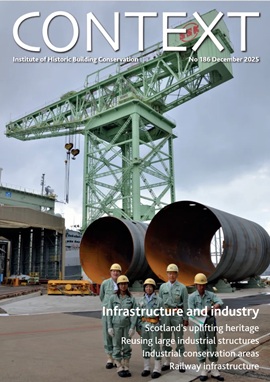
IHBC's members' journal reports on the challenges of conserving infrastructure
Book now for IHBC Annual School 2026

IHBC Annual School is taking place 18-20 June 2026 in Newcastle
RICHeS Research Infrastructure offers ‘Full Access Fund Call’
RICHeS offers a ‘Help’ webinar on 11 March
Latest IHBC Issue of Context features Roofing
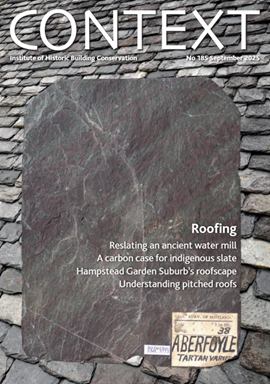
Articles range from slate to pitched roofs, and carbon impact to solar generation to roofscapes
Three reasons not to demolish Edinburgh’s Argyle House

Should 'Edinburgh's ugliest building' be saved?
IHBC’s 2025 Parliamentary Briefing...from Crafts in Crisis to Rubbish Retrofit
IHBC launches research-led ‘5 Commitments to Help Heritage Skills in Conservation’
How RDSAP 10.2 impacts EPC assessments in traditional buildings

Energy performance certificates (EPCs) tell us how energy efficient our buildings are, but the way these certificates are generated has changed.