





Mobile Asphalt Plant Dispatch and Relocation Practices in Latin American Cross-Regional Projects
Across Latin America’s rapidly expanding road infrastructure sector, the ability to move production capacity efficiently across borders and between remote job sites has become a defining factor for project success. Unlike stationary setups, a mobile asphalt plant(planta de asfalto móvil) offers the flexibility required for highway corridors that stretch through multiple countries, from Mexico to the Southern Cone. However, dispatch and relocation are not merely logistical tasks—they demand strategic planning, local knowledge, and precise coordination to avoid costly downtime.
In this article, we explore field-proven practices for relocating asphalt plant equipment across Latin American regions, focusing on how contractors can maintain continuous paving operations while minimizing transport risks and customs delays.

[edit] The Growing Need for Cross-Regional Asphalt Production
Latin American infrastructure projects often span diverse climates and jurisdictions. A single road-building contract might require production in coastal lowlands, Andean highlands, and tropical rainforest zones within months. Here, a mobile asphalt plant becomes indispensable because it can be dismantled, loaded, and reassembled in under two weeks—a timeline impossible for traditional stationary units.
Furthermore, many cross-regional projects involve public-private partnerships with strict completion penalties. When delays occur, contractors using a mini asphalt plant for smaller rural segments or temporary bypasses can keep critical paths moving while larger units handle mainline production. This layered approach to fleet composition reduces overall project risk.
[edit] Pre-Move Planning: Permits, Routes, and Site Preparation
Before any asphalt plant(planta de asfalto) moves, three pillars must be secured: legal compliance, route feasibility, and ground readiness.
[edit] Securing Cross-Border Permits
In Latin America, moving a mobile asphalt plant between countries like Peru, Bolivia, and Chile requires temporary import permits, phytosanitary certificates (for tires and wooden components), and weight clearances. Start the permit process at least 30 days before dispatch. Work with local customs brokers who specialize in heavy machinery—they can classify the asphalt plant under the correct HS code to avoid hold-ups.
[edit] Route Surveys for Over-Dimensional Loads
Many rural highways have weight-restricted bridges or sharp switchbacks. Send a survey team with GPS mapping to identify low-clearance power lines and narrow town crossings. For a mini asphalt plant, the smaller footprint allows more route options, but don’t assume all side roads are passable during rainy seasons.
[edit] Site Readiness at the New Location
The receiving site must have compacted ground, drainage, and space for aggregate stockpiles. For a mobile asphalt plant, leveling within 0.5% slope is critical for drum alignment. Prepare concrete pads or timber mats for each module—especially the drying drum and control cabin.
[edit] Efficient Dispatch Procedures: From Dismantling to Loading
Dismantling a mobile asphalt plant requires a systematic reverse-assembly sequence. Label every electrical harness, hydraulic line, and bolt set with color-coded tags. Photograph each disconnection step. Use dedicated containers for sensitive components (burners, sensors, PLC panels) to prevent dust or moisture damage during transit.
For asphalt plant relocations across multiple regions, maintain a digital inventory of every module. This allows you to verify load completeness before crossing each border. Contractors who skip this step often lose small parts, leading to weeks of replacement procurement.
[edit] Coordinating Fleet Movements
When dispatching both a standard mobile asphalt plant and a mini asphalt plant(mini planta de asfalto) to different segments of the same corridor, stagger departure times by 48 hours. This prevents both convoys from getting stuck simultaneously at a bottleneck (e.g., a one-lane mountain tunnel). Use satellite tracking devices on each lowboy trailer and update the project control room twice daily.
[edit] On-Site Reassembly and Calibration
Upon arrival, reassemble the asphalt plant in reverse order of dismantling. Priority goes to the power generator, control cabin, and dryer drum—these allow you to produce cold feed while the baghouse and silo are being completed. Calibrate the aggregate feeder belts using local materials, because aggregate density varies significantly across Latin American regions.
For a mini asphalt plant, reassembly can often be completed in 48 hours by a crew of four, making it ideal for emergency bypass paving or short-span rural connector roads. Always run a two-hour warm-up cycle before commercial production to verify temperature consistency and mix homogeneity.
[edit] Overcoming Common Regional Challenges
Fuel logistics are a recurring issue. Many cross-regional routes pass through areas with unreliable diesel supply. Before relocating a mobile asphalt plant, contract with a fuel distributor that has depots in both origin and destination regions. Similarly, secure spare parts for the asphalt plant’s burner and chain conveyor—local dealers may not stock them.
Climate also plays a role. Moving a mini asphalt plant from arid northern Mexico to humid southern Colombia requires immediate rust protection on exposed steel. Apply a vapor-phase corrosion inhibitor to electrical terminals before sealing transport covers.

[edit] Lessons From the Field: Adaptability Drives Profitability
One contractor working on the Pan-American Highway corridor moved a mobile asphalt plant 1,200 km across two borders in 11 days—five days faster than their previous attempt. Their key change: pre-positioning a mini asphalt plant at the destination site to produce base course material while the main asphalt plant was in transit. This overlap eliminated a 10-day production gap, saving over $200,000 in idle labor and equipment.
Another team used a mini asphalt plant to pave detours around landslide-prone sections, allowing the primary mobile asphalt plant to keep advancing on the main alignment. This layered production strategy is now being written into bid proposals for future cross-regional projects.
[edit] Strategic Recommendations for Fleet Managers
Relocating asphalt plant assets across Latin American regions will never be simple, but the following practices consistently reduce headaches:
- Maintain a dedicated “relocation kit” with pre-cut cables, spare hydraulic hoses, and a full bolt set for your specific mobile asphalt plant model.
- Train at least two crew members on complete teardown and reassembly—don’t rely on a single expert.
- For projects with multiple short-term segments, consider owning a mini asphalt plant as a support unit rather than moving the main plant repeatedly.
- Build border crossing time into your critical path schedule as a non-compressible activity.
[edit] Moving Forward With Smarter Dispatching
The Latin American road construction boom shows no sign of slowing, and the contractors who master mobile asphalt plant relocation will capture the most profitable segments. By treating dispatch not as an afterthought but as a core competency—and by leveraging a mini asphalt plant for tactical flexibility—your operation can keep asphalt flowing even when the main asphalt plant is on the move. Plan ahead, document everything, and always have a backup route for your lowboy trailers. The road ahead is long, but with the right practices, you’ll never have to stop paving.
Featured articles and news
Building Control Independent Panel final report
A precis of a key report lead by Dame Hackitt with full recomendations and link to the government response.
Guide to ISO 19650 for Architecture Firms (2026)
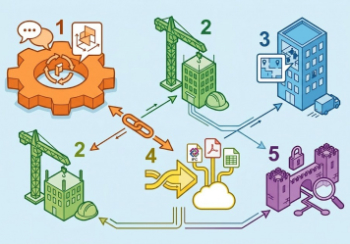
A user gives their low down.

A UK training and membership provider for mould remediation professionals.
Building Safety recap April, 2026
A short and longer run-through of the month, with links to further information and sources.

CIAT May 2026 briefing.

Independent NSI and BAFE study exploring how organisations are changing the way they buy fire safety services.

From medieval scribes to modern word art.

ECA welcomes crackdown on late payment and push for clean energy, whilst CIOB seek fixed cladding removal timeframes.
Cyber Security in the Built Environment
Protecting projects, data, and digital assets: A CIOB Academy TIS.
Managing competence in the built environment

ITFG publishes new industry guide on how to meet the ICC principles.

The UK's campaign to reduce noise pollution: Mythbusting, articles and topic guides.
Setting Expectations on Competence Management

Industry Competence Committee.
New Scottish and Welsh governments

CIOB stresses importance of construction after new parliament elections.
The sad story of Derby Hippodrome

An historic building left to decay.

ECA, JIB and JTL back Fabian Society call to invest in skills for a stronger built environment workforce.