





Development appraisal
Development appraisal involves research into constraints and opportunities evolving from the location, legal and planning aspects of potential sites as well as their physical characteristics.
This can be a complex process, and independent client advisers may be required by the client to supplement in-house expertise and assist research and evaluation. This might include:
- Lawyers to report on legal encumbrances and ownership.
- Surveyors to research site history and planning issues.
- Geotechnical and civil engineers.
- Rights of light surveyors.
- Archaeological consultants.
- Traffic and highway consultants.
- Services engineers to study existing and future services to site.
- Valuation surveyors to study demand and competing values.
- Planning consultants.
- Cost consultants.
Potential sites will need to reflect the developers corporate strategy in relation to:
- Region and location.
- Size of the potential development.
- Type of development and its market.
- Proximity to transportation or centres of population.
- Order of costs.
Research into legal issues may include:
- Title and conveyance documentation.
- Land Registry records.
- Boundaries and demarcation.
- Restrictive covenants.
- Rights of way and easements.
- Rights of light.
- Party walls.
- Existing tenancies licences and unexpired leases.
- Access, adopted highways and third-party access rights.
- Tree preservation orders
- Listed buildings and conservation areas.
Government policy on planning is now set out in the National Planning Policy Framework. When considering potential sites, developers may which to consider whether the proposed development will impact on, or be impacted by:
- The planning history of the site.
- Local needs such as employment and affordable housing.
- Likely local reaction.
- The need for consultation.
- The local plan.
- The potential for the development to set planning precedents for the local area.
- The effects on the local community and local businesses.
- The potential for the imposition of planning conditions or planning obligations (section 106 agreements).
- The community infrastructure levy.
- Transportation and parking restrictions.
- The likely reaction of statutory consultees and non-statutory consultees.
- The likely need for an environmental impact assessment and the possible scope of such an assessment.
- Tree preservation orders
- Listed buildings and conservation area restrictions.
NB: For more information on the powers and influence of local authorities and local communities on local planning policy and permissions see the article on the National Planning Policy Framework.
Key physical characteristics of a potential site will need to be assessed. This assessment might include:
- Existing site survey information including drawings of public utilities and services including overhead cables
- Assessment of shape and topography of the site.
- Any history of flood risk.
- Condition of existing buildings on site.
- Geotechnical information such as previous foundation drawings and any boreholes or trial pit information.
- Characteristics and condition of surrounding buildings affected by the development.
- Ground contamination.
- Landscape features, water run-off and surface drainage.
- Proximity of surrounding occupants likely to be affected by nuisance the redevelopment.
- Old wells, basements and underground obstructions or underground storage tanks.
NB: For additional information see articles on technical due diligence, site appraisals, site information and site surveys.
Market research might include:
- Estimate of time before the development is completed
- Local amenities attractive to the market, such as; location, ease of parking , public transportation.
- The scale of potential tenants' or purchasers' requirements.
- Site and local features that may be attractive to future tenants or purchasers.
- Lessons learned from similar developments.
- Current demand and competing supply of facilities coming onto the market within the timeframe of the development.
- Future proofing building requirements.
- National and regional economic trends.
- The potential effect of technical change.
- The potential effect of social trends.
- The potential effect of changes in working practices.
[edit] Related articles on Designing Buildings
- Additionality.
- Building People.
- Built to suit.
- Case study.
- Client requirements.
- Community infrastructure levy.
- Condition.
- Condition survey.
- Cost-benefit analysis in construction.
- Desk study.
- Developer.
- Development manager.
- Existing use value.
- Future proofing.
- Gross development value.
- Hope value.
- Investment.
- Investment property.
- Legal agreements.
- Location plan.
- National Planning Policy Framework.
- Net Present Value.
- Residual valuation.
- Site selection and acquisition.
- Site appraisal.
- Site information.
- Site surveys.
- Speculative construction.
- Surveyor.
- Technical due diligence.
- Types of development.
- Vendor survey.
- Yield.
Featured articles and news

We're expanding our collaborative mission by launching DB Intelligence, an exclusive market research advisory panel. Built environment professionals can now get paid to share their expertise on industry trends, products and services.
Panel members receive direct financial incentives for participating in research projects like short surveys, 1-2-1 interviews and focus groups. Register today to shape the future of the construction sector.
Building Safety Wiki Interviews

Chief executive of the British Woodworking Federation.
Planning condition discharge in England and Wales

A brief exoplanation from a building compliance expert, with further links.
Overheating guidance and tools for building designers

Guidance for dealing with element of building fabric control that have increasing importance.
Shading for housing, a design guide

From the Good Homes Alliance and British Blind and Shutter Association.
UK Standard Skills Classification (SSC)

A shared framework for describing skills needs.
Social media ban consultation comes to close

CIOB urges UK Government to consider social media’s role in careers guidance in ban debate.
The latest of eight Skills England apprenticeship units

The addition of battery manufacturing welcomed by ECA with a warning about the risks of fast-tracked apprenticeship units.
Building Control Independent Panel final report
A precis of a key report led by Dame Hackitt with full recommendations and link to the government response.
Building Safety recap April, 2026
A short and longer run-through of the month, with links to further information and sources.
CIAT May 2026 briefing.

From medieval scribes to modern word art.

ECA welcomes crackdown on late payment and push for clean energy, whilst CIOB seek fixed cladding removal timeframes.
Cyber Security in the Built Environment
Protecting projects, data, and digital assets: A CIOB Academy TIS.
Managing competence in the built environment
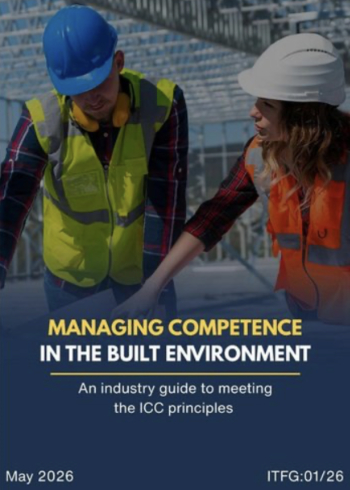
ITFG publishes new industry guide on how to meet the ICC principles.