





Supply chains in construction

The supply chain is the interconnected hierarchy of supply contracts necessary to procure a built asset. Managing the supply chain involves understanding the breakdown and traceability of products and services, organisations, logistics, people, activities, information and resources that transform raw materials into a finished product that is fit for its purpose.
Unlike the automotive industry, the construction industry has the particular difficulty that every building is different, a unique prototype, developed by a team of consultants, contractors and other suppliers that may never have worked together before and may never work together again.
To add to the complexity, different procurement systems place elements of supply chain management with varying disciplines and organisations.
On a 'traditional' building project, design consultants are first tier suppliers, working for the client, and the contractor has a supply chain of sub-contractors and specialist suppliers. On PFI or design and build projects, however, there may be just one first tier supplier (sometimes the contractor) and design consultants will work for them as part of their supply chain.
On large or complex projects, responsibility and performance may cascade down the supply chain to a plethora of suppliers sometimes unknown to management at the top of the chain. For more information see: Suppliers.
One of the problems in the construction industry is that the first and second tier of the supply chain typically sign up to fairly onerous agreements, but as the chain develops, so the contractual liabilities decrease until suppliers at the end of the chain are often not locked in at all.
The key to supply chain management is providing a strategy that aligns with the project programme. This starts at the design stage, scoping the work into packages. Early evaluation based on feedback from the supply chain can produce enormous cost benefits and value. Capacity and production capability in a market controlled by supply and demand are particularly significant if programme bottlenecks are to be avoided.
In recent years larger companies offering continuity in construction have taken an increasing interest in establishing relationships beyond direct, first tier suppliers. Framework contracts and partnering agreements have pioneered this approach, encouraging the involvement of selected suppliers at relatively early stages of projects while offering continuity of work. This has led to greater collaboration between lead designers and product designers to the advantage of all parties.
'Integrated supply team' describes the integration of the complete supply chain involved in the delivery of a project. This may include the main contractor, designers, sub-contractors, suppliers, facilities managers, and so on. The integrated supply team is particularly relevant on public projects that may follow private finance initiative (PFI), prime contracting or design and build procurement routes. Under these routes, the entire supply team may be appointed after the project brief has been prepared, often under just one contract rather than separate contracts with each individual company.
Supply chain integration (SCI): 'involves everyone in the supply chain working cooperatively and collaboratively, so that the collective effort effectively delivers the client’s requirements and avoids unnecessary work. SCI is about adding value to design and construction processes, improving time, cost, quality, health and safety and other outcomes.' Ref BIM Overlay to the RIBA Outline Plan of Work, published by the RIBA in 2012.
NB In June 2019, the Construction Leadership Council (CLC) published Future Skills Report, criticising extended supply chains and calling for more direct employment of labour. Mark Reynolds, chair of the CLC skills workstream said: “This important report clearly sets out the challenge the industry and our clients face and the actions that must be taken now to avoid significant skills shortages in the future. When we have seen projects with higher levels of direct employment the results are often better, the workforce more engaged and ultimately the client and end users are happier with the final product.”
[edit] Related articles on Designing Buildings
- 2021 Building Engineering Business Survey.
- Broken chain.
- BSI construction product identification system.
- CLC urges inclusion of fluctuations provisions in contracts.
- Collaborative practices.
- Collateral warranties.
- Contractor.
- Contractor vs supplier.
- Cyber resilience.
- Down payment chain.
- Fair payment practices.
- Fragmentation of the UK construction industry.
- Framework agreement.
- Green supply chain management.
- Integrated supply team.
- Named supplier.
- Onerous contract.
- Partnering.
- Reflections on 2021.
- Subcontractor vs supplier.
- Supply.
- Supply chain integration.
- Supplier.
- Supplier selection.
- Supply chain management.
- Vertical integration.
- What is causing the rise in steel prices?
Featured articles and news

We're expanding our collaborative mission by launching DB Intelligence, an exclusive market research advisory panel. Built environment professionals can now get paid to share their expertise on industry trends, products and services.
Panel members receive direct financial incentives for participating in research projects like short surveys, 1-2-1 interviews and focus groups. Register today to shape the future of the construction sector.
Planning condition discharge in England and Wales

A brief exoplanation from a building compliance expert, with further links.
Overheating guidance and tools for building designers

Guidance for dealing with element of building fabric control that have increasing importance.
Shading for housing, a design guide

From the Good Homes Alliance and British Blind and Shutter Association.
UK Standard Skills Classification (SSC)

A shared framework for describing skills needs.
Social media ban consultation comes to close

CIOB urges UK Government to consider social media’s role in careers guidance in ban debate.
The latest of eight Skills England apprenticeship units

The addition of battery manufacturing welcomed by ECA with a warning about the risks of fast-tracked apprenticeship units.
Building Control Independent Panel final report
A precis of a key report led by Dame Hackitt with full recommendations and link to the government response.
Building Safety recap April, 2026
A short and longer run-through of the month, with links to further information and sources.

CIAT May 2026 briefing.

From medieval scribes to modern word art.

ECA welcomes crackdown on late payment and push for clean energy, whilst CIOB seek fixed cladding removal timeframes.
Cyber Security in the Built Environment
Protecting projects, data, and digital assets: A CIOB Academy TIS.
Managing competence in the built environment
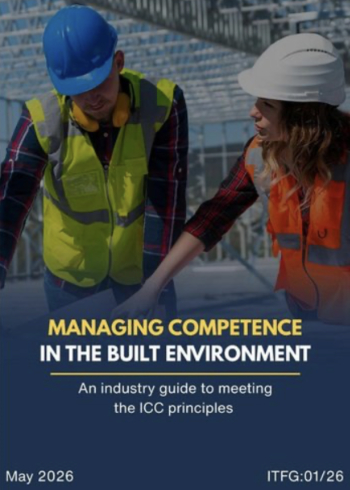
ITFG publishes new industry guide on how to meet the ICC principles.

The UK's campaign to reduce noise pollution: Mythbusting, articles and topic guides.