





Cost Optimal Domestic Electrification CODE

Cost-Optimal Domestic Electrification (CODE) was a research and modelling project with the final report written Jason Palmer and Nicola Terry and published by BEIS with oversight from Oliver Sutton, George Bennett and Anna Stephenson. Acknowledgements for the work are also given to Cambridge Architectural Research (CAR) and Cambridge Energy (CE) teams; Ian Cooper, Anthony Guillem, Fionna Catlin, Janet Owers, Suzie Webb, and Yi Zhang.
The objective of the study was to assess costs of retrofits based on the perspective of the consumer. It therefore only considers costs that directly impact the consumer: the upfront cost of equipment, energy costs and maintenance costs. The Final Report BEIS Research Paper 2021/051 can be accessed via the government link here. The report takes the view that the decarbonisation of electricity creates a major opportunity to reduce greenhouse gas emissions from home heating in Great Britain without requiring extensive and costly deep retrofits. The study tries to demonstrate that home conversions from gas or oil heating to electric heating can be achieved at significantly lower costs than commonly assumed, while maintaining thermal comfort and delivering substantial emissions reductions.
The research was commissioned to identify cost-optimal pathways for installing electric heating and complementary energy-efficiency measures from the consumer’s perspective. Whereby the costs considered included upfront capital expenditure, energy costs, and maintenance over a 15-year period, discounted at 3.5% to 2020 prices. Wider electricity system costs, such as network reinforcement or generation capacity, were excluded. As a result, “cost-optimal” in the study refers strictly to what minimises total cost of ownership for households under present-day conditions.
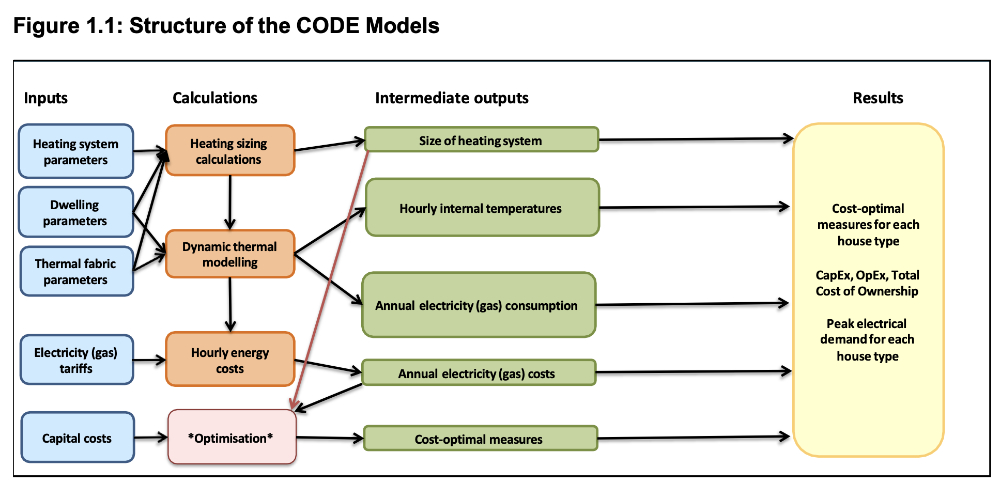
Detailed modelling was undertaken across 12 representative house types, or typologies covering around 90% of Britain’s 28 million dwellings. The typologies reflected common combinations of dwelling form, construction type, and existing heating systems.
Firstly a form factor-based approach was looked at, comparing the all important heat loss parameters for detached dwellings with and without extensions and semi-detatched and end of terrace with and without an extensions. This led to an approach that divided the 'semi-D's, end-of-terrace, and detached’ cases into three groups of compact, medium and sprawling.
Secondly, a construction-based approach, looked at the roof, floor, windows and walls. Roofs tended to be pitched and it was assumed insulation levels were similar at around 100mm. Floor type related to wall type, but with suspended timber floors as a minority for all types except the 28% of dwellings with solid walls. So all solid-wall properties were modelled with suspended timber floors and as many were built with no insulation up to at least the 1990s, all cases floors were modelled with no insulation in the base case. Wall typologies were referred to as bungalow, flat-small, flat-ground, flat-mid, flat-top, mid-terrace, compact house, medium house and sprawling house, with differentiation between Cavity High U, Cavity low U, Solid high U and system high U. the final analysis included nine cases with Cavity walls and low U-values, plus three solid walls with high U-values.
Dynamic thermal models with hourly resolution were used to simulate tens of thousands of combinations of heating technologies and fabric upgrades, ensuring that all selected options met defined comfort standards. The modelling included a range of electric heating technologies currently available in the UK, including high- and low-temperature air- and ground-source heat pumps, air-to-air heat pumps, infrared panels, and electric storage heaters. These were assessed in combination with insulation measures, solar PV, batteries, and thermal storage where appropriate.
Results showed that, over 15 years, cost differences between most electric heating options are relatively small, typically within 10%. Low-temperature air-source heat pumps and air-to-air heat pumps are cost-optimal for most house types when time-of-use electricity tariffs are applied. Under flat-rate or Economy-7 tariffs, electric storage heaters become cost-optimal for some homes, particularly small flats.
The analysis found that extensive fabric upgrades are rarely cost-optimal over a 15-year horizon. In most cases, minimal measures such as draught-proofing and top-up loft insulation provide the best value, while high-cost interventions like internal or external wall insulation do not repay their capital costs within the modelling period.
Sensitivity testing highlights that assumptions about time horizon, electricity prices, and disruption strongly influence outcomes. Longer horizons reduce the attractiveness of heat pumps due to replacement costs, while lower electricity prices shift cost-optimal solutions toward storage heating. Finally, while batteries and thermal stores can provide demand flexibility, neither is currently cost-optimal at prevailing energy and capital costs, though thermal stores offer better value than batteries for load shifting.
The outputs of this work have fed into various aspects of policy moving forward including the Boiler Upgrade Scheme (BUS) and the Warm Homes Plan.
[edit] Related Articles on Designing Buildings
- Beyond the Warm Homes Plan: A National Retrofit Programme for people and planet
- Boiler.
- Boiler markets and the green recovery.
- Building heating systems.
- Boiler Upgrade Scheme updates.
- Cambridge Housing Model.
- CIOB holds net zero event with industry experts and UK Government.
- Domestic heat pumps and the electricity supply system.
- ECA urges Government to uphold 13.2 billion Warm Homes manifesto commitment
- Fabric first will safeguard heat decarbonisation.
- Government urged to uphold Warm Homes manifesto commitment
- Heat pump.
- Hydronic heat pump.
- Low carbon in the construction industry.
- Net zero strategy: build back greener.
- Performance gap in low energy housing.
- Renewable heat incentive RHI.
- The Warm Homes Plan and existing policies to help with energy bills
- The Warm Homes Plan details released.
- Thermal comfort in buildings.
- Treasury responds to sector submission on Labour Warm Homes manifesto pledge
- Types of heat pump.
- Up to 300,000 homes to benefit from upgrades with the rollout of the Warm Homes Plan in 2025
- Warm Homes Plan Workforce Taskforce.
- The Warm Homes Plan details released.
- Warm homes programme, Wales
- Warm Homes Skills Programme
- Waste heat from the Underground to warm offices and homes
Featured articles
Check out some of the best features and news from Designing Buildings as well as key stories from around the web.

Government launches a one stop shop for flood preparedness.

Sir Edwin Lutyens: Britain's greatest architect? Book review.

CIOB publishes free template to help assess and manage risks.
ECA's reflections on Party Conference season

Burnham wants to be confident of winning before asking for a fresh mandate.
New Chief Construction and Scientific Adviser

Sergio Cavalaro, Professor of Infrastructure Systems at Loughborough University.
Building safety levy for England

CIAT publish estimator tool for members.

Water sector faces a growing crisis that could slow the delivery of vital infrastructure.
Undervaluing our industrial past

Heritage value changes as taste for building styles changes.
Changing expectations around competence and compliance

New information sheet from CIAT.
Grenfell investigation files passed to CPS

Angela Rayner apologises on behalf of the British state.

Electrical contractors need to understand the practical implications.

The real barrier to getting more value from digital technology.