





Nairn's Liverpool revisited
The architecture critic Ian Nairn was in love with Liverpool’s architectural inheritance in the 1960s, and we can imagine what he would make of the city’s controversies today.

|
| Terraced houses in Canning Street, built in the 1830s, with the Anglican Cathedral beyond (Photo: Peter de Figueiredo). |
When Ian Nairn visited Liverpool in the 1960s, he found the city in an optimistic and creative maelstrom [1]. There were 250 beat groups; the Beatles were becoming an international sensation; Mersey poets Roger McGough, Brian Patten and Adrian Henri had written a bestselling anthology [2]; and in the visual arts, the city hosted the annual John Moores Exhibition for contemporary visual art. In this, as in other new cultural arenas, Liverpool led the country, if not the world, for London’s galleries had shown little interest in young contemporary artists. Visiting US beat poet Allen Ginsberg claimed that Liverpool was the centre of consciousness of the human universe. ‘I think Allen believed the centre of human consciousness to be wherever he was at the time,’ quipped Liverpool poet Brian Patten. Liverpool was even into acid before the Americans.
Years ahead of popular opinion, Nairn was in love with Liverpool’s architectural inheritance, in the city’s still soot-encrusted Victorian and Georgian architecture, as much as its amazing rising site. Many cities, such as London, New York and Manchester, are on flat sites. In Liverpool, coming away from the waterfront, development sits in tiers on the sandstone ridge just inland from the Mersey estuary. The centre remains compact and easy to walk around.
Liverpool was (and still is) full of great and richly endowed buildings. They are rooted in the city’s wealthy past as England’s greatest imperial seaport, as much as its dark history as England’s biggest slave trading port – although it was not the centre for slave ownership, a dubious distinction that applies to London.
The sandstone ridge is covered in landmarks, including the two cathedrals and the University of Liverpool. Rodney Street remains one of the finest Georgian streets in England. ‘It is the nearest thing to Dublin on this side of the Irish Sea,’ Nairn ventured. Then come the individual masterpieces: the Town Hall built by Wood of Bath in 1749; St Georges Hall, opposite Lime Street station, designed as a competition entry by the 25-year-old Harvey Lonsdale Elmes. St Georges Hall is a subtle exercise in classical elevations, finished by Cockerell after Elmes died of tuberculosis. Opposite is an imposing group of great public buildings: the Walker Art Gallery, the Picton Reading Room and the Museum of Liverpool. All are intact and in more than good order today, especially the Picton, beneficiary of an inspired recent reconstruction of the bomb-damaged library.
Cockerill was also responsible for Liverpool’s monumental Bank of England branch which, said Nairn, ‘closes the view up Brunswick Street from the waterfront with a shattering drum roll.’ Vacant for years following the closure of the branch, it is now restored as an Ivy Restaurant. Not to be forgotten are the exuberant Pier Head waterfront buildings: the Liver Building, the Cunard Building, and the Mersey Docks and Harbour Building. Perhaps in the 1960s it was not possible to enter the Docks Building. Today an informed and smartly dressed tourist can slip inside, to be overwhelmed by the internal dome, inscribed with appropriate biblical text for ‘those who go down to the sea in ships’.
As Nairn appreciated, the city’s great wealth trickled out beyond the city centre. Liverpool’s suburban terraced housing is modest, but so often dignified with touches of fancy, in porches, bays and details in polychromatic brickwork. For Nairn this was evidence of prodigious self-respect in these humble buildings. And that self-respect extended to minor public buildings. Singled out for attention was Everton’s water tower, a municipal build of ‘Piranesian splendour’. Equally impressive, and still just clinging to life, is the Italianate Christchurch, Kensington, a big statement in one of the city’s roughest and toughest wards, now returned to religious use after a long stint as second-hand furniture warehouse. Let’s hope the church’s new owners clean out the gutters and fix the roof.
For Nairn, modern buildings were equally welcome – irrespective of scale, provided they were of real quality. Gilbert Scott’s colossal Anglican Cathedral is ‘part of Liverpool in its immense warmth’. Basil Spence’s 1960 university physics department tower is simply ‘the best new building in the city’. Yet he saw through misplaced 1960s optimism. Graeme Shankland, as planning consultant and Walter Bor as city planning officer, might ‘give modern architecture a fighting chance’. But the results ‘could still be terrible’. Worse still, the brutish blocks of flats put up to replace the slum clearance terraces replaced the old integrity with nothing more than a jumble of cliches. The risk is that the city will really have slum problems, said Nairn – a problem of New York proportions with ‘an urban population reacting in loveless meaningless violence against the up to date but loveless environment.’
Nairn’s doubts proved well founded. Starting in the 1970s, Liverpool experienced multiple layers of collapse. Jobs were lost, people moved out, vast wastelands emerged in the inner city and social collapse led to some of the worst riots in England, followed by a left-wing regime in the council, bent on confrontation with the Thatcher government.
Yet if the 1960s were a false dawn, the 1970s and 1980s were a false apocalypse. With massive infusions of public-sector funds, much wiser planning, focused on regeneration, conservation and the human scale, slowly turned the city round. The council cleared many of the brutal 1960s towers and gave Everton a new city park on the ridge top, with spectacular views across the estuary. The 2000s were almost a golden era, with enlightened private investment in housing, retailing, higher education and tourism, alongside the public-sector commitment. And the 25 years in which the city centre simply fell asleep had saved much of its historic fabric. Restoring the derelict yet wondrous Sefton Park Palm House was emblematic of wider achievement.
At last Liverpool’s architectural inheritance seemed to get the recognition it deserved. In 2004 the city was inscribed as a Unesco world heritage site. Nairn would surely have approved. Equally he might have been infuriated by the decision to remove that status only 17 years later, mainly because of an outline permission for speculative development of high-rise buildings in the derelict North Docks (never built) and one completed high-rise building (in scale with its surroundings) [3]. All this was incompatible with the preservationist ethos of Unesco and its advisor in ICOMOS, the International Council for Monuments and Sites. In Unesco-speak, just the possibility of new tall buildings (not unlike those already constructed in the early 1970s) had caused ‘irretrievable damage to the outstanding universal value of the world heritage site.’ With characteristic irreverence the city kept the brown tourist signs on the waterfront and by the M62 approaches to the city, which read ‘Liverpool World Heritage City’ rather than ‘World Heritage Site’.
Truly, it was an odd decision. None of the great buildings and vistas identified by Nairn had been damaged. During the period as a world heritage site there had been massive improvement in the condition of historic buildings. The final traces of city-centre dereliction were swept away. Grosvenor’s Liverpool One development reinstated the old street patterns, bringing together the waterfront, the fabric of the restored Albert Dock and the city’s retail core in an award-winning scheme.
One other great development project did proceed. Nearing completion, it is in Liverpool’s long-standing tradition of massive structures on the waterfront – the ocean liners, the cruise ships, the dock cranes, the shipyards, the grain silos, the big warehouses, the Pier Head buildings, not to mention those massive 20thcentury cathedrals, perched high on the ridge.
That new building is the Everton football stadium. Like a huge, glistening, recently landed UFO, it sits in tawdry North Liverpool industrial landscapes (still scarred by wartime bombing and cheap redevelopment). The stadium is a powerful visual foil for the recently regenerated Stanley Dock complex, including the Tobacco Warehouse, one of the biggest brick buildings in the world. It has retained and restored all the derelict historic dock fabric below and around it. Unfortunately, a water area in part of the derelict North Docks has been lost, to make way for the football pitch. Unesco saw it as final justification for striking Liverpool off.
We can be sure that Nairn would have enjoyed the big buildings Unesco so evidently dislikes. Concluding his account, he wrote: ‘Even good modern architecture is not enough. Here it must be way out, possessed of the huge scale and drama of the city itself. It is a tall order. But then Liverpool is probably the tallest city in Britain.’
- [1] Ian Nairn (1967) Britain’s Changing Towns, BBC, was republished in 2017, introduced and edited by Owen Hatherly, Notting Hill Editions.
- [2] The Mersey Sound (2007 edition) Penguin Books.
- [3] See Dave Chetwyn and Ian Wray (2021) ‘What Was Unesco up to in Liverpool?’ Context 170, December.
This article originally appeared in the Institute of Historic Building Conservation’s (IHBC’s) Context 183, published in March 2025. It was written by Ian Wray, the author of Great British Plans, a fellow at Manchester University’s planning school and an honorary professor at the University of Liverpool’s Heseltine Institute.
--Institute of Historic Building Conservation
Related articles on Designing Buildings Conservation.
- Conservation area.
- Conservation.
- Conservation in the heritage cities of Venice and Liverpool.
- Defects in brickwork.
- Delisting Liverpool world heritage site.
- Heritage.
- Historic environment.
- IHBC.
- IHBC articles.
- Liverpool world heritage site status - who is to blame?
- Nairn's Manchester revisited.
- Urban landscape and the delisting of Liverpool - maritime mercantile city.
IHBC NewsBlog
IHBC sponsors Gardens Trust event 23-4 Sept 2026
.jpeg)
'Learning from the Past, Shaping the Future’ takes place in Milton Keynes
Renovations to Frank Lloyd Wright's Fallingwater complete
.jpg)
World Heritage Preserved project opens house for tours again
Shakespeare Birthplace Trust places Hall's Croft on HAR Register
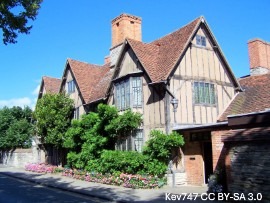
Stratford-upon-Avon home of Shakespeare's daughter is 'At Risk'
Lady Grange’s House repaired on St Kilda
.jpg)
National Trust for Scotland repairs stone cleit with link to famous island resident
Griff Rhys Jones on BBC Radio 4 Today programme
,_Green_Lane,_Derby.jpg)
The Victorian Society’s President unveiled its latest Top Ten Endangered Buildings 2026.
Need a MATE? Book your place now.
IHBC offers free webinars on applying for IHBC accreditation (Full & Associate).
UK Stained Glass Repository finds windows new homes
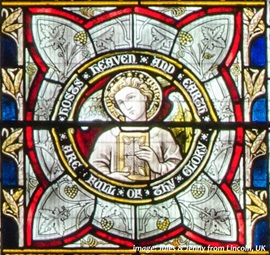
How are stained glass windows are rescued, stored and repurposed?
APPGEBE report sets high aims for quality
'Government must not sacrifice quality in drive to build 1.5m homes'
New measures protect Historic Shipwrecks from heritage crime

Underwater cultural heritage benefits from new HE guidance
How could the City of London skyline look in 6 years' time?

Visualisation shows approved planning applications as completed buildings
National Trust for Scotland calls for VAT cuts
Heritage neglect is encouraged by current policies
IHBC's 'Context' Issue 186 features Industrial Heritage
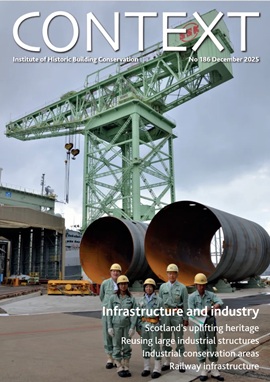
IHBC's members' journal reports on the challenges of conserving infrastructure
Book now for IHBC Annual School 2026

IHBC Annual School is taking place 18-20 June 2026 in Newcastle
RICHeS Research Infrastructure offers ‘Full Access Fund Call’
RICHeS offers a ‘Help’ webinar on 11 March
Latest IHBC Issue of Context features Roofing
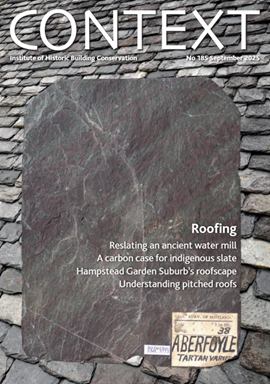
Articles range from slate to pitched roofs, and carbon impact to solar generation to roofscapes
Three reasons not to demolish Edinburgh’s Argyle House

Should 'Edinburgh's ugliest building' be saved?
IHBC’s 2025 Parliamentary Briefing...from Crafts in Crisis to Rubbish Retrofit
IHBC launches research-led ‘5 Commitments to Help Heritage Skills in Conservation’
How RDSAP 10.2 impacts EPC assessments in traditional buildings

Energy performance certificates (EPCs) tell us how energy efficient our buildings are, but the way these certificates are generated has changed.