





CIC and the Edge launch competence framework for sustainability in the built environment

[edit] Competence Framework for Sustainability in the Built Environment Launched
Achieving a sustainable built environment, including buildings, external works and infrastructure, is key to addressing the climate and biodiversity emergencies and meeting numerous national and international requirements and agreements. This needs to be the focus of the entire sector, working in collaboration and building on current efforts to achieve a transformation in building safety. To facilitate this, the sector needs to ensure that it develops the necessary interlocking competencies across all disciplines based on a common understanding and language.
To help enable this, the Construction Industry Council (CIC) and the Edge jointly published the ‘Competence Framework for Sustainability in the Built Environment’ on 24 February, 2025. This is an underpinning framework for developing discipline-specific sustainability competence requirements across the built and natural environment sector. The standard has been drafted as a Seed Document for a British Standard in the BSI’s Competence in the Built Environment series that commenced with BS 8670: Part 1 on Competence for Building Safety published in 2024.
The framework was developed under Workstream 10 of CIC’s Climate Action Plan, coordinated by the Edge with support from the University College of Estate Management (UCEM), through a process of extensive cross-sector and public consultation.
The aims of the framework are to:
- a) Set core criteria for achieving sustainability;
- b) Facilitate the development of sector-specific competence frameworks; and
- c) Support a consistent approach to competence frameworks across the built environment.
The framework is intended for use by a wide range of organisations describing the competence requirements for specific roles in the sector, including commissioning clients and advisers, professionals, contractors, managers, manufacturers, suppliers and regulators.
The framework defines sustainability through five core criteria: Potential, covering natural systems, resources, energy and carbon, social impact, and harms and solutions; People, focusing on education, training and literacy, behaviours and teamwork; Process, addressing finance and risk, practice, and tools and technologies; Projects, encompassing land use and planning, external spaces, infrastructure and accessibility, and buildings; and Performance, which includes monitoring, information and feedback, resilience and adaptation, and emergency response. It also outlines five stages of competence for roles and functions: Recognise, Analyse, Apply, Achieve, and Advance.
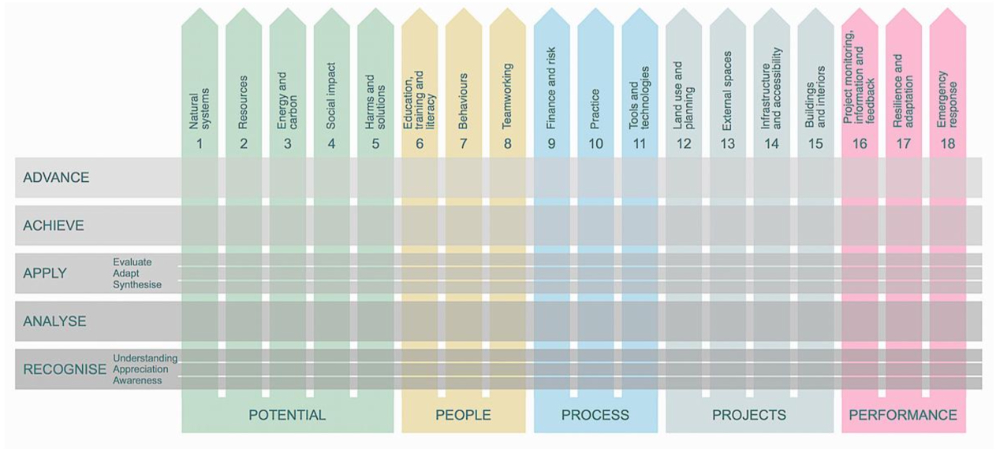
Diagram 1: Competence Categories
A full copy of the framework can be downloaded here.
A free webinar presenting the Framework is being held on Wednesday 12 March at 1pm; registration to attend here.
CIC is the representative forum for the professional bodies, research organisations and specialist business associations for professional services providers in the construction industry. It provides a single voice for professionals in all sectors of the built environment through its collective membership of 500,000 individual professionals and 25,000 firms of construction consultants.
the Edge is a built and natural environment think tank and network. It is multi-disciplinary in a sector notable for its abundance of single-discipline institutions. the Edge is a voluntary group with no staff and multiple stakeholders across the built and natural environment professions and beyond. We encourage cross- disciplinary debate and campaign for change that will improve outcomes for society.
This article was issued via press release as 'Competence Framework for Sustainability in the Built Environment Launched' dated 27 February, 2025.
[edit] Related articles on Designing Buildings
- A Higher Bar. Achieving a competence led built environment.
- Best practice.
- Competence framework.
- Competence framework for project managers in the built environment launched.
- Competence management.
- Collaboration for Change, The Edge Commission Report on the Future of Professionalism
- Competence.
- Draft competence framework for sustainability in the built environment.
- Edge Debate 71 - Can decentralisation solve the housing crisis?
- Environmental frameworks, assessments and certifications in their historical context.
- Grenfell Tower.
- Hackitt review of the building regulations and fire safety, final report.
- Learning.
- Professional.
- Professional conduct.
- Professional practice.
- Recruiting and retaining talent in the construction industry.
- Robin Nicholson, convenor of the Edge and fellow of Cullinan studio.
- Skills gap.
- Submission of evidence to the Edge commission of inquiry on future professionalism.
- Sustainable development.
- Sustainable materials.
- Sustainable procurement.
- Sustainability appraisal.
- Sustainability in building design and construction
- Sustainability in facility management.
- The Edge Debate 74: Building better places - who cares?
- The Edge policy proposals for the built and natural environment 2022.
- The Edge Debate.
- The Edge Biannual Report 2023.
- The sustainability of construction works
Featured articles
Check out some of the best features and news from Designing Buildings as well as key stories from around the web.

Sir Edwin Lutyens: Britain's greatest architect? Book review.

CIOB publishes free template to help assess and manage risks.
ECA's reflections on Party Conference season

Burnham wants to be confident of winning before asking for a fresh mandate.
New Chief Construction and Scientific Adviser

Sergio Cavalaro, Professor of Infrastructure Systems at Loughborough University.
Building safety levy for England

CIAT publish estimator tool for members.

Water sector faces a growing crisis that could slow the delivery of vital infrastructure.
Undervaluing our industrial past

Heritage value changes as taste for building styles changes.
Changing expectations around competence and compliance

New information sheet from CIAT.
Grenfell investigation files passed to CPS

Angela Rayner apologises on behalf of the British state.

Electrical contractors need to understand the practical implications.

The real barrier to getting more value from digital technology.

Your guide to The Construction Reset at UKCW Birmingham.