





The Edge policy proposals for the built and natural environment 2022
Contents |
[edit] Introduction
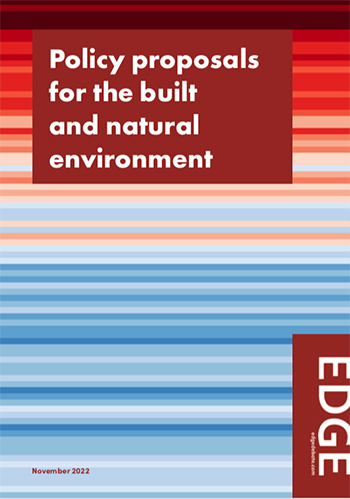
In November 2022, multi-disciplinary think tank and network, The Edge, which campaigns on on issues related to the built and natural environment, published Policy proposals for the built and natural environment, a call for action.
[edit] Holistic single package
The report presents as a holistic package of interconnected policy proposals, from broad suggestions to tightly-focused recommendations targetted at different government departments and sectors of the construction industry. The intention is to publish further details at a later date, whilst in the meantime, discussion and debate, are welcomed and post publication sessions are likely to follow.
[edit] Timely response
There is no doubt that these proposals are timely, being released after the BEIS Net Zero review consultation period but prior to COP27 and the publication of the Government's Review of Net Zero, now known as Mission zero. In itself the document cross references many other key publications that could be tied together as an evidence base shaped into policy that is forward thinking and supports both the built and natural environment as well as the economy and society.
[edit] The headings
The document is structured under 8 headings, each of which takes up just a single page clearly outlining the context in which the UK finds itself, the key issues round the topic and a number of policy measures that should taken:
- An economy that supports the environment; “A carbon emissions tax to replace VAT”.
- Planning and investing for the benefit of society as a whole; “Social value a core component of the NPPF”.
- Using our limited land intelligently and productively; “A land use framework to ensure the wellbeing of future generations”.
- Delivering essential infrastructure and transport; “Infrastructure provision that demands carbon accounting and responsibility”.
- Building climate and biodiversity skills and understanding; “Climate skills and understanding delivered at all stages of education”.
- Measuring, declaring and eradicating carbon emissions; “Carbon rationing introduced for all buildings and developments”.
- Creating a resilient built and natural environment; “Buildings and environments configured to absorb climate shock”.
- Design and construction performing in the public interest; “Individual Building Passports to record essential building and performance data”.
For further information downloaded the full document here: https://edgedebate.com/edge-policy-recommendations
[edit] Discussion, development and action
Future actions will include:
- Testing the programme in depth, with political groups, parties and advisers; civil servants; building industry experts, organisations and campaigners as well as the wider public.
- Publishing a detailed and referenced support document.
- Discussing further at COP27 and Futurebuild in March 2023.
- Building a coalition for change comprising politicians, local authorities, building owners and developers, contractors, professional organisations and campaign bodies.
For further information and contact details visit https://edgedebate.com
[edit] Related articles on Designing Buildings
- Aligning net zero with the levelling-up agenda.
- Edge Debate 71 - Can decentralisation solve the housing crisis?
- Fabric first will safeguard heat decarbonisation.
- Government net zero review 2022.
- Net zero carbon 2050.
- Net zero strategy: build back greener.
- Net zero strategy.
- Net Zero Review underlines role for engineering services.
- Smoothing the path to net zero.
- The Edge Biannual Report 2023.
- The Edge Debate 74: Building better places - who cares?
- What's missing from The Government's 10-point plan?
- Zero carbon non-domestic buildings.
- Zero carbon homes.
Featured articles
Check out some of the best features and news from Designing Buildings as well as key stories from around the web.

Sir Edwin Lutyens: Britain's greatest architect? Book review.

CIOB publishes free template to help assess and manage risks.
ECA's reflections on Party Conference season

Burnham wants to be confident of winning before asking for a fresh mandate.
New Chief Construction and Scientific Adviser

Sergio Cavalaro, Professor of Infrastructure Systems at Loughborough University.
Building safety levy for England

CIAT publish estimator tool for members.

Water sector faces a growing crisis that could slow the delivery of vital infrastructure.
Undervaluing our industrial past

Heritage value changes as taste for building styles changes.
Changing expectations around competence and compliance

New information sheet from CIAT.
Grenfell investigation files passed to CPS

Angela Rayner apologises on behalf of the British state.

Electrical contractors need to understand the practical implications.

The real barrier to getting more value from digital technology.

Your guide to The Construction Reset at UKCW Birmingham.
Comments
[edit] To make a comment about this article, or to suggest changes, click 'Add a comment' above. Separate your comments from any existing comments by inserting a horizontal line.