





Ebenezer Howard: inventor of the garden city

Ebenezer Howard: inventor of the garden city, Frances Knight, Oxford University Press, 2023, 240 pages, hardback.
One night in 1914 an idea came to Ebenezer Howard in a dream. He would write a message to the German people, go up in a plane (yes, in 1914) and scatter pacifist leaflets (1,200,000 of them, he calculated) over Germany. His message would warn of the danger of nations being plunged into slaughter by the decisions of tyrannical rulers. Arbitration at the Hague would enable ‘humanity and civilisation [to] triumph over brutality and barbarism.’
Howard’s friend, the playwright George Bernard Shaw, told him that the idea was ‘entirely impractical’ and that he should ‘sit quietly at home.’
The man often described as the father of modern town planning, and a person of notable modesty, Howard certainly had a high degree of self-confidence. Having founded Letchworth Garden City in 1903, by 1919 he was disappointed by its financial difficulties and lack of progress. So he decided to found another garden city. Without the support of his colleagues in the Garden Cities and Town Planning Association, he went to an auction and bid for the land on which to build Welwyn Garden City. Lacking the necessary funding, he somehow persuaded the auctioneer to lend him the balance of the deposit.
After his death Shaw described Howard as ‘one of those heroic simpletons who do big things while our prominent worldlings are explaining why they are Utopian and impossible.’
The subtitle of Frances Knight’s biography ‘Ebenezer Howard: inventor of the garden city’ is well chosen. Howard was an inveterate inventor of mechanical devices (most of which failed), and the garden city was also an invention. None of its elements was new: Howard reviewed a wide range of ideas of 19th-century visionaries, adopting only those that he thought would complement each other and, crucially, promote social and economic cooperation.
His boldest idea of all was that the freehold of each garden city would be collectively owned, enabling the rise in land values brought about by the creation of the city to be retained as part of the community’s wealth, rather than being siphoned off by developers and speculators. The present Labour government is trying to work out how that principle can be applied to urban development today.
Frances Knight is emeritus professor of the history of Christianity at the University of Nottingham. Her book is in a series called ‘Spiritual Lives’, featuring biographies of prominent men and woman whose eminence was not primarily based on a specifically religious contribution. Religion was central to Ebenezer Howard’s life: ‘the Garden City movement was designed to solve a spiritual, as much as an economic problem,’ Knight writes, ‘and Howard believed that it had arisen as a result of his being the recipient of divine inspiration.’
As well as being a committed nonconformist Christian, Howard believed in spiritualism, making determined efforts to contact his first wife after her early death. One of the fascinating themes in Knight’s book is, as she describes it, ‘the syncretic relationship between Protestant orthodoxy and the spirit world in the late nineteenth and twentieth centuries’.
The son of a baker, Howard earned his living for most of his career as a shorthand-writer in Parliament and the courts. Frances Knight has done a superb job of researching and telling the story of how Shaw’s ‘heroic simpleton’ founded two garden cities, inspired the town-planning movement and earned a knighthood.
This article originally appeared as ‘Heroic simpleton’ in the Institute of Historic Building Conservation’s (IHBC’s) Context 181, published in December 2024. It was written by Rob Cowan, editor of Context.
--Institute of Historic Building Conservation
Related articles on Designing Buildings Conservation.
- Conservation.
- Garden cities.
- Heritage.
- Historic environment.
- IHBC articles.
- Institute of Historic Building Conservation.
- Post-war new towns in Germany.
- Radial city plan.
- Repurposing the Green Belt in the 21st Century.
- Richard Rogers - A Place for all People.
- Richard Rogers in conversation at Somerset House.
- The green belt and historic buildings.
- Town and Country Planning Association TCPA.
- Vital Little Plans - book launch.
IHBC NewsBlog
IHBC sponsors Gardens Trust event 23-4 Sept 2026
.jpeg)
'Learning from the Past, Shaping the Future’ takes place in Milton Keynes
Renovations to Frank Lloyd Wright's Fallingwater complete
.jpg)
World Heritage Preserved project opens house for tours again
Shakespeare Birthplace Trust places Hall's Croft on HAR Register
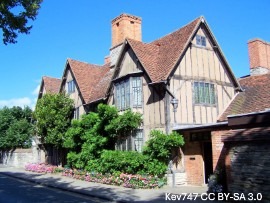
Stratford-upon-Avon home of Shakespeare's daughter is 'At Risk'
Lady Grange’s House repaired on St Kilda
.jpg)
National Trust for Scotland repairs stone cleit with link to famous island resident
Griff Rhys Jones on BBC Radio 4 Today programme
,_Green_Lane,_Derby.jpg)
The Victorian Society’s President unveiled its latest Top Ten Endangered Buildings 2026.
Need a MATE? Book your place now.
IHBC offers free webinars on applying for IHBC accreditation (Full & Associate).
UK Stained Glass Repository finds windows new homes
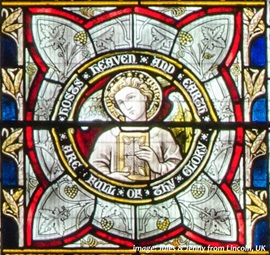
How are stained glass windows are rescued, stored and repurposed?
APPGEBE report sets high aims for quality
'Government must not sacrifice quality in drive to build 1.5m homes'
New measures protect Historic Shipwrecks from heritage crime

Underwater cultural heritage benefits from new HE guidance
How could the City of London skyline look in 6 years' time?

Visualisation shows approved planning applications as completed buildings
National Trust for Scotland calls for VAT cuts
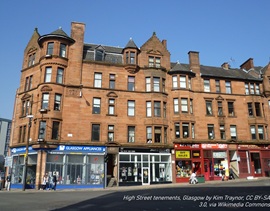
Heritage neglect is encouraged by current policies
IHBC's 'Context' Issue 186 features Industrial Heritage
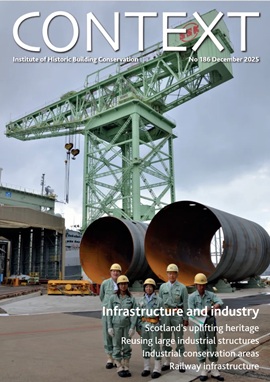
IHBC's members' journal reports on the challenges of conserving infrastructure
Book now for IHBC Annual School 2026
IHBC Annual School is taking place 18-20 June 2026 in Newcastle
RICHeS Research Infrastructure offers ‘Full Access Fund Call’
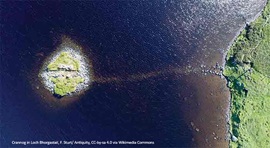
RICHeS offers a ‘Help’ webinar on 11 March
Latest IHBC Issue of Context features Roofing
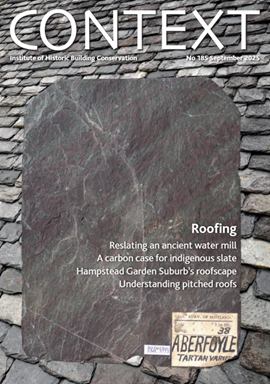
Articles range from slate to pitched roofs, and carbon impact to solar generation to roofscapes
Three reasons not to demolish Edinburgh’s Argyle House

Should 'Edinburgh's ugliest building' be saved?
IHBC’s 2025 Parliamentary Briefing...from Crafts in Crisis to Rubbish Retrofit
IHBC launches research-led ‘5 Commitments to Help Heritage Skills in Conservation’
How RDSAP 10.2 impacts EPC assessments in traditional buildings

Energy performance certificates (EPCs) tell us how energy efficient our buildings are, but the way these certificates are generated has changed.