




Raj Green Sandstone Supplier in UK
Contents |
[edit] Introduction
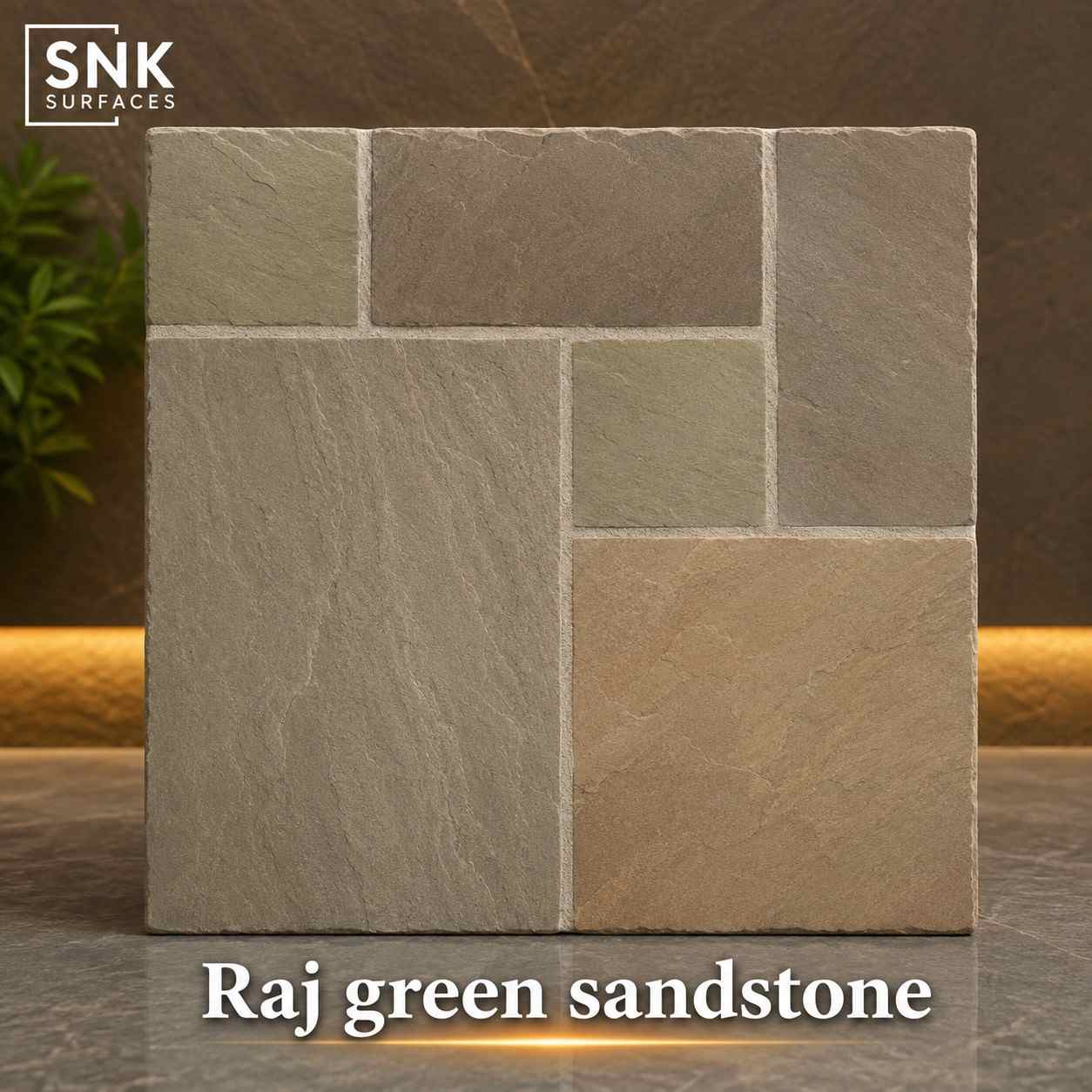
Raj Green sandstone is a commercially available natural sandstone commonly used for external paving, landscaping and other construction applications. The name generally refers to sandstone products with a mixture of green, grey, brown, buff and earthy tones rather than to a single geological classification.
Raj Green sandstone is commonly associated with sandstone quarried in India, particularly Rajasthan. It is processed into paving slabs and other products in a range of sizes, thicknesses and finishes. As with other natural stone, its suitability for a particular application depends on its physical and technical properties, the finish and dimensions of the stone, the proposed use and the design of the supporting construction.
When purchasing sandstone, the supplier is one consideration, but the specification, testing, provenance, quality consistency, documentation, transport arrangements and suitability for the intended application are also important.
[edit] Characteristics and appearance
Raj Green sandstone is characterised by a varied colour palette that can include olive green, khaki, grey, brown and buff tones. Individual slabs can differ considerably in colour, grain, mineral content and surface texture. This natural variation is part of the character of the material and means that a single sample may not represent the full range of material in a larger order.
The term Raj Blend is also used commercially for some sandstone products with similar colour characteristics. Trade names should not, however, be assumed to define an identical geological material. The physical properties of the particular product should be established from appropriate technical information.
Common finishes include naturally riven surfaces, which retain the natural texture of the stone, as well as sawn, honed, sandblasted and tumbled finishes. The finish can affect appearance, surface texture, cleaning requirements and slip performance.
[edit] Comparison with other sandstone
Raj Green is one of several commercially available Indian sandstone colour ranges. Other products include Kandla Grey and Rippon Buff, which have different colour characteristics.
Stone Typical colour characteristics Typical applications
Raj Green
Green, grey, brown and buff tones
Patios, paths and traditional landscaping
Kandla Grey
Grey and blue-grey tones
Contemporary paving and landscaping
Rippon Buff
Buff, cream and honey tones
Patios and other warm-coloured landscaping
The choice between these products is primarily a matter of the required appearance and the technical suitability of the particular stone. Natural colour names should not be treated as technical classifications.
[edit] Applications
Raj Green sandstone can be used for a range of external applications where its properties are appropriate. These can include:
- patios and garden paving;
- paths and courtyards;
- terraces;
- steps and copings;
- walling and cladding;
- landscape features; and
- some areas subject to vehicular loading, where the stone and supporting pavement have been designed for the expected loads.
Paving intended for vehicle traffic requires particular consideration. A stone thickness that is suitable for pedestrian paving should not automatically be assumed to be suitable for a driveway. The required thickness and construction depend on factors including the stone's mechanical properties, paving unit dimensions, bedding, sub-base, ground conditions and expected traffic.
[edit] Selection and specification
A reliable supply of natural stone involves more than assessing the colour shown in a photograph. Samples should be examined to assess colour, texture and finish, but a representative range or control sample is preferable for significant projects because individual pieces of natural stone can vary.
Technical information should be obtained for the particular product being specified. Depending on the intended application, relevant properties can include water absorption, apparent density, flexural strength, compressive strength, resistance to abrasion, frost resistance and slip or skid resistance.
The required dimensions and thickness should be selected according to the application and the tested characteristics of the particular stone. There is no single thickness that is appropriate for every patio, pathway or driveway.
For external paving, BS EN 1341 is the relevant European standard for slabs of natural stone used for external paving. It specifies requirements and test methods for such products. Other standards may be relevant depending on the application and form of the stone.
The specification should also identify the required finish, dimensions, tolerances, colour range and other characteristics where these are important to the project.
[edit] Buying from a supplier
When purchasing Raj Green sandstone, the supplier should be able to provide sufficient information to establish the source, characteristics and suitability of the material.
For larger orders, buyers may wish to establish:
- the quarrying and processing location;
- the type and finish of the stone;
- available dimensions and thicknesses;
- relevant test results and technical documentation;
- the expected range of natural colour and texture variation;
- packaging and protection arrangements;
- minimum order quantities and lead times;
- inspection arrangements; and
- transport and delivery responsibilities.
For imported stone, the responsibilities of the supplier and purchaser for customs documentation, transport, import requirements and delivery should also be established before the order is placed.
A manufacturer-direct purchase is not necessarily better than purchasing through a specialist distributor or trader. The important consideration is whether the supplier can provide appropriate technical information, consistent material, clear contractual arrangements and suitable support for the intended project.
[edit] Samples and quality inspection
A sample should be obtained before a substantial order where appearance is important. For large projects, the sample should be representative of the expected colour and natural variation rather than being treated as a guarantee that every paving unit will be identical.
For significant commercial orders, inspection of representative material before shipment may also be appropriate. This can be undertaken by the supplier's quality-control team or, where justified by the value and risk of the order, by an independent inspection organisation.
[edit] Importing and transport
Raj Green sandstone supplied to the UK may be transported from India by sea freight, with the stone normally being processed and packed before export. The precise supply chain varies between suppliers and products.
Natural stone paving is commonly packaged to reduce movement and damage during transport. Appropriate pallets, strapping, wrapping and edge protection can help reduce the risk of breakage and chipping. The packaging requirements depend on the dimensions, thickness, finish and form of the stone.
For containerised imports, the quantity that can be transported depends on factors including the dimensions and thickness of the paving, packing arrangements and applicable container weight limits. A supplier should therefore provide the expected quantity and weight for the particular order rather than relying on a generic container capacity.
Shipping documentation, delivery responsibilities and inspection arrangements should be agreed before dispatch.
[edit] Installation
The performance of sandstone paving depends on the complete paving construction rather than on the stone alone. The supporting ground, sub-base, bedding, joints and drainage all need to be appropriate for the intended use and site conditions.
The sub-base should be designed and compacted to provide adequate support for the expected loading. The required depth is not necessarily the same for every project and depends on factors including ground conditions, drainage, loading and the type of paving construction.
Sandstone paving should be laid using a suitable bedding system that provides adequate and continuous support. The appropriate method depends on the paving units, substrate, expected loading and site conditions. The use of isolated dabs of mortar can result in inadequate support and should not be assumed to be suitable.
Paving should normally be laid to appropriate falls so that surface water drains effectively and prolonged standing water is avoided. Joint widths and jointing materials should be selected as part of the paving system rather than applying a single joint width to every installation.
Where the stone has substantial natural colour variation, slabs from different packs should be mixed during installation. This distributes the variation throughout the completed area rather than creating distinct areas of different colour.
[edit] Maintenance
Sandstone is a porous natural material and can absorb water and contaminants. Regular sweeping can help prevent the accumulation of dirt and organic matter. Spills should be dealt with promptly where staining is a concern.
Cleaning products should be suitable for natural sandstone. Strongly acidic or otherwise aggressive products can damage some natural stone surfaces and should not be used unless their suitability has been established. Pressure washing can also damage some finishes if excessive pressure or inappropriate techniques are used.
Sealing is not universally required. Where a sealer is used, it should be suitable for the particular sandstone, surface finish and intended application. The manufacturer's instructions should be followed, including requirements relating to surface preparation, drying and subsequent maintenance.
Sealing should not be regarded as a substitute for suitable drainage or correct installation.
[edit] Advantages and limitations
Raj Green sandstone can provide a natural and varied appearance that is difficult to reproduce with manufactured paving products. Its range of earthy colours can be suitable for traditional and contemporary landscaping, depending on the selected finish and design.
Natural colour and texture variation can also be an advantage where a varied appearance is wanted, but it may be a disadvantage where a highly uniform finish is required. Riven surfaces can contain natural pits, ridges and variations in level, while smoother finishes can provide a more consistent surface.
The stone's porosity and physical properties also need to be considered. Water absorption, frost resistance, strength, abrasion resistance and slip performance can vary between products. These properties should therefore be assessed rather than inferred from the name 'Raj Green' alone.
[edit] Common specification mistakes
Common problems when specifying or purchasing natural sandstone include:
- selecting the stone based solely on photographs;
- treating a single sample as representative of an entire shipment;
- specifying a thickness without considering the intended loading and construction;
- assuming that a stone suitable for pedestrian paving is automatically suitable for vehicles;
- failing to obtain relevant technical data;
- overlooking drainage and the supporting sub-base;
- specifying a finish without considering its surface performance;
- failing to establish the expected range of natural variation; and
- not agreeing inspection, packaging, transport and delivery responsibilities for large orders.
For imported stone, buyers should also establish who is responsible for the various stages of transport and importation before placing an order.
[edit] Conclusion
Raj Green sandstone is a commercially available natural sandstone valued particularly for its varied green, grey, brown and buff appearance. It is commonly used for external paving and landscaping and is associated with sandstone products quarried and processed in India.
The suitability of Raj Green sandstone depends on the characteristics of the particular product and the requirements of the project. Colour and appearance are important considerations, but technical properties such as strength, water absorption, frost resistance, abrasion resistance and slip performance may be equally important depending on the application.
A reliable purchasing process should therefore consider representative samples, technical documentation, quality inspection, appropriate specification, packaging and transport arrangements. Correct design and installation of the supporting construction are also essential to the long-term performance of sandstone paving.
[edit] Related articles on Designing Buildings
Featured articles
Check out some of the best features and news from Designing Buildings as well as key stories from around the web.
Code of Practice for Electrical Energy Storage Systems.

ECA calls on members to comment on draft 4th edition.

Bringing together expertise and creating cultural benefits.

CIOB celebrates positive Ofsted report.

The Building Safety Regulator announces a call for evidence.

Government approach could undermine delivery and regeneration.
World's first mass timber data centre.

The overlooked environmental aspect of data centre development.
Introduction to radon awareness

New technical information sheet published by CIOB.

Updated supplier guide can help electrical contractors engage with NHP.

CIAT confirm the winners of the 2026 architectural technology awards.

Government launches a one stop shop for flood preparedness.

Sir Edwin Lutyens: Britain's greatest architect? Book review.

CIOB publishes free template to help assess and manage risks.