





Carbon Fiber Reinforced Polymer (CFRP)
Contents |
[edit] Introduction
Carbon fibre reinforced polymer (CFRP) is a composite material consisting of carbon fibres embedded within a polymer matrix, typically an epoxy resin. Owing to its high strength-to-weight ratio, corrosion resistance and durability, CFRP is widely used for the strengthening, repair and rehabilitation of existing structures.
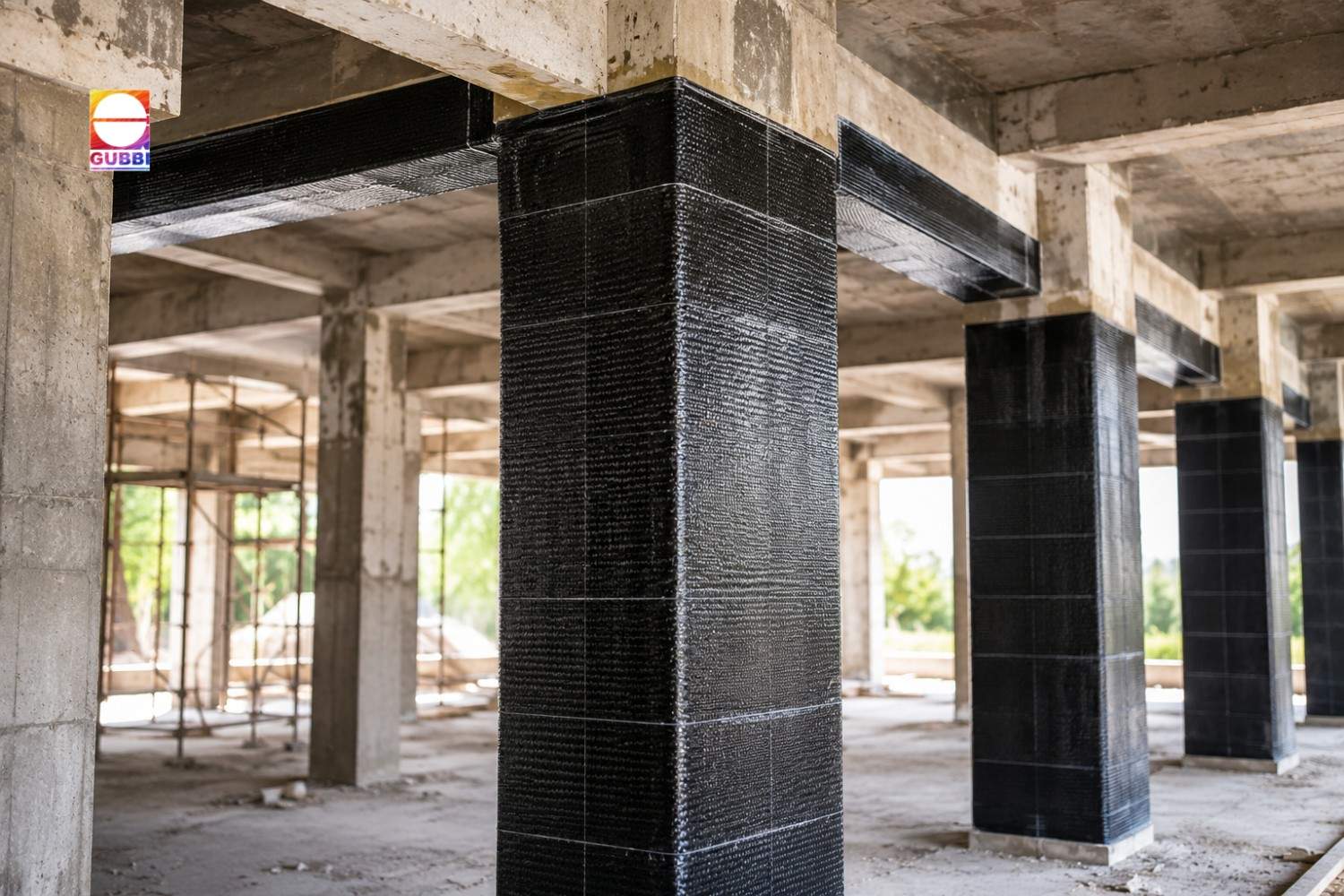
In construction and civil engineering, CFRP systems are commonly applied to concrete, masonry, timber and steel structures to enhance structural performance without significantly increasing member dimensions or dead loads. This makes CFRP particularly suitable for refurbishment projects, bridges, parking structures, industrial facilities and other infrastructure assets where conventional strengthening methods may be impractical.
[edit] Applications of CFRP strengthening
CFRP strengthening systems are used to address a range of structural issues, including:
- Increased loading requirements resulting from changes of use.
- Deterioration caused by ageing, corrosion or environmental exposure.
- Design or construction deficiencies.
- Damage resulting from accidental loading, impact or fire.
- Upgrading structures to meet revised design standards.
Depending on the application, CFRP may be installed as externally bonded sheets, strips, laminates or near-surface mounted reinforcement.
[edit] Structural benefits
When properly designed and installed, CFRP systems can provide several structural benefits, including:
[edit] Increased flexural capacity
CFRP reinforcement can increase the bending resistance of beams, slabs and other structural elements by providing additional tensile capacity.
[edit] Enhanced shear resistance
The application of CFRP wraps or strips can improve the shear capacity of reinforced concrete members and help reduce the risk of shear failure.
[edit] Improved confinement and ductility
Wrapping columns and other compression members with CFRP can provide confinement to the concrete core, increasing strength, ductility and energy absorption capacity.
[edit] Reduced additional dead load
Compared with steel plate bonding or concrete jacketing, CFRP systems add minimal weight to the structure while providing significant strengthening benefits.
[edit] Corrosion resistance
Carbon fibres are inherently resistant to corrosion, making CFRP particularly suitable for structures exposed to aggressive environmental conditions.
[edit] Structural assessment
Before any strengthening scheme is undertaken, a detailed structural assessment is required. This typically includes:
- Evaluation of the existing structural system.
- Assessment of concrete condition and deterioration.
- Identification of reinforcement details.
- Investigation of cracking and defects.
- Determination of existing and future loading requirements.
- Review of serviceability and durability considerations.
The assessment informs the design of the strengthening system and ensures compatibility between the existing structure and the proposed intervention.
[edit] Installation considerations
The performance of a CFRP strengthening system is highly dependent on installation quality. Typical installation procedures include:
[edit] Surface preparation
The substrate must be sound, clean and adequately prepared to achieve a reliable bond. Damaged concrete should be repaired before the CFRP system is installed.
[edit] Application of resin and fibres
The polymer resin is applied to the prepared surface, followed by placement of the carbon fibre material in accordance with the design specification.
[edit] Quality control
Inspection and testing may be carried out during installation to verify substrate preparation, resin application, fibre alignment and curing conditions.
Proper installation is essential because the effectiveness of externally bonded CFRP systems depends on the transfer of stresses between the existing structure and the composite material through the adhesive bond.
[edit] Advantages of CFRP strengthening
Key advantages of CFRP strengthening include:
- High strength-to-weight ratio.
- Minimal increase in structural dimensions.
- Rapid installation compared with traditional strengthening methods.
- Reduced disruption to building operations.
- Excellent durability and corrosion resistance.
- Compatibility with a wide range of structural forms.
- Potential extension of service life for existing assets.
[edit] Limitations
Although CFRP offers numerous advantages, certain limitations should be considered:
- Relatively high material costs compared with some conventional strengthening methods.
- Dependence on proper substrate preparation and installation quality.
- Sensitivity of polymer resins to elevated temperatures and fire unless protected.
- Potential long-term effects of environmental exposure if not adequately designed and detailed.
- Requirement for specialist design and installation expertise.
[edit] Design considerations
The design of CFRP strengthening systems should be undertaken by suitably qualified structural engineers and in accordance with relevant standards, guidance documents and manufacturer-tested performance data.
Design considerations may include:
- Ultimate and serviceability limit states.
- Bond and anchorage requirements.
- Environmental exposure conditions.
- Fire performance requirements.
- Fatigue loading.
- Long-term creep and durability behaviour.
[edit] Sustainability considerations
Strengthening existing structures using CFRP can contribute to more sustainable asset management by extending service life and reducing the need for demolition and reconstruction. Retaining existing structural elements can help reduce material consumption, construction waste and embodied carbon associated with replacement works.
[edit] Related articles on Designing Buildings
Featured articles
Check out some of the best features and news from Designing Buildings as well as key stories from around the web.

Government approach could undermine delivery and regeneration.
World's first mass timber data centre.

The overlooked environmental aspect of data centre development.
Introduction to radon awareness

New technical information sheet published by CIOB.

Updated supplier guide can help electrical contractors engage with NHP.

CIAT confirm the winners of the 2026 architectural technology awards.

Government launches a one stop shop for flood preparedness.

Sir Edwin Lutyens: Britain's greatest architect? Book review.

CIOB publishes free template to help assess and manage risks.
ECA's reflections on Party Conference season

Burnham wants to be confident of winning before asking for a fresh mandate.
New Chief Construction and Scientific Adviser

Sergio Cavalaro, Professor of Infrastructure Systems at Loughborough University.
Building safety levy for England

CIAT publish estimator tool for members.

Water sector faces a growing crisis that could slow the delivery of vital infrastructure.