





Housing and heritage
The government’s target and land-supply-led approach could undermine housing delivery in some areas, and undermine the regeneration of brownfield sites and historic towns.

|
| Residential development around Blandford Forum town centre should boost the vitality of the high street. (Photo: Dave Chetwyn). |
Contents |
Introduction
The government aims to deliver 1.5 million new homes. It means to achieve this by increasing the land supply for housing through much higher targets for local authorities, enabling them to meet in local plan housing site allocations and by the introduction of grey belt sites (to make development of some green belt sites easier). Is this target and land-supply-led approach likely to work? Or could it undermine housing delivery in some areas, while also undermining the regeneration of brownfield sites and historic towns and buildings?
Housing, viability and regeneration
Increasing the rate of house building has been an aim of governments over the last decade or two. This includes target-led approaches, which have been largely unsuccessful in achieving an actual increase in the rate of delivery. Over the last couple of decades, geographical economic discrepancies have tended to widen rather than narrow. In high-growth areas, land and property price inflation have accelerated, while areas with viability challenges have often stagnated or declined further. This has affected historic towns and buildings in some areas. Housing has been one of the key approaches to regenerating historic towns and improving the vitality of high streets.
The more prosperous town centres tend to be those that have developed residential populations in and around the centre over the past few decades. One example is Blandford Forum, where the town council and two adjoining parish councils made housing site allocations around the historic centre through a neighbourhood plan, potentially increasing the residential catchment considerably. This could be game-changing for the historic town centre.
The approach to residential site allocations and heritage has sometimes been negative and passive, focusing on negative impacts and mitigation. But planning positively for heritage means locating housing growth where it will have beneficial impacts on heritage, including benefits to the vitality and viability of historic centres.
Media coverage often suggests that all town centres are in trouble. The reality is more mixed. Some town centres are doing well, while others have declined. In Stoke-on-Trent, this is especially apparent in Hanley and Burslem. Burslem and nearby Middleport and Longport have benefited from various kinds of heritage funding over the past few decades, with some high-profile projects such as the refurbishment of the Grade II*-listed Middleport Pottery and the refurbishment of adjacent former housing. However, some properties in Burslem town centre and the surrounding areas have deteriorated. The Grade II* Price and Kensington Pottery Factory in nearby Longport is partially collapsed. This decline is due to a viability gap. This means that the returns on development (including refurbishment) do not cover the development costs.
In such areas, the consequence of increasing the supply of greenfield housing land is likely to be to be a further widening of the viability gap, making development of brownfield land and reuse, and conversion of historic buildings more challenging. This is not a simple north/ south issue. There are many parts of the southeast that have viability challenges, such as the Isle of Sheppey and other parts of Swale. Even quite prosperous areas like Faversham have viability challenges in reusing industrial heritage. Grey belt land does not include consideration of the particular green belt purpose: ‘to assist in urban regeneration, by encouraging the recycling of derelict and other urban land.’ Exclusion of this purpose highlights that viability is simply not on the political agenda.
The higher housing targets are based on assumptions of more prosperous areas. In London and high-growth areas, affordability is an important issue and the rate of housing delivery a key challenge. There can also be challenges where there are disproportionate levels of overseas and remote ownership of housing assets, further inflating house prices and rental levels. In some areas, including historic coastal towns and rural settlements, second home ownership or loss of family homes to visitor accommodation has led to housing shortages. At the same time, many jobs associated with the tourist and visitor economy are relatively poorly paid, so incomes and house prices are out of kilter.
The application of targets to less well-off areas will oversupply housing land, widening viability gaps or creating viability gaps in more marginal areas. This is likely to undermine market confidence, leading to less rather than more investment by developers. There is already evidence of a drop in the number of residential planning permissions being granted.
Conservation challenges and approaches are fundamentally linked to local land and property economies, which is why economic data is such an important part of heritage evidence bases. There is usually a direct relationship between the land and property economy, vacancy, building condition, high-street vitality and the number of buildings at risk. In some areas, the challenge is price inflation and pressure for development. But in many areas, the challenge is viability.
The needs of high-growth areas and places with viability challenges are almost diametrically opposed. In areas with suppressed land and property values, an over-supply of housing land undermines housing delivery and the prospects of regenerating older urban areas, including the refurbishment and reuse of historic buildings.
Neighbourhood plans
One of the few planning reforms to have achieved additional housing site allocations in the places where they are most needed is neighbourhood planning. Neighbourhood plans have tended to allocate sites in the places where they meet local need and are most sustainable, for example around towns. There has usually been strong public support for this due to the more rigorous and inclusive approaches to stakeholder and community engagement, with most plans receiving strong ‘yes’ votes at referendum. In addition, some neighbourhood plans have included creative approaches to regeneration and economic development, including heritage regeneration policies, for example in the Faversham neighbourhood plan. Against this context, it is disappointing that the national neighbourhood planning support programme has been discontinued.
Only a couple of decades ago, housing market renewal areas (pathfinders) were based on a concept of over-supply and managed decline. This primarily involved the purchase and proposed demolition of late-Victorian terraced housing. Large areas of housing were proposed for compulsory purchase and demolition in places like Liverpool and Stoke-on-Trent.
The decision to end the pathfinder programmes led to the selling of vacant properties (which had been subject to compulsory purchase). The housing was subsequently sold off cheaply, including direct sales to the public for £1 per house in Stoke-on-Trent and Liverpool. By selling at low rates, viability gaps were bridged. Some areas proposed for demolition have now been transformed into attractive and desirable neighbourhoods, reconciling heritage conservation (and conservation of embodied carbon) with the provision of improved housing. The pathfinders were based on very questionable assumptions and generalisations. Rather than incentivising growth, the approach was to ‘manage’ decline. Hopefully, few people would support this approach today.
The current policy is also based on blanket assumptions and is equally questionable. A ‘national housing crisis’ and a ‘crisis of affordability’ are often referred to, and this certainly applies to parts of the country. But for many areas, the challenge is viability, and the barrier to housing is low income and lack of local economic opportunity.
The one-size-fits-all approach of planning policy has prevented the country from realising its economic potential. National policy should place greater emphasis on areas in need of physical and economic regeneration. Positive planning can help to address viability challenges and create market confidence. The current focus on increasing land supply is rather like pouring petrol on the flames in such areas.
Historic town centres
There should be greater synergy between different chapters of the National Planning Policy Framework. A practical example is in focusing housing growth in and around historic town centres. This is often a good solution in terms of creating sustainable live/work patterns, access to facilities and infrastructure, enhancing the vitality of high streets, and regenerating historic buildings and areas. The NPPF could recognise the role of older peripheral areas (often declining commercial or industrial areas) in offering cheap and affordable floorspace for small businesses, start-ups, and creative and knowledge-based industries.
A more joined-up approach to planning for heritage would be useful. It is not helpful that heritage is in a separate ministry (since 1990) to planning and regeneration, so tends to be seen in cultural rather than socio-economic terms. A useful start would be to redraft some national heritage guidance to focus more on the positive outcomes, including a strong focus on realising the economic potential of historic areas. A much stronger focus on legal terminology would also be useful. Treating heritage as an integral part of social and economic planning for an area can achieve much better conservation outcomes.
This article originally appeared in the Institute of Historic Building Conservation’s (IHBC’s) Context 186, published in December 2025. It was written by Dave Chetwyn, managing director of Urban Vision Enterprise, IHBC secretary, and chair of the IHBC communications and outreach committee.
--Institute of Historic Building Conservation
Related articles on Designing Buildings Conservation.
IHBC NewsBlog
IHBC sponsors Gardens Trust event 23-4 Sept 2026
.jpeg)
'Learning from the Past, Shaping the Future’ takes place in Milton Keynes
Renovations to Frank Lloyd Wright's Fallingwater complete
.jpg)
World Heritage Preserved project opens house for tours again
Shakespeare Birthplace Trust places Hall's Croft on HAR Register
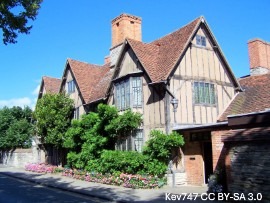
Stratford-upon-Avon home of Shakespeare's daughter is 'At Risk'
Lady Grange’s House repaired on St Kilda
.jpg)
National Trust for Scotland repairs stone cleit with link to famous island resident
Griff Rhys Jones on BBC Radio 4 Today programme
,_Green_Lane,_Derby.jpg)
The Victorian Society’s President unveiled its latest Top Ten Endangered Buildings 2026.
Need a MATE? Book your place now.

IHBC offers free webinars on applying for IHBC accreditation (Full & Associate).
UK Stained Glass Repository finds windows new homes

How are stained glass windows are rescued, stored and repurposed?
APPGEBE report sets high aims for quality
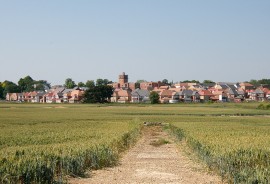
'Government must not sacrifice quality in drive to build 1.5m homes'
New measures protect Historic Shipwrecks from heritage crime

Underwater cultural heritage benefits from new HE guidance
How could the City of London skyline look in 6 years' time?

Visualisation shows approved planning applications as completed buildings
National Trust for Scotland calls for VAT cuts
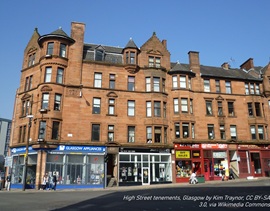
Heritage neglect is encouraged by current policies
IHBC's 'Context' Issue 186 features Industrial Heritage
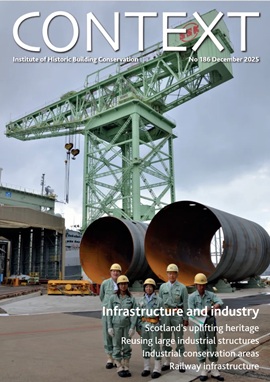
IHBC's members' journal reports on the challenges of conserving infrastructure
Book now for IHBC Annual School 2026

IHBC Annual School is taking place 18-20 June 2026 in Newcastle
RICHeS Research Infrastructure offers ‘Full Access Fund Call’

RICHeS offers a ‘Help’ webinar on 11 March
Latest IHBC Issue of Context features Roofing
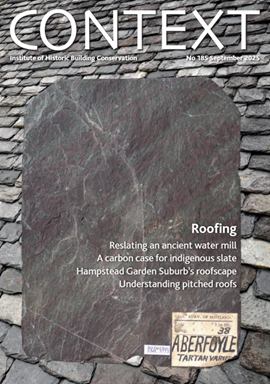
Articles range from slate to pitched roofs, and carbon impact to solar generation to roofscapes
Three reasons not to demolish Edinburgh’s Argyle House

Should 'Edinburgh's ugliest building' be saved?
IHBC’s 2025 Parliamentary Briefing...from Crafts in Crisis to Rubbish Retrofit
IHBC launches research-led ‘5 Commitments to Help Heritage Skills in Conservation’
How RDSAP 10.2 impacts EPC assessments in traditional buildings

Energy performance certificates (EPCs) tell us how energy efficient our buildings are, but the way these certificates are generated has changed.