





Understanding pitched roofs
Retaining our beautiful and distinctive roofscapes depends on understanding the function and design of pitched roof coverings, and the management of rainwater and vapour.

|
| Pantiles at Culross Palace (Photo: Historic Environment Scotland) |
Contents |
Introduction
At the most basic level, the purpose of a roof is to keep a building and its occupants safe and protected from the weather elements, acting as the hat that keeps a property dry. Roof coverings, alongside rainwater disposal goods and weather detailing, have a key role to play as the first line of defence. Different roofing materials are shaped, applied and utilised in different ways to better manage rainwater and snow, and withstand wind. As moisture ingress is the primary cause of decay in any traditional property, this functionality has always been a priority. Craftspeople have therefore focused their skills and adapted components accordingly, from stone gargoyles spouting water away from churches and towers, to lead flashings and drip detailing.
The form and function of roof coverings originally developed according to the materials that were available locally – stone slabs, slates, clay tiles and various types of gathered or grown thatching material. All roof coverings of interlocking units like these, act in unison to create a barrier to the wind and buffer moisture, but each with its own nuances when it comes to application. Regional variations developed according to what resources were available, the inherent material properties and the prevailing weather conditions of the locality. The development of rail and canal infrastructure allowed for easier movement of slates and pantiles. This gradually brought more homogeneity to roofs throughout the 18th and 19th centuries, but the general principles around detailing for the shedding of water remain the same.
Common pitched roof coverings in Scotland
Slate roofing
Slating styles vary widely due to different properties of the locally quarried materials and the slating traditions in each area. Typically, slated roofs in Scotland tend to have a steep pitch, around 40 degrees, which can accommodate relatively small, thicker slates and can also better handle wind-driven rain and snow. Slaters made the most of this, and maximised the volume of usable slate quarried, through the distinctive Scottish tradition of slating in diminishing courses. Larger slates were used at the bottom as they were better able to handle large volumes of rainwater that shed down off the roof. The smallest slates were the most robust against strong winds, so it was sensible to fix these closer to the ridge.
Smaller slates also allowed for single centre fixings, which made ongoing maintenance and repair easier, as slates could be simply swung to the side to replace any damage underneath. Slates are usually laid in a double lap in Scotland. This is best able to cope with the Scottish weather, but the ratios of side lap to head lap will vary depending on the size of the slates used. Experienced slaters will calculate these proportions at every new course as the size of slates changes. Traditionally, the slates would be laid on sarking boards (rather than batons) to allow for slates of random sizes to be laid and provide more robustness against wind lift. A ‘penny gap’ was left between boards to allow for free moisture and vapour movement. When underlays were introduced, this was to reduce any draughts coming through, rather than replacing a well-calculated side lap to make the roof watertight.

|
Sarking boards, showing the distribution of nails (Photo: Madeleine Clark) |
Pantiles
Clay pantiles have been used in Scotland since at least the 17th century, originally due to Scottish trading ties with the Low Countries, until pantiles started to be made locally in the 18th century. The range of colours from local clay variations and distinctive undulation add their own specific character to the roofscape. The properties of clay change depending on the type of deposit they are formed from, which varies both the colour and durability. Unlike slates, pantiles are typically laid in a fixed-gauge single lap, where the s-shaped tiles have notches or mitres that fit closely. This distinctive shape means that, when laid correctly, rainwater is directed right down the centre of the tiles and off the roof. Replacing damaged tiles with ones which do not match closely can throw off this line and cause issues with water shedding. Clay ridge tiles would typically be laid in a lime mortar and there would be a lime-mortar skew fillet to ensure that the roof was kept weathertight, but still breathable and compatible with the vapour-permeable clay tiles.
In some areas, the bottom courses of a pantile roof are finished in slate. This allows for a gentle easing to slightly flatten out the roof into a bellcast profile. This detailing is useful in more exposed and windy areas as it gives greater protection from the rain at the wall head and helps to prevent damage caused by uplift from the wind.
Thatch
While the number of thatched roofs has declined dramatically since their heyday, those that remain are an important reminder of their former ubiquity and the aesthetic of Scotland’s community-led vernacular building tradition. Materials varied greatly and changed depending on what was available locally at the time, with a mix of crops such as rye, barley, black oat, and gathered materials like heather, broom, rush, marram grass and bracken.
When thatching a roof, a base layer of, for example, a woven web of ropes or timber poles would first be needed to support the thatch. A layer of turf on top was also sometimes added, which could help with the weatherproofing of the roof structure as a whole. The thatching material above would shed water through a combination of surface tension and gravity, directing water over and off the roof edge. It was important that the thatch was applied thickly enough to prevent any rainwater penetrating the roof.
Available materials and the type of thatch also led to the development of different finishing details such as those on the ridge and verges, and different methods of fixing, such as using hazel spars or rods, as well as netting (and later chicken-wire). Additional weights such as logs, bricks and stones were also sometimes added, especially in very exposed areas, as can be seen at the Arnol Blackhouse.

|
| Thatch at Arnol Blackhouse (Photo: Crown Copyright, HES) |
Every aspect of this construction was highly regional and developed in accordance with the needs of the location, giving a distinctive character to the local area. For example, in the Western Isles marram grasses would be gathered locally from sand dunes, and properties surrounding the Tay reed beds, once they were established, would have harvested this reed. Sourcing sufficient material sustainably and avoiding ecological impacts requires careful thought and management.
Over time thatched roofs started to be replaced. Thatching was labour intensive, the materials became harder to source and were relatively short-lived, and expertise held by the community that enabled them to repair and rethatch roofs was lost. Other, simpler practices started to become more available and affordable, and they became more popular. Many of these roofs therefore changed over time and were eventually covered, often by corrugated iron. However, in some instances, such temporary coverings allowed for the roofs to retain their older layers underneath, providing a fascinating record of changing materials and practices, and telling us the story of the surrounding land over time.
It’s all in the details
The changing UK climate means that we need to consider the detailing of our roofs and associated rainwater goods more carefully than ever. Excessive rain is already causing damage to many of our traditional buildings, and a well-maintained roof is one of the most fundamental ways to protect the long life of a building. This may mean that some additional detailing needs to be considered, but on a property-by-property basis to get the best outcome.
The junction of the roof and gable can be a weak point for water ingress. Historically, detailing helped divert water away from the gable. Ideally skew copes should have a good margin projecting over the wall, with a drip detail on the underside to control the shedding of the water away from the gables. Traditional roofs often have skew putts, grooved channels carved into the lowest section of the skew copes, and on slate roofs, slates at the verges may have a notch taken out of the corner. These features all act to divert water away from the corner of the building and towards the slates or tiles. This helps to protect the masonry, and any lime finishes below, from water run-off.
Carefully detailed leadwork can also do a great deal of the heavy lifting to ensure that a roof expels water in the most effective way possible. When applied by a skilled leadworker, lead detailing can last for many decades. However, with the increasing rainwater, some of these features need to be adapted to provide deeper downstands and bigger laps, and so on. Functional designs that would once have easily managed our climate are being challenged more and more regularly. In Scotland for example, secret gutters regularly overflow and are increasingly difficult to maintain.
The lack of maintenance of roofs can be seen right across the UK. As we have become more removed from the knowledge of how our buildings were designed to function, tasks such as checking gutters and repairing slates are often forgotten. In Scotland, lime-mortar skew-fillets would traditionally have been limewashed regularly as part of a routine maintenance cycle, and without this an extra level of weather-proofing is gone. A lack of regular care prevents roofs from functioning as the water-tight hats that we expect. This risks traditional roofing materials being blamed for the inevitable leaks that follow. Investing in and developing skills and education in the maintenance and repair of our roofs is vital if we are to retain our beautiful and distinctive roofscapes.
This article originally appeared in the Institute of Historic Building Conservation’s (IHBC’s) Context 185, published in September 2025. It was written by Madeleine Clark, a technical officer in the technical conservation projects team at Historic Environment Scotland.
--Institute of Historic Building Conservation
Related articles on Designing Buildings Conservation.
IHBC NewsBlog
IHBC sponsors Gardens Trust event 23-4 Sept 2026
.jpeg)
'Learning from the Past, Shaping the Future’ takes place in Milton Keynes
Renovations to Frank Lloyd Wright's Fallingwater complete
.jpg)
World Heritage Preserved project opens house for tours again
Shakespeare Birthplace Trust places Hall's Croft on HAR Register
Stratford-upon-Avon home of Shakespeare's daughter is 'At Risk'
Lady Grange’s House repaired on St Kilda
.jpg)
National Trust for Scotland repairs stone cleit with link to famous island resident
Griff Rhys Jones on BBC Radio 4 Today programme
,_Green_Lane,_Derby.jpg)
The Victorian Society’s President unveiled its latest Top Ten Endangered Buildings 2026.
Need a MATE? Book your place now.

IHBC offers free webinars on applying for IHBC accreditation (Full & Associate).
UK Stained Glass Repository finds windows new homes

How are stained glass windows are rescued, stored and repurposed?
APPGEBE report sets high aims for quality
'Government must not sacrifice quality in drive to build 1.5m homes'
New measures protect Historic Shipwrecks from heritage crime

Underwater cultural heritage benefits from new HE guidance
How could the City of London skyline look in 6 years' time?

Visualisation shows approved planning applications as completed buildings
National Trust for Scotland calls for VAT cuts

Heritage neglect is encouraged by current policies
IHBC's 'Context' Issue 186 features Industrial Heritage

IHBC's members' journal reports on the challenges of conserving infrastructure
Book now for IHBC Annual School 2026

IHBC Annual School is taking place 18-20 June 2026 in Newcastle
RICHeS Research Infrastructure offers ‘Full Access Fund Call’
RICHeS offers a ‘Help’ webinar on 11 March
Latest IHBC Issue of Context features Roofing
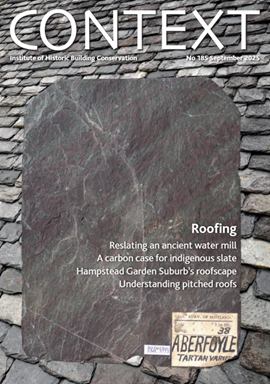
Articles range from slate to pitched roofs, and carbon impact to solar generation to roofscapes
Three reasons not to demolish Edinburgh’s Argyle House

Should 'Edinburgh's ugliest building' be saved?
IHBC’s 2025 Parliamentary Briefing...from Crafts in Crisis to Rubbish Retrofit
IHBC launches research-led ‘5 Commitments to Help Heritage Skills in Conservation’
How RDSAP 10.2 impacts EPC assessments in traditional buildings

Energy performance certificates (EPCs) tell us how energy efficient our buildings are, but the way these certificates are generated has changed.