





Future Homes Standard Essentials launched

Contents |
[edit] New standard new campaign
On 4 March, 2026 the Future Homes Hub announced the launch of a new campaign to help the homebuilding sector prepare for the implementation of new building standards, calling on builders of all shapes and sizes to start their journey towards Future Homes Standard compliance.
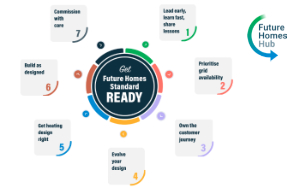
Based on real-world experience, the ‘Future Homes Standard Essentials’ set out seven critical actions to help homebuilders and their advisors to de-risk the delivery of more sustainable homes that are comfortable, healthy, low-energy, zero carbon ready and aligned with the future energy system.
Future Homes Hub says the Future Homes Standard (FHS) represents a fundamental shift in home building, creating a clear performance distinction between new builds and the existing housing stock. Central to the FHS is the move away from fossil-fuel boilers to low carbon heating systems, often in the form of heat pumps where the lower temperatures require high levels of construction and heating system precision to deliver the required level of performance.
Get Future Homes Standard Ready "Homes built to the FHS will be comfortable, healthy, low-energy, and zero-carbon ready - without the need for expensive retrofit. However, the transition to FHS could carry real delivery and reputational risks if not carefully managed.A range of homebuilders are already successfully delivering homes that include low‑temperature heating and other FHS technologies, but others are only just beginning. The FHS Essentials set out seven key practical actions drawn from early adopters. Following these will help homebuilders deliver consistent performance, strengthen the customer experience and reduce risk. This is a moment of true transformation."
[edit] A step change for the sector
The Future Homes Standard represents a fundamental shift in how new homes are designed, built, commissioned and supported. Central to the FHS is the move away from fossil-fuel boilers to low carbon heating systems, often in the form of heat pumps where the lower temperatures require high levels of construction and heating system precision to deliver the required level of performance. The Future Homes Standard Essentials describes seven key actions to de-risk delivery:
|
|
[edit] Partnering with the SME community
Small and medium-sized enterprise (SME) homebuilders are considered vital to achieving the UK government’s target of 1.5 million new homes and are a primary focus for the campaign, which is releasing new guidance on topics including grid connections and the customer journey through to heating design and procurement.
The guidance includes:
- Grid connections for all-electric houses - hints and tips for SME homebuilders
- Heating system procurement - hints and tips for procuring heat pumps in low density homes
- Delivering homes with heat pumps - hints and tips for successful deployment
- Heat pumps - hints and tips for site managers
- Heat pump commissioning - hints and tips for homebuilders
- Selling a new low energy home - hints and tips for sales negotiators and estate agents
For more info see https://www.futurehomes.org.uk/future-homes-standard-ready
[edit] Comments
Ed Lockhart, CEO of the Future Homes Hub, said:
"The introduction of the Future Homes Standard is a transformational moment for the sector and for the residents of new homes. We know that some homebuilders have already started to build with the technologies and approaches that will be mandatory under the new Standard. But it’s only by working together and sharing information that we'll avoid the risks of the switchover and ensure new homes built to higher standards consistently perform better.”
Charlotte Lee, Chief Executive of HPA UK and Chair of the Future Homes Hub Heat Pump Development Group said:
“Following the introduction of the 2021 Part L Building Regulations, there has been clear progress in reducing gas grid connections, with around 25% of UK new-build completions in 2025 installing a heat pump, up from 15% in 2024. The forthcoming Future Homes Standard will go further, effectively prohibiting new homes from connecting to the gas grid and driving a significant increase in heat pump adoption. Heat pumps are a proven, scalable, low-carbon alternative to fossil fuel boilers. However, their successful deployment requires sector-specific skills, careful design, and informed use. The FHH Essentials provide a timely and welcome intervention, helping homebuilders to de-risk delivery, optimise performance and maintain high levels of customer satisfaction at scale by drawing on lessons learnt from early adopters and pilot projects.”
Chair of the Future Homes Hub’s SME Liaison Group and Managing Director of Hampshire-based housebuilder Bargate, Mark White, said: "What's critical for us as a community of SMEs is to listen to the advice that's out there and gather information from the experts - whether that's organisations like the Future Homes Hub or from the suppliers and installers themselves. We've got to accept that this is a partnership. We're all on the journey together - and the end result will be beautiful homes for our customers.”
Usman Yaqub PCIAT, President of the Chartered Institute of Architectural Technologists, said:
"As experts in technical design and project management, Chartered Architectural Technologists know that even seemingly small changes can have significant impacts across an entire project, from building performance to delivery timelines and costs. That's why it is so important that professionals start preparing for the Future Homes Standard now. The FHS Essentials will help the whole sector get ready for these new requirements, so that we seize the opportunity of the Future Homes Standard to deliver the high-quality, healthy, and sustainable homes our communities need. Let's get #FHSReady."
This article is based on the Futurte Humes Hub news item "Get Future Homes Standard Ready: UK new homes sector unites on mission to deliver next generation of low energy homes", "Get Future Homes Standard Ready" as well as CIAT news item "Future Homes Standard Essentials launched" all dated 4 March 2026.
[edit] Related articles on Designing buildings
- Air permeability testing.
- Air tightness.
- Applying Fabric First principles: Complying with UK energy efficiency requirements FB 80.
- Approved building energy calculation software.
- Approved documents.
- Building Regulations.
- Building Research Establishment.
- Changes in SAP 10.
- Co-heating test.
- Conventions for U-value calculations (2006 edition) BR 443.
- Dynamic Simulation Model.
- Emission rates.
- Energy efficiency of traditional buildings.
- Energy Performance Certificates.
- Energy Performance of Buildings Directive.
- IHBC responds to Energy Company Obligation ECO4 and PAS 2035.
- National Calculation Method.
- Passivhaus vs SAP.
- Standard Assessment Procedure SAP.
- Simplified Building Energy Model.
- Target fabric energy efficiency rate.
- The Home Energy model and its wrappers.
- Thermal dynamic analysis.
- U-value conventions in practice: Worked examples using BR 443.
- Future Homes Standard, solar and potential shortfalls.
Featured articles and news

We're expanding our collaborative mission by launching DB Intelligence, an exclusive market research advisory panel. Built environment professionals can now get paid to share their expertise on industry trends, products and services.
Panel members receive direct financial incentives for participating in research projects like short surveys, 1-2-1 interviews and focus groups. Register today to shape the future of the construction sector.
Building Control Independent Panel final report
A precis of a key report led by Dame Hackitt with full recommendations and link to the government response.
Guide to ISO 19650 for Architecture Firms (2026)
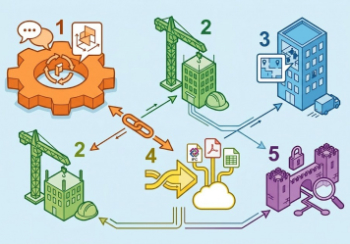
A user gives their low down.

A UK training and membership provider for mould remediation professionals.
Building Safety recap April, 2026
A short and longer run-through of the month, with links to further information and sources.
CIAT May 2026 briefing.
Independent NSI and BAFE study exploring how organisations are changing the way they buy fire safety services.

From medieval scribes to modern word art.
ECA welcomes crackdown on late payment and push for clean energy, whilst CIOB seek fixed cladding removal timeframes.
Cyber Security in the Built Environment
Protecting projects, data, and digital assets: A CIOB Academy TIS.
Managing competence in the built environment

ITFG publishes new industry guide on how to meet the ICC principles.

The UK's campaign to reduce noise pollution: Mythbusting, articles and topic guides.