





Future Homes Standard, solar and potential shortfalls

Contents |
[edit] FHS, HEM and solar
The Future Homes Standard (FHS) is a planned obligatory standard for all new homes that aims to reduce carbon emissions by 75–80% compared to current UK regulation requirements. Intended to come into force in 2025, it will introduce a new way of calculating how the standard is met, using the new Home Energy Model (HEM) with a component called the FHS wrapper for domestic buildings. However, the government recently announced that at least initially both SAP 10.3 and the HEM with the wrapper may be used to assess compliance.
A key element of the new standard will be to prevent new buildings from having gas boilers, with only low- or zero-carbon heating systems being allowed - the majority of which are likely to be heat pumps. The Government announced in July 2025 that a change to the standard will mean that all new homes will also be required to include solar (subject to practical limits in terms of trees or excessive shading).
The Future Homes and Buildings Standards were initially announced in 2019, with an associated consultation, and again in 2023 specifically a consultation on changes to Part 6, Part L (conservation of fuel and power) and Part F (ventilation) of the Building Regulations for dwellings and non-domestic buildings and seeking evidence on previous changes to Part O (overheating) in effect forming what will be the Future Homes and Buildings Standards.
[edit] Will the requirements go far enough ?
By going fully electric, the standard talks about being "zero carbon ready", which means that with some energy produced on site (by solar), the rest (or most) of the buildings' electricity use would become zero carbon when the national electricity grid is fully de-carbonised. In September 2024, the Microgeneration Certification Scheme (MCS) published its report."Future Homes Savings: Modelling the running costs of new homes with renewables", which looked into the cost benefits of adding the requirements for solar.
Other aspects required to meet the standard include improvements in the fabric of buildings, such as walls and window performance (U values), improved air tightness and so on. However, prior to the publication of the consultation in May 2022, some argued that whilst there were improvements in fabric requirements, they were not significantly more than is currently required by the building regulations. Dr Sarah Price and Tim Wilcockson of QODA Consulting presented an AECB webinar on an overview of the Part L updates and a quick look at the Future Homes Standard in 2025, comparing FHS, Passivhaus, the AECB standard and Part L 2021. (see below slides can be downloaded here)
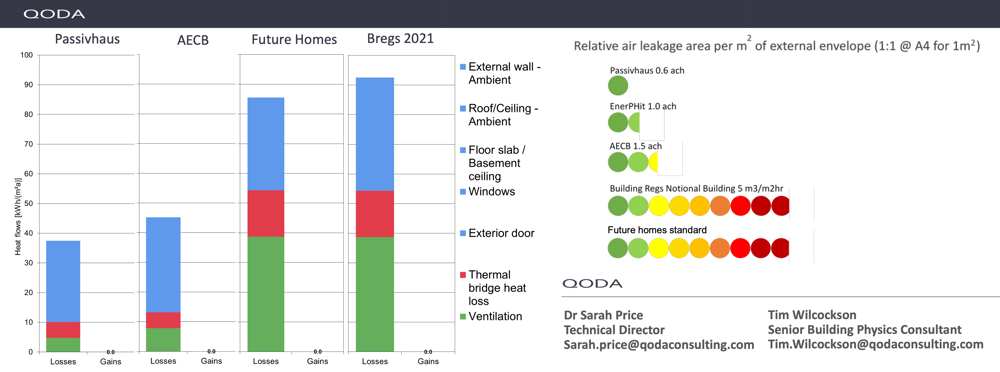
The criticism at the time was in the consideration that has been given to thermal bridging, air tightness and ventilation, where many advocate for Mechanical Ventilation Heat Recovery (MVHR); the new standard remains a naturally ventilated solution. The graph above highlights these discrepancies, where the blue losses show relatively similar amounts, whilst the red and green sections representing thermal bridging and ventilation are more than double in Part L and the FHS compared to Passivhaus or the AECB standard. The diagram to the right highlights the considerable difference in the air tightness requirements between the two sets of standards.
Following an initial letter on 17 October 2024, a group of the authors (Bioregional, Good Homes Alliance, LETI, and UKGBC) met with Baroness Taylor, Parliamentary Under-Secretary of State at MHCLG, to discuss concerns they had with the proposed options and the FHS. Following this meeting, the coalition sent a follow up letter clarifying key points and asking for a formal response. Some of these points included the need to regulate embodied carbon in new buildings, improve the fabric standards for U values and air tightness, improve new home ventilation systems and reduce the electricity generation investment required.
In March 2025 the UK Passivhaus Trust published "Passivhaus compared to the proposed FHS 2025: PHT Position Paper", which highlights similar points regarding fabric performance. The Trust also published a position paper suggesting "Passivhaus as an alternative means of compliance to the FHS". The introduction of mandatory solar for the FHS in June suggests that revisions are likely to be made to the requirements of the FHS before it becomes mandatory in the Autumn, what is not clear is exactly what these revisions will be.
[edit] Calculation methods
It seems the FHS may continue to allow the use of both SAP 10.3 and HEM with the wrapper. The assumptions that will be made by wrappers, in order to assess if the standard is met represent a variety of data input sets which might include factors such as occupancy patterns, local weather, building standards and potentially white goods, airtightness, and ventilation. The idea being that the HEM is more sophisticated than previous tools such as SAP, being more detailed and flexible enough for a range of buildings, whilst the wrapper helps to simplify the process so it can be applied more widely.
The Future Buildings Standard (FBS) will on the other hand will most likely continue to use a combination of different energy performance modelling tools; such as Dynamic Simulation Models (DSMs) and the most recent update of Simplified Building Energy Model (SBEM). The current version is iSBEM_v6.1.e, and it can be used for assessing compliance with 2021 ADL V2 in England and generating EPCs.
In terms of existing residential buildings, in February 2024, BRE released the specification for RdSAP10, which offers a more detailed and accurate assessment of energy performance in existing dwellings. RdSAP10 aligns more closely with the full SAP method used for new builds by expanding reduced data into a full dataset before running the calculation. This updated version is now part of the SAP 10.2 specification and helps enhance the accuracy of EPCs for existing homes, but this currently remains separate from the FHS. In the case of existing buildings the standards are being raised by slowly requiring all existing buildings to achieve an EPC performance rating of C rather than use the FHS.
[edit] Related articles on Designing Buildings
- BRE Group response to the Future Homes Standard consultation.
- BRE response to the green housing revolution.
- Building Beautiful Places plan.
- Building Better, Building Beautiful Commission interim report.
- Building Better, Building Beautiful Commission.
- Changes to Building Regulations Part F.
- Consortium issues urgent call for more ambitious Future Homes Standard.
- EPC changes for existing buildings.
- Getting zero carbon done.
- Future Buildings Standard.
- Future Buildings Standard shortcomings raised.
- Future Homes Standard consultations.
- Green Housing Revolution.
- Home design prospects under the Future Homes Standard.
- Home Energy Model.
- Hybrid heat pump electric panel heating.
- Is hydrogen the heating fuel of the future?
- National Design Guide.
- Pilot programme for National Model Design Code NMDC.
- The effects of subframe systems on the overall thermal performance of external rainscreen walls.
- The EPC consultation in the context of changes to the NCM.
- The Home Energy Model and Future Homes Standard assessment wrapper.
- Thermal bridging and the Future Homes Standard.
Featured articles
Check out some of the best features and news from Designing Buildings as well as key stories from around the web.

CIAT confirm the winners of the 2026 architectural technology awards.

Government launches a one stop shop for flood preparedness.

Sir Edwin Lutyens: Britain's greatest architect? Book review.

CIOB publishes free template to help assess and manage risks.
ECA's reflections on Party Conference season

Burnham wants to be confident of winning before asking for a fresh mandate.
New Chief Construction and Scientific Adviser

Sergio Cavalaro, Professor of Infrastructure Systems at Loughborough University.
Building safety levy for England

CIAT publish estimator tool for members.

Water sector faces a growing crisis that could slow the delivery of vital infrastructure.
Undervaluing our industrial past

Heritage value changes as taste for building styles changes.
Changing expectations around competence and compliance

New information sheet from CIAT.
Grenfell investigation files passed to CPS

Angela Rayner apologises on behalf of the British state.

Electrical contractors need to understand the practical implications.
Comments
Add your comments here.