





Service provider
A service provider in the general sense is a vendor who supplies services, rather than actual products. In recent years, the term has been applied largely to companies in the fields of communications and technology, such as Internet service providers (ISPs), however, with the rise of servitisation, almost anything can now be supplied as a service.
The distinction between services and products can be quite blurred: there are few pure services and few pure products. Tradiationally, service providers typically provide activities which are of an intangible nature (such as consulting, legal and processing) and which are supplied as a direct consequence of a contract that exists between the service provider and the customer.
Such companies usually provide their services to customers on a subscription basis – say 12-, 18- or 24-month contracts. Mobile-phone companies may also be included in this category but in addition to providing the service of access to a mobile phone network, they generally also supply products – mobile phones.
Some firms, such as banks and insurance brokers, also provide a service but are not generally thought of as service providers.
Other types of service provider include:
- Providers of building maintenance contracts
- Data storage
- Security solutions providers
- Storage providers
- Cleaning services
- Gardening services
- Pest control
Recently, there has been an increase in the provision of products as a 'service' such as 'software as a service', as well as cars, computers, lighting and so on. Buildings and infrastructure can also be provided as a service, as in the case of the Private Finance Initiative.
NB RICS property measurement, 2nd edition, published by the Royal Institution of Chartered Surveyors (RICS) in January 2018, defines a Service Provider as: ‘Any entity providing real estate advice to a User or Third Party including, but not limited to, Valuers, surveyors, facility managers, property managers, asset managers, agents and brokers, Space Measurement Professionals, cost consultants, interior designers and architects.’
ICMS: Global Consistency in Presenting Construction Life Cycle Costs and Carbon Emissions, 3rd edition, November 2021, published by the ICMS (International Cost Management Standard) Coalition, defines a service provider as: ‘Any organisation or individual providing advice or a service to a Client at any point in a Project’s life including, but not limited to, project managers, architects, engineers, technical architects or engineers, surveyors, cost management and environmental professionals, constructors, facilities managers, planners, valuers, property managers, asset managers, agents and brokers.’
[edit] Related articles on Designing Buildings
Featured articles and news

We're expanding our collaborative mission by launching DB Intelligence, an exclusive market research advisory panel. Built environment professionals can now get paid to share their expertise on industry trends, products and services.
Panel members receive direct financial incentives for participating in research projects like short surveys, 1-2-1 interviews and focus groups. Register today to shape the future of the construction sector.
Building Control Independent Panel final report
A precis of a key report led by Dame Hackitt with full recommendations and link to the government response.
Guide to ISO 19650 for Architecture Firms (2026)
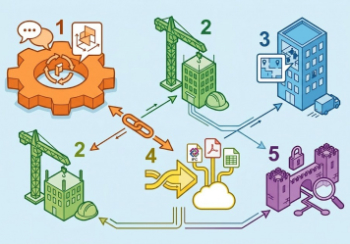
A user gives their low down.

A UK training and membership provider for mould remediation professionals.
Building Safety recap April, 2026

A short and longer run-through of the month, with links to further information and sources.

CIAT May 2026 briefing.

Independent NSI and BAFE study exploring how organisations are changing the way they buy fire safety services.

From medieval scribes to modern word art.

ECA welcomes crackdown on late payment and push for clean energy, whilst CIOB seek fixed cladding removal timeframes.
Cyber Security in the Built Environment

Protecting projects, data, and digital assets: A CIOB Academy TIS.
Managing competence in the built environment
ITFG publishes new industry guide on how to meet the ICC principles.

The UK's campaign to reduce noise pollution: Mythbusting, articles and topic guides.
Comments
[edit] To make a comment about this article, or to suggest changes, click 'Add a comment' above. Separate your comments from any existing comments by inserting a horizontal line.