





Reichstag building

Contents |
[edit] Introduction
The Reichstag building is one of the most important historic buildings in Berlin, Germany, and one of its most popular tourist attractions. It serves as the meeting place of the German parliament, the Bundestag.
Construction of the original building was completed in 1894 and housed the Imperial Diet until 1933. In 1933, the building was set on fire in what was reported to be an arson attack by a Dutch communist, although many believe that it was orchestrated by the Nazis as a ‘false flag operation’, to enable Adolf Hitler to step up his state security operations and crack down on civil liberties.
During the Second World War, the Reichstag was badly damaged and it then fell into disuse. A partial refurbishment took place in the 1960s, but it was only after German reunification in 1990 that a full-scale reconstruction was proposed and eventually got underway, led by the British architect Norman Foster. It was completed in 1999, when it resumed its role as the meeting place of the Bundestag.
[edit] Design and construction
Prior to the 1871 unification of Germany, parliament had assembled in various smaller buildings around Berlin. An architectural competition for a single building was held in 1872. The site that was chosen was already occupied by the Raczynski Palace, owned by a Polish-Prussian aristocrat, who refused to sell his land. It wasn’t until 10 years later that the site was purchased and the palace demolished.
Another design competition was held in 1882, and was won by the architect Paul Wallot, who proposed a Neo-Baroque building adorned with decorative sculptures, reliefs, and inscriptions by the sculptor Otto Lessing. Construction took place between 1892 and 1894, and included a cupola of steel and glass that was heralded as a major engineering accomplishment, while the building as a whole drew criticism for its mixture of architectural styles.
[edit] Post-WWII
The building was badly damaged by the fire of 1933 and subsequent bombing attacks during the Second World War. It became one of the central targets for the Russian Red Army during the Battle of Berlin in 1945. One of history’s most famous photographs ‘Raising a flag over the Reichstag’ was taken on the building’s roof on 2nd May 1945, symbolising the Russian victory over Germany.

After the war there were calls to demolish the building, and indeed the cupola was; however, a decision was made to try and restore the rest of the building. Paul Baumgarten won a design competition with plans involving the retention of only the outer walls, with a plain building inside that was stripped of all heraldic statues, monuments, and decorations that were representative of German mythology.
Reconstruction took place between 1961 and 1964.
[edit] Norman Foster reconstruction

After the reunification of Germany in 1990, a decision was made to undertake a drastic reconstruction of the building. In 1992, an architectural competition was won by Norman Foster with a design comprising a steel-and-glass canopy that would have covered the original structure ‘like an enormous table’. However, as budget realities began to set in, Foster was forced to reduce the scale and ambition of his design, reverting instead to a large glass dome.
Before reconstruction work began, in 1995, the Reichstag was ‘wrapped’ by the artist Christo as an art piece that attracted millions of visitors.
The building was completely gutted, with everything being removed, including all of Baumgarten’s changes, other than the outer walls which were left intact. Traces of graffiti left by Soviet soldiers in 1945 were carefully retained. Foster’s design consolidated the functional spaces of the parliament back into a single building.
The clear glass dome includes a helical ramp around its outer edges leading to a public observation deck with a 360-degree view of the city. Skylights at the base of the cupola open into the parliamentary debating chamber directly below, allowing natural light in by way of an inverted cone of mirrored panels. This blocks direct sunlight which would cause solar gain and glare, and enables natural ventilation, exhausting hot air through the top of the cupola.
The reconstruction project was completed in 1999, with the Bundestag convening there for the first time in April of that year.
[edit] Find out more
[edit] Related articles on Designing Buildings Wiki
Featured articles and news

We're expanding our collaborative mission by launching DB Intelligence, an exclusive market research advisory panel. Built environment professionals can now get paid to share their expertise on industry trends, products and services.
Panel members receive direct financial incentives for participating in research projects like short surveys, 1-2-1 interviews and focus groups. Register today to shape the future of the construction sector.
Planning condition discharge in England and Wales

A brief exoplanation from a building compliance expert, with further links.
Overheating guidance and tools for building designers

Guidance for dealing with element of building fabric control that have increasing importance.
Shading for housing, a design guide

From the Good Homes Alliance and British Blind and Shutter Association.
UK Standard Skills Classification (SSC)

A shared framework for describing skills needs.
Social media ban consultation comes to close

CIOB urges UK Government to consider social media’s role in careers guidance in ban debate.
The latest of eight Skills England apprenticeship units

The addition of battery manufacturing welcomed by ECA with a warning about the risks of fast-tracked apprenticeship units.
Building Control Independent Panel final report
A precis of a key report led by Dame Hackitt with full recommendations and link to the government response.
Guide to ISO 19650 for Architecture Firms (2026)
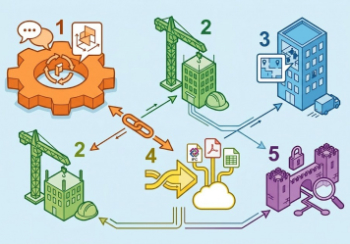
A user gives their low down.

A UK training and membership provider for mould remediation professionals.
Building Safety recap April, 2026
A short and longer run-through of the month, with links to further information and sources.
CIAT May 2026 briefing.

Independent NSI and BAFE study exploring how organisations are changing the way they buy fire safety services.
From medieval scribes to modern word art.

ECA welcomes crackdown on late payment and push for clean energy, whilst CIOB seek fixed cladding removal timeframes.
Cyber Security in the Built Environment

Protecting projects, data, and digital assets: A CIOB Academy TIS.
Managing competence in the built environment
ITFG publishes new industry guide on how to meet the ICC principles.

The UK's campaign to reduce noise pollution: Mythbusting, articles and topic guides.