




Palace of Westminster

Contents |
[edit] Introduction
The Palace of Westminster, more commonly referred to as the Houses of Parliament, is the symbolic centre of political power in the United Kingdom and is one of the most recognisable and iconic buildings in the world.
The building, on the northern bank of the River Thames in London, incorporates the House of Commons and the House of Lords which together act as the UK's Parliament. It was designed according to the Gothic tradition by the architect Charles Barry together with Augustus Pugin, was constructed between 1840 and 1870. Perhaps its most iconic feature is the Elizabeth Tower, more famously known by the name of its bell, Big Ben.
The Palace of Westminster is a Grade I listed building and Westminster Abbey and St Margaret's Church, have formed part of a UNESCO World Heritage Site since 1987.
[edit] History
[edit] Middle Ages
The site on the northern bank of the Thames, originally known as Thorney Island, was the location of ecclesiastical buildings and royal power from the Middle Ages onwards. The first palace was constructed on the site in the tenth century, followed by the nearby Westminster Abbey, overseen by the newly crowned Edward the Confessor. The original Great Hall, still the largest in Europe, was built under the reign ofWilliam II andcompleted in 1099.
With the ceremonial focus beginning to shift to Westminster and away from the Anglo-Saxon capital of Winchester, the Model Parliament first met at the palace in 1295.
[edit] Medieval period
In the late medieval period, the Palace served as the monarch's primary place of residence ensuring its status as the centre of government and royal authority, and a new range of buildings and courts were constructed. However, a fire in 1512 destroyed the residential area of the palace, forcing King Henry VIII to move elsewhere.
During the 16th and 17th centuries, the Chapel of St. Stephen's became home to the Commons Chamber where parliamentarians engaged in rigorous debate.
[edit] Gunpowder Plot
The palace narrowly avoided being the target of an assassination attempt on 5 November 1605, as a group of provincial English Catholics sought to blow up the House of Lords during the State Opening of Parliament. After an anonymous letter alerted the authorities, Guy Fawkes was discovered hiding in the Lords guarding several barrels of gunpowder. This thwarting of the plot has now evolved into the traditional annual celebrations of Bonfire Night.
[edit] 18th century
There were calls for Parliament to move to a different location due to the Palace's increasing unsuitability. However, these calls were resisted and further construction work was undertaken to alter and enlarge the palace.
[edit] 19th century
Between 1824 and 1827, Sir John Soane undertook substantial remodeling works, including new library facilities and new law courts.
On 16 October 1834, a fire spread through the entire palace causing substantial damage, although Westminster Hall escaped.
Several different designs were proposed for a replacement building, but the Royal Commission selected Charles Barry's Perpendicular Gothic plan. It was thought that the Gothic revival design embodied traditional conservative values. An expert on the Gothic style, Augustus Pugin was brought in to assist with the detailing and other features such as the vanes and spires. The new Lords Chamber was completed in 1847, the Commons Chamber in 1852, and full construction completed in 1870.
[edit] 20th century - present
During the Blitz of the Second World War, the Palace was struck by bombs on 14 separate occasions, causing serious damage to the House of Commons. After the war, the Commons was redesigned, with construction works being completed in 1950.
Today, the Palace is one of the busiest Parliaments in the world, with more than a million people visiting each year.
The current palace building contains more than 1,100 rooms, 100 staircases and 3 miles (4.8 km) of passageways. The main rooms include:
- Norman Porch: The grand entrance to the Palace.
- Queen's Robing Room: Where the sovereign prepares for the State Opening of Parliament.
- Royal Gallery: The stage for the royal procession at State Openings of Parliament.
- House of Lords: The red-benched chamber which the Lords occupy.
- Central lobby: The heart of the palace, halfway between the two debating chambers.
- House of Commons: The green-benched chamber which the MPs occupy.Westminster Hall: The oldest existing part of the Palace, used traditionally for ceremonial purposes.

[edit] Renovation
For many years, the Palace has been in need of serious renovation and restoration works, in particular to the external fabric of the building. A major programme of repair and conservation is intended to start during the 2020 Parliament.
In 2015, an Independent Options Appraisal Report found that the restoration costs could be as high as £7.1 billion should MPs and peers remain in the buildings whilst work is ongoing. Alternatively, the business of government could be temporarily relocated, for which a cost of £3.5 billion has been estimated.
On 30 November 2015, the Joint Committee on the Palace of Westminster, co-chaired by the Leader of the House of Commons and the Leader of the House of Lords, launched a consultation on the restoration and renewal of the building.
On 31 January 2018, MPs narrowly voted in favour of vacating the Palace during the course of its renovation. The vote passed by 236 to 220 in favour of the full decant option, with those in favour citing the escalated costs if MPs were to remain, and those against raising fears that tradition would be lost if the business of the Palace were moved elsewhere.
The issue progressed to the House of Lords where the peers followed the Commons’ lead in voting for the full temporary decant.
[edit] Timeline of events
- 2026: Delivering restoration and renewal of the Palace of Westminster: the costed proposals published.
- 2025: R&R focus on critical, preparatory works, deep-ground investigations and structural assessments.
- 2024: R&R to develop three options to present in 2025, as surveying, design and remediation work progresses.
- 2023: A new two-tier governance structure (Client Board and Program Board) was established, with the Programme Board meeting for the first time in February 2023.
- 2022: Review completed and restructuring announced to replace the initial sponsor governing body.
- 2021: R&R focus on planning and assessments, safety risks, including fire hazards, asbestos, and failing infrastructure, with ongoing debates on the strategy carried out in both Houses during the year.
- 2020: National Audit Office reports and Public Accounts Committee review project.
- 2019: The Parliamentary Buildings (Restoration and Renewal) Act 2019 received Royal Assent.
- 2018: Major restoration of the Elizabeth Tower (Big Ben).
- 2017: Parliament decides in principle to proceed with a full restoration.
- 2016: Joint Committee report recommended a full decant
- 2015: Independent Options Appraisal published.
- 2013: Initial establishment of the Restoration and Renewal (R&R) programme.
- 2000 - Portcullis House completed. The new Parliamentary building was completed by M. Hopkins.
- 1990 - 1994: Restoration of the Victoria Tower, the tallest tower in the Palace.
- 1982 - 1990: Stone cleaning and restoration of north, west, south and River fronts.
- 1981 - 1982: Major stone cleaning and restoration programme starts with New Palace Yard.
- 1971 - Working group set up to offer advice on restoration as pollution taking its toll
- 1951 - The House of Lords returns to its Chamber.
- 1950 - The new Commons Chamber first used.
- 1948 - Foundation stone of new Commons Chamber laid.
- 1943 - Architect Sir Giles Gilbert Scott appointed for rebuild of chamber designed on similar lines to the old.
- 1941 - 1950: Rebuilding of the Commons Chamber following destruction in the Blitz.
- 1941 - The Commons Chamber destroyed on the last day of the Blitz
- 1936 - Scaffold for restoration of Victoria Tower, halted during the Second World War
- 1920 - Large fragment of stone falls from the Victoria Tower
- 1912 - Electric lighting installed in the House of Commons.
- 1883 - Electric lighting installed in the House of Lords.
- 1870 - The rebuilding of the Palace completed.
- 1860 - Victoria Tower completed.
- 1859 - Big Ben installed in the Clock Tower.
- 1852 - The Common's Chamber completed.
- 1849 - Defects in the choice of stone became apparent, experiments with various compositions on stone
- 1847 - The Lord's Chamber completed
- 1840–1870: Construction of the current Palace by Charles Barry after the 1834 fire.
- 1834 - The Great Fire destroys most of Palace.
- 1097 - Westminster Hall built under William II (Rufus), the oldest part of the current Palace.
- 1016 - Original structure a royal residence on Thorney Island.
[edit] Related articles on Designing Buildings
- 10 Downing Street.
- 2020 IHBC Gus Astley Student Awards.
- Big Ben.
- City Hall, London.
- Demolishing Whitehall.
- Enhanced Maintenance and Improvement EMI.
- Gothic revival style.
- Machicolation.
- Monument and context.
- Mr Barry's War.
- Nineteenth century building types.
- Oxford Movement.
- Parliamentary procedure.
- Redesigning parliament to help end the Brexit deadlock.
- Restoring the Palace of Westminster's ventilation system.
- Scottish Parliament Building.
- St Pauls Cathedral.
- Strawberry Hill House.
- The Story of Kensington Palace.
- US Capitol Building.
[edit] External references
- Parliament UK
- Londontopia
- Joint Committee - Restoration works consultation
IHBC NewsBlog
IHBC sponsors Gardens Trust event 23-4 Sept 2026
.jpeg)
'Learning from the Past, Shaping the Future’ takes place in Milton Keynes
Renovations to Frank Lloyd Wright's Fallingwater complete
.jpg)
World Heritage Preserved project opens house for tours again
Shakespeare Birthplace Trust places Hall's Croft on HAR Register
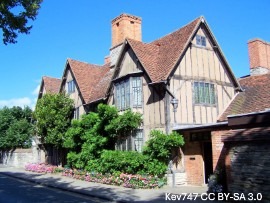
Stratford-upon-Avon home of Shakespeare's daughter is 'At Risk'
Lady Grange’s House repaired on St Kilda
.jpg)
National Trust for Scotland repairs stone cleit with link to famous island resident
Griff Rhys Jones on BBC Radio 4 Today programme
,_Green_Lane,_Derby.jpg)
The Victorian Society’s President unveiled its latest Top Ten Endangered Buildings 2026.
Need a MATE? Book your place now.

IHBC offers free webinars on applying for IHBC accreditation (Full & Associate).
UK Stained Glass Repository finds windows new homes
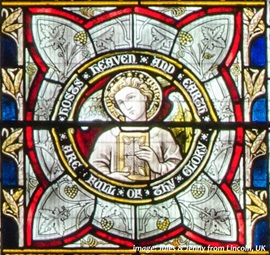
How are stained glass windows are rescued, stored and repurposed?
APPGEBE report sets high aims for quality
'Government must not sacrifice quality in drive to build 1.5m homes'
New measures protect Historic Shipwrecks from heritage crime

Underwater cultural heritage benefits from new HE guidance
How could the City of London skyline look in 6 years' time?

Visualisation shows approved planning applications as completed buildings
National Trust for Scotland calls for VAT cuts
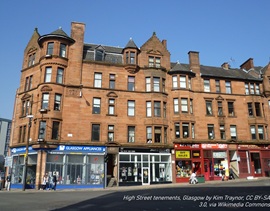
Heritage neglect is encouraged by current policies
IHBC's 'Context' Issue 186 features Industrial Heritage
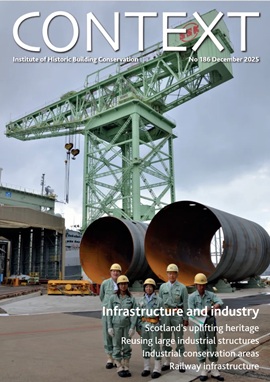
IHBC's members' journal reports on the challenges of conserving infrastructure
Book now for IHBC Annual School 2026
IHBC Annual School is taking place 18-20 June 2026 in Newcastle
RICHeS Research Infrastructure offers ‘Full Access Fund Call’
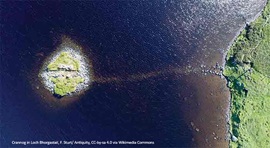
RICHeS offers a ‘Help’ webinar on 11 March
Latest IHBC Issue of Context features Roofing
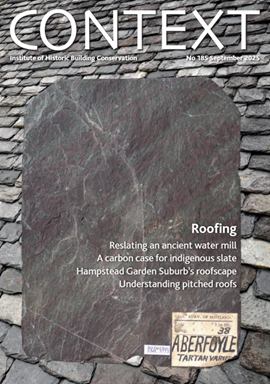
Articles range from slate to pitched roofs, and carbon impact to solar generation to roofscapes
Three reasons not to demolish Edinburgh’s Argyle House

Should 'Edinburgh's ugliest building' be saved?
IHBC’s 2025 Parliamentary Briefing...from Crafts in Crisis to Rubbish Retrofit
IHBC launches research-led ‘5 Commitments to Help Heritage Skills in Conservation’
How RDSAP 10.2 impacts EPC assessments in traditional buildings

Energy performance certificates (EPCs) tell us how energy efficient our buildings are, but the way these certificates are generated has changed.
Comments
[edit] To make a comment about this article, click 'Add a comment' above. Separate your comments from any existing comments by inserting a horizontal line.
William II was the 3rd son of William I not Edward the confessor
Corrected. Thanks!
This is a wiki site - so if you are unhappy with something, just click 'Edit this article' at the top of the page and change it.