





Design and build: mobilisation

Mobilisation refers to the activities carried out after the client has selected the contractor, but before the contractor commences work on site. It is a preparatory stage during which the majority of activities are managed by the contractor.
We attribute the role of contract administrator to an 'employer's agent'. This role might be carried out by the client if they are experienced.
[edit] Preparing for the construction stage.
The employer's agent arranges a pre-contract meeting to discuss procedures that will be adopted during the construction stage.
There are a range of tasks necessary to prepare for the construction stage:
- The client and contractor prepare and agree schedules of conditions for adjacent property or structures to be retained.
- The client and contractor check that all necessary insurance, permissions, approvals, party wall agreements and other statutory requirements are in place and that all necessary planning conditions have been satisfied.
- If necessary, and if it has not already been done, party wall surveyors should be appointed.
- The client appoints an in-house or outsourced engineering team to witness testing and commissioning and to take over the running of the services as soon as practical completion is certified.
- The client may need to appoint additional independent client advisers (such as site inspectors) in particular if the consultant team has been novated or switched to the contractor.
- If appointed, the client briefs the site inspectors regarding procedures for inspecting and reporting on work on site as it progresses.
- The contractor may wish to bring key dates to the attention of the client (for example dates for works outside of the contract). The contractor may be required by the employer's requirements to produce a construction programme, but this is not typically a requirement of design and build contracts themselves. The client should not approve any programmes as approval might be considered to relieve the contractor of liability for programming the works in such a way as to achieve the completion date.
- The principal designer ensures that co-ordination procedures are in place for any further design carried out by the contractor, specialist contractors or specialist designers.
- The client may need to put procedures in place to move some of its staff and equipment so that it can continue to operate effectively during construction.
- The contractor agrees the basic principles with the design team to be used for grid lines and setting out of the site.
[edit] Mobilising.
Mobilising may involve the contractor carrying out the following tasks:
- Arranging for production information to be issued for construction.
- Co-ordinating the preparation and issue of a project handbook setting out responsibilities, procedures, and lines of communication for the construction stage.
- Preparing method statements and obtaining method statements from sub-contractors such as demolition and groundwork sub-contractors.
- Preparing a site layout plan for construction.
- Placing sub-contracts.
- Advertising and selecting catering, security and cleaning contracts as well as any direct labour requirements.
- Establishing a contract register scheduling: the contracts which have been placed, who signed them and when, what the value of the contract is and where it is stored. This can be crucial information if for example the contractor becomes insolvent.
- Establishing an asset register scheduling assets on site and who they belong to. This information may later be incorporated into the building owner's manual.
- Establishing all statutory site registers such as; lifting equipment, dangerous and explosive substance storage, scaffolding and accident reports.
- Managing specialist design and drawing approval. The contractor may wish to appoint a design co-ordinator to be responsible for this.
- Complying with any statutory conditions that must be satisfied prior to construction (such as tree protection, submission of contaminated soil disposal plans, approval of work adjacent to an operating rail track and so on).
- Ensuring (in their role as principal contractor) that workers are provided with suitable site induction, training and information to be able to work without undue risk to their health or safety.
- Establishing inspection regimes and quality assurance procedures for construction.
- Commissioning any further geotechnical survey work required.
- If it has not already been done, obtaining statutory utility drawings of all existing and surrounding services including details of any telecoms, wells and hydraulic mains.
- Arranging road closures and restrictions, diversions of services and connections necessary for the works to be carried out.
- If it has not already been done, obtaining legal documentation describing precisely the site boundary and ownership.
- Preparing (in their role as principal contractor) a construction phase plan, if this has not already been done.
- Developing the site waste management plan (if required).
- Commissioning a survey team to establish semi-permanent setting out theodolite base plates.
- Arranging for the statutory utilities to provide the necessary water, power supplies, and ICT services required for construction activities.
- Notifying the local authority (or approved inspector) of their intention to begin construction.
- Informing the emergency services of their intention to begin construction.
- Notifying the HSE if this has not already been done
Featured articles and news

We're expanding our collaborative mission by launching DB Intelligence, an exclusive market research advisory panel. Built environment professionals can now get paid to share their expertise on industry trends, products and services.
Panel members receive direct financial incentives for participating in research projects like short surveys, 1-2-1 interviews and focus groups. Register today to shape the future of the construction sector.
Planning condition discharge in England and Wales

A brief exoplanation from a building compliance expert, with further links.
Overheating guidance and tools for building designers

Guidance for dealing with element of building fabric control that have increasing importance.
Shading for housing, a design guide

From the Good Homes Alliance and British Blind and Shutter Association.
UK Standard Skills Classification (SSC)

A shared framework for describing skills needs.
Social media ban consultation comes to close

CIOB urges UK Government to consider social media’s role in careers guidance in ban debate.
The latest of eight Skills England apprenticeship units

The addition of battery manufacturing welcomed by ECA with a warning about the risks of fast-tracked apprenticeship units.
Building Control Independent Panel final report
A precis of a key report led by Dame Hackitt with full recommendations and link to the government response.
Building Safety recap April, 2026
A short and longer run-through of the month, with links to further information and sources.

CIAT May 2026 briefing.

From medieval scribes to modern word art.

ECA welcomes crackdown on late payment and push for clean energy, whilst CIOB seek fixed cladding removal timeframes.
Cyber Security in the Built Environment

Protecting projects, data, and digital assets: A CIOB Academy TIS.
Managing competence in the built environment
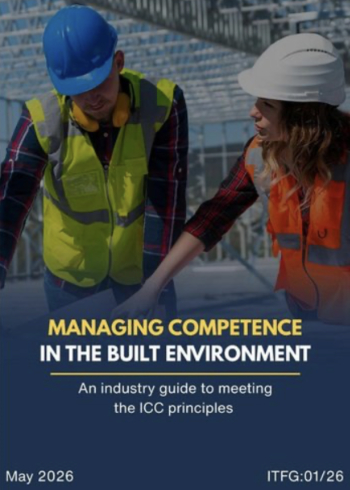
ITFG publishes new industry guide on how to meet the ICC principles.

The UK's campaign to reduce noise pollution: Mythbusting, articles and topic guides.
Comments
¡Good Morning! this article is amazing, thank you so much for share this information, sometimes we don´t pay attention to things that may sound basic, like design, mobilisation, inspection regimes and quality assurance, etc...but in the end they turn out to be very very important. So thank you again, is very useful to me this information. Happy Tuesday.