





A code of practice for slate and stone roofing

|
| Cleft oak laths (seen here) were traditionally used to hang hand-made tiles and stone slates. Much of the attraction of these roofs rests with the slight undulations of each course, which has much to do with the laths. Today, BS5534 stipulates that 50 mm x 25 mm sawn battens are used for safety reasons to take the weight of a roofer, unlike cleft lathes, apparently. (Photo: Chris Wood). |
Contents |
Introduction
Slate and stone roofs are often the most important part of a historic building. They may contain evidence of structures and detailing going back many centuries and are usually the least altered parts of a building. But much of the subtle detailing which gives them their attractive and unique character is being lost during works which comply with modern standards and recommendations. As a result, Historic England is intending to publish a Code of Practice for Slate and Stone Roofing which aims to provide best practice advice and guidance for repairing historic stone and slate roofs. The code will be supported by a more detailed technical advice note (TAN).
The need for a code of practice
Current standards and guidance documents are mainly written by the industry and intended for new works, and inevitably champion modern methods and materials. A number of important standards and codes include recommendations that are unnecessary and positively harm the significance of historic and traditional buildings. Many roofers who work on these buildings are not trained in the use of vernacular methods and detailing and have not even used traditional materials.
This is not a new problem. A decade ago, the author of this article suggested in the industry’s magazine Roofing Today that a new code providing advice for those working on historic roofs was needed. Vitriolic complaints were expected, but surprisingly the feedback was very positive as many contractors agreed with the idea.
The main British Standards are BS 5534 (Slating and tiling for pitched roofs and vertical cladding, Code of Practice 2018) and BS 8000-6 (covering workmanship), which tend to be followed by many specifiers and contractors who use the National Building Specification (NBS) by default. BS5534 contains a great deal of extremely useful advice and guidance, but it does acknowledge that it is written for modern buildings and may not be appropriate for old roofs. Slavish adherence to a British Standard is not a requisite for specifiers, provided they can show that other methods will ensure a satisfactory outcome. Historic buildings have the cardinal benefit of demonstrating effective longevity as a way of justifying ‘non-compliant’ traditional methods and materials.
Modern methods
BS 5534 generally discourages the use of mortar on roofs and now recommends dry fixing for ridges and hips, following failures of cement mortar used on new-build houses. Lime mortar has been used for centuries on slate and stone roofs and placed appropriately it provides good performance and longevity. It was applied judiciously with minimum exposure on ridges, hips and verges, unlike today where the common practice is to use a thick layer of mortar exposed to the elements. Lime mortar was essential in some regions where dabs of mortar were used to provide an even bed for the slate above and to provide additional support to strengthen the fixings for peg-hung slates. Lime mortar could be removed easily during the next re-roofing, which meant that stones, slate, ridges and the like could be re-used, unlike those bedded in cement mortar, which often cannot be detached without breakage.
The standard does contain a table showing mortar mixes using hydrated (used with cements) and hydraulic lime, but all mixes are proposed in proportions of 1:3. Nowadays, experienced traditional roofing contractors use a variety of mixes depending on their application. These tend to be more lime-rich, particularly if using a quicklime, which also can provide significant adhesion and therefore can be very beneficial against wind-lift.
In current standards, battens are recommended to be preservative-treated softwood with a minimum size of 50 mm x 25 mm for natural slates. This is to counter bounce in modern truss roofs and to allow roofers to safely stand on them. Historically, riven hardwood (usually oak) laths were used. While they were much thinner, because they are riven rather than sawn, they are sufficiently robust to cope adequately. Historic slate roofs use more closely spaced laths, compared to single-lap tiles, so any imposed shock loads (such as a slater falling on them) is spread over many laths, but the standard makes no distinction between the size of battens needed for triple-lapped slates, for example, or single-lapped tiles.
There are many other examples of modern recommendations being applied to historic roofs which are resulting in a continuing loss of vital vernacular detailing, much of it unrecorded.
The code of practice and technical advice note
To address these problems, Historic England has commissioned Terry Hughes and the author of this article to write a code of practice and technical advice note.
The code of practice seeks to encourage best practice for any works on stone and slate roofs. It is intended to provide concise recommendations on dealing with the conservation and repair of roofs, ranging from setting out the roof to repairing individual details such as the eaves, valleys and verges. Unusual and innovative roofs are also covered, such as curved slating and patent slating. All these are illustrated with sketches and images. Allowance is made for changes to existing or historic detailing if these are either not performing well, or the anticipated changes in climate (for example, increasing instances and severity of driving and deluge rain) may overwhelm the existing drainage details. The need to improve energy efficiency is also included. Heritage values and significance are explained, along with all the legal issues that need to be considered before repairing or changing historic roofs. Advice on specifying repairs is also a key component.
The code of practice is complemented by a new technical advice note, which will replace Stone Slate Roofing: technical advice note, published by English Heritage in 2005. It has been updated and expanded to include advice on metamorphic slates as well. This document is being aligned closely to the code to provide further background and information on its recommendations.
Not surprisingly, both documents promote the need to record roofs, particularly ones that have not been substantially altered for a century or more and may contain important examples of rare vernacular techniques. Historic roof detailing is one of the most neglected areas of research, yet it is of singular importance in terms of the attractive appearance of a roof and understanding much of its history. These local traditional roofs are also a quintessential element in defining the character and unique identity of an area, village or individual building. A careful study of the detailing will also show how the roof has managed to perform so well without the ubiquitous use of underlays, and features such as lead valleys and flashings.
Problematic issues
Most of the advice in the new documents is intended to ensure maximum retention of original or authentic materials and details. Despite the advice differing from much modern practice, from a conservation perspective it is essentially non-controversial. Some issues, though, are more difficult. Obtaining slates (especially stone slates) from authentic sources for repair often poses a problem, as many historic quarries have ceased production. Advice has consistently encouraged using new materials, rather than secondhand, to help sustain a small industry and ensure continuing supplies of material and the skills to make them.
If it is not possible to source authentic new materials, a decision is needed as to whether to use matching secondhand, find new material that is a good geological match (possibly from abroad), or use a totally different slate or stone slate, such as limestone instead of sandstone. Using another material altogether – such as tile – is another option to consider. The answer will be case-specific, but the TAN will provide advice on assessing the options in the context of sustaining building significance, as well as the wider benefits of supporting indigenous slate and stone slate production.
Another problematic issue is the question of felts, underlays and permeable membranes. These have mainly been developed in the latter part of the 20th century and, as the National Federation of Roofing Contractors (NFRC) Bulletin (TB06) states: ‘permanent underlays are universally accepted practice in the UK’. Originally used to reduce draughts and powdery snow ingress, as well as wind pressure, modern permeable membranes in particular are now advocated as a way of dealing with moisture loads in more thermally efficient buildings. Perhaps their main advantage is that their installation keeps a building dry during roofing works, but they can mask poor workmanship by hiding leaks.
The NFRC Technical Bulletin on Pitched Roof Underlays, states that vapour-permeable underlays can be used in ventilated and nonventilated cold and warm pitched roofs, subject to the ceiling and associated wall junctions being sealed against internal moisture transfer, as set out in BS5534 and BS5250 (Management of moisture in buildings). The problem is that it is extremely difficult to retrofit effective seals in old buildings. It is perhaps better to rely on the capacity of roof timbers, boarding, laths and lime-mortar torching to buffer moisture in the roof, as was traditionally the case, even in ones that were not ventilated.
The aim of the code of practice is to ensure that historic stone and slate roofs are cared for and conserved effectively. Beyond that, it is hoped that it will raise awareness of the importance of vernacular roofs and details, and encourage more recording and research so that lasting records of these important traditions are built up. In time, they may well provide irrefutable evidence that these techniques and materials do perform well and are entirely suited to modern-day living.
This article originally appeared in the Institute of Historic Building Conservation’s (IHBC’s) Context 185, published in September 2025. It was written by Chris Wood, chair of the IHBC education, training and standards committee. Now retired, he was formerly head of building conservation and research at Historic England. He was the main author of the Roofing volume in the English Heritage Practical Building Conservation series.
--Institute of Historic Building Conservation
Related articles on Designing Buildings Conservation.
IHBC NewsBlog
IHBC sponsors Gardens Trust event 23-4 Sept 2026
.jpeg)
'Learning from the Past, Shaping the Future’ takes place in Milton Keynes
Renovations to Frank Lloyd Wright's Fallingwater complete
.jpg)
World Heritage Preserved project opens house for tours again
Shakespeare Birthplace Trust places Hall's Croft on HAR Register
Stratford-upon-Avon home of Shakespeare's daughter is 'At Risk'
Lady Grange’s House repaired on St Kilda
.jpg)
National Trust for Scotland repairs stone cleit with link to famous island resident
Griff Rhys Jones on BBC Radio 4 Today programme
,_Green_Lane,_Derby.jpg)
The Victorian Society’s President unveiled its latest Top Ten Endangered Buildings 2026.
Need a MATE? Book your place now.

IHBC offers free webinars on applying for IHBC accreditation (Full & Associate).
UK Stained Glass Repository finds windows new homes
How are stained glass windows are rescued, stored and repurposed?
APPGEBE report sets high aims for quality
'Government must not sacrifice quality in drive to build 1.5m homes'
New measures protect Historic Shipwrecks from heritage crime

Underwater cultural heritage benefits from new HE guidance
How could the City of London skyline look in 6 years' time?

Visualisation shows approved planning applications as completed buildings
National Trust for Scotland calls for VAT cuts

Heritage neglect is encouraged by current policies
IHBC's 'Context' Issue 186 features Industrial Heritage

IHBC's members' journal reports on the challenges of conserving infrastructure
Book now for IHBC Annual School 2026

IHBC Annual School is taking place 18-20 June 2026 in Newcastle
RICHeS Research Infrastructure offers ‘Full Access Fund Call’

RICHeS offers a ‘Help’ webinar on 11 March
Latest IHBC Issue of Context features Roofing
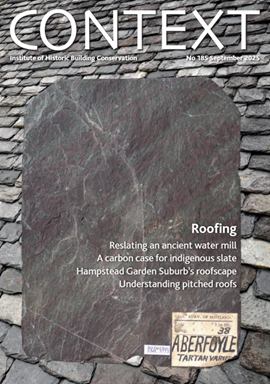
Articles range from slate to pitched roofs, and carbon impact to solar generation to roofscapes
Three reasons not to demolish Edinburgh’s Argyle House

Should 'Edinburgh's ugliest building' be saved?
IHBC’s 2025 Parliamentary Briefing...from Crafts in Crisis to Rubbish Retrofit
IHBC launches research-led ‘5 Commitments to Help Heritage Skills in Conservation’
How RDSAP 10.2 impacts EPC assessments in traditional buildings

Energy performance certificates (EPCs) tell us how energy efficient our buildings are, but the way these certificates are generated has changed.