





Waivers relating to construction contracts
Contents |
[edit] Waivers in brief
Waivers are the act of intentionally relinquishing, abandoning or giving up a known right, claim, privilege or fee etc. So for example in agreeing to a settlement via a third party, both other parties may be required to waive their right of appeal.
In many applications a waiver is a formal and legal document used to modify or waive specific terms or conditions within a contract or legal agreement. They are often used to address changes, disputes, or unexpected circumstances that arise during the course of a construction project, that release said party from said rights or obligations outlined within a contract or legal arrangement. In British English terms such as exemption, variation, relinquishment, abandonment and others, may be used which may have slightly differing meanings in legal terms.
[edit] Lien waivers
Lien waivers relinquish the right to retain possession of another person’s property pending the payment of a debt. A common example is automobiles in a mechanics garage, often referred to as mechanic’s lien. The same approach maybe adopted in construction, a type of lien that gives a contractor a security interest in the property being worked on until they have been paid for their work on that property, in these cases often called a labourer or artisan's lien. A lien waiver in this case is normally a document signed by the contractor, or supplier involved in the project that relinquishes these rights, however in exchange for waiving their lien rights, the party may receive payment for the services or materials.
[edit] Change order waivers
Change order waivers, can be a contentious area, for example if project manager fails to enforce an agreed change order it may be interpreted as a waiver, though the validity of this will depend on the nature of the change order and in many cases the waiver if not formally agreed may not be valid. The waiver likely to require acknowledgement of the change order and require parties to formally agree on adjustments to cost or schedule in lieu of the change, thus acting as a waiver. For further information see change order for construction contracts.
[edit] Delay or time extension waivers
Similar to change order waivers, delay or time extension waivers need to be formally agreed by all parties. In these cases a client may waive their right, under the contract to claim damages for a project delays, thus agreeing to a time extension without penalty. These types of waiver may occur where extenuating or unforeseen circumstances are agreed as being valid within a project. For further information see time extensions in construction contracts.
[edit] Related articles on Designing Buildings
- Addendum.
- Agreement.
- Concession Contracts Regulations.
- Construction contract.
- Contract documents for construction.
- Contractual chain.
- Contractual obligation.
- Contractual right.
- Core clause.
- Forward contract.
- Hybrid construction contract.
- Intermediate building contract.
- Job order contracting.
- Memorandum of understanding.
- Model Services Contract MSC.
- Modifying clauses in standard forms of construction contract.
- Onerous contract.
- Reserved contract.
- Tender documentation for construction projects.
- Traditional contract for construction.
Featured articles and news

We're expanding our collaborative mission by launching DB Intelligence, an exclusive market research advisory panel. Built environment professionals can now get paid to share their expertise on industry trends, products and services.
Panel members receive direct financial incentives for participating in research projects like short surveys, 1-2-1 interviews and focus groups. Register today to shape the future of the construction sector.
Planning condition discharge in England and Wales

A brief exoplanation from a building compliance expert, with further links.
Overheating guidance and tools for building designers

Guidance for dealing with element of building fabric control that have increasing importance.
Shading for housing, a design guide

From the Good Homes Alliance and British Blind and Shutter Association.
UK Standard Skills Classification (SSC)

A shared framework for describing skills needs.
Social media ban consultation comes to close

CIOB urges UK Government to consider social media’s role in careers guidance in ban debate.
The latest of eight Skills England apprenticeship units

The addition of battery manufacturing welcomed by ECA with a warning about the risks of fast-tracked apprenticeship units.
Building Control Independent Panel final report
A precis of a key report led by Dame Hackitt with full recommendations and link to the government response.
Building Safety recap April, 2026
A short and longer run-through of the month, with links to further information and sources.

CIAT May 2026 briefing.

From medieval scribes to modern word art.

ECA welcomes crackdown on late payment and push for clean energy, whilst CIOB seek fixed cladding removal timeframes.
Cyber Security in the Built Environment
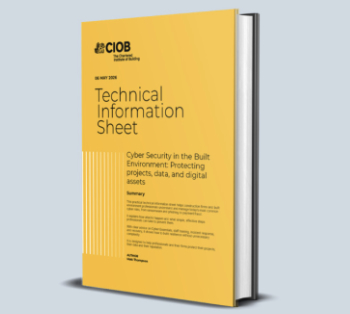
Protecting projects, data, and digital assets: A CIOB Academy TIS.
Managing competence in the built environment

ITFG publishes new industry guide on how to meet the ICC principles.
The UK's campaign to reduce noise pollution: Mythbusting, articles and topic guides.