





The economics of heritage and wellbeing
Wellbeing offers a methodology that can quantitatively assess the broad range of benefits that heritage provides, often more effectively than traditional economic measures.

|
| School children engaging with Sunderland’s historic high streets heritage action zone (Photo: Alun Bull, Historic England). |
Contents |
Introduction
Heritage enjoys widespread public support. For instance, in 2022, Britain Thinks reported the results from a survey demonstrating that for 81 per cent of people ‘looking after historic buildings, monuments and archaeology to safeguard the places people love’ is personally important to them.[1] The Department for Culture, Media and Sport’s (DCMS) Taking Part Survey[2] shows that in 2019/20 95 per cent of adults agreed that heritage and place should be well looked after. In the more recent 2022/23 Participation Survey, the DCMS reports that 67.5 per cent of people visited a heritage site during the year.[3]
Where heritage struggles is in its ability to demonstrate its investment worth through traditional economic approaches. Consequently, we undervalue and underinvest in all forms of heritage. In the UK, heritage and other cultural goods often face disproportionate cuts to local government expenditure, while national departments responsible for heritage remain unprotected from previous and future budget reductions. This paradox, where people feel a significant connection to heritage but it remains unrepresented economically, highlights the need for new approaches that prioritise what people truly value, particularly in economic decision-making about the allocation of finite resources.
Change is afoot. Since 2018, the UK’s HM Treasury has placed greater weight on wellbeing as a core economic outcome in its revised publication of The Green Book, the framework under which government departments make investment decisions. In this, social or public value is seen to include all significant costs and benefits that affect the welfare and wellbeing of the population, not just market effects. Wellbeing can be assessed in the form of a monetary benefit similar to more common market transactions that worldwide finance and treasuries are familiar with.
Similarly, the UK’s Office for National Statistics’ (ONS) ‘Beyond GDP’ initiative seeks to develop supplementary measures that provide a more holistic understanding of the UK economy, society and the environment. The ONS now regularly publishes wellbeing statistics via the UK Measures of National Wellbeing Dashboard.
With governments everywhere constrained by limited fiscal resources, particularly in the wake of the 2008 financial crisis, investments in heritage must be understood within the context of the trade-offs with investments in other areas. To justify investment, we are required to show that heritage delivers tangible returns, in economic, cultural, environmental and social terms. The compelling part is that when demonstrating the impacts on wellbeing through monetary estimates, investments in heritage may sometimes yield a higher marginal return than expanding already overstretched sectors like healthcare.
What do we know?
HM Treasury’s The Green Book reshaped how UK government evaluates investment, placing greater emphasis on wellbeing. The approach, known as the Wellbeing-Adjusted Life Years (WELLBY), allows policymakers to assess the impact of policy through life satisfaction. In the simplest terms, a WELLBY represents a one-unit increase on the 1–10 life satisfaction scale sustained for one person over a year. Analysts can evaluate the effectiveness of policies by quantifying their impact on overall wellbeing, with each WELLBY valued at £15,300 at the time of writing.
Heritage projects are particularly well suited to demonstrating their value through this wellbeing lens. Take the National Lottery Heritage Fund’s Volunteering for Wellbeing project in Greater Manchester, which worked with people who had been long-term unemployed or socially isolated.[4] Through volunteering and training at 10 heritage sites, 75 per cent of participants reported feeling better after a year. Importantly, for most this was not a short-term change. Sixty per cent sustained these improvements for 2–3 years, and 30 per cent found jobs as a result. For every pound spent, the project generated an estimated £3.50 in socio-economic benefits.
Two examples from Christian Krekel and Paul Fijters’ Handbook for Wellbeing Policy- Making (2021)[5] show how heritage supports mental health in tangible ways. In Wiltshire, the Human Henge Project worked with people managing long-term mental health conditions, inviting them to experience Stonehenge in a new way. The project evaluation and an economic review found that participants reported a 0.68-point improvement in life satisfaction. Framed through the WELLBY approach, this highlights how targeted investments in heritage can deliver marginal wellbeing gains that may exceed what traditional clinical treatments alone can achieve.
Similarly, the authors’ evaluation of Hull City of Culture made a case for heritage as a wellbeing investment. Using orthodox economic metrics, the project’s net present value was evaluated at minus £4.4 million. However, when impact was framed through the lens of wellbeing, the authors found that the project delivered 28,000 WELLBYs. They estimate that the project’s true net present value stood at an impressive £247.6 million, better value than the 2012 London Olympics, for example.
In the European Union, volunteering in heritage activities has been shown to increase life satisfaction. [6] Researchers found that heritage volunteering raised the likelihood of being ‘very satisfied’ with life from 27 per cent to 33 per cent, and increased reported life satisfaction by 0.21. These wellbeing benefits extend beyond adults. Norway’s Young HUNT study demonstrated that adolescents participating in cultural activities had better mental health, higher life satisfaction and improved overall health compared to those who did not engage.[7]
Churches play a role. The House of Good report in 2020 estimated the average wellbeing value generated by a UK church at £4,712 annually, primarily driven by volunteering and community activities. Across all UK churches, this adds up to around £190 million a year — a significant contribution to national wellbeing.[8]
The Culture and Heritage Capital Programme
The DCMS Culture and Heritage Capital (CHC) programme is making significant strides in developing and promoting evidence of the wellbeing impact of culture and heritage. The pioneering programme aims to ensure that the economic, social and cultural value of culture and heritage is included in appraisals and evaluations, following best practice guidance set out by HM Treasury’s The Green Book. By investing in a programme of research the DCMS aims to more comprehensively evidence the value and impact that cultural and heritage sectors have on long-term standards of living and wellbeing. At the end of 2024, the DCMS released a report examining the wellbeing impact of a range of arts and cultural goods, demonstrating the positive effects of engaging with arts and culture. Although heritage was less featured in the study, as the evidence for robust quantification was limited, this is expected to change as more research is conducted.
In March 2024, Historic England published the first of a series of CHC programme funded research projects. The research showed that everyday passive interactions with cultural heritage could enhance individual wellbeing.[9] Using an HM Treasury-approved approach to wellbeing valuation, the study assigned a monetary value to the life satisfaction impact using the WELLBY approach. It demonstrated that the very existence of cultural heritage in a place impacted residents’ quality of life, above and beyond individual usage patterns and after controlling for individual and neighbourhood effects. On average across England, individual life satisfaction gained from proximity to heritage is valued at approximately £515 per person, with an aggregate total of £29 billion for England.
The study highlights that heritage does not just enhance our surroundings; it significantly boosts our life satisfaction. The use of a wellbeing measure was also able to show something unique: the existence and abundance of local heritage, rather than the presence of rare, exceptional Grade I and II* heritage assets, were the main drivers of higher life satisfaction. The study concluded that policies that preserved and increased access to historic resources could serve as effective pathways to improving our national wellbeing, for both current and future generations.
Looking ahead, the future of wellbeing as a metric appears promising. It is gaining recognition as an important indicator of public welfare and offers a methodology to assess the broad range of benefits that heritage provides, often more effectively than traditional economic measures. If the heritage sector recognises the significance of this from both policy and private perspectives, it will make the case for investment in the sector much stronger.
References:
- 1 Britain Thinks (2022) National Lottery Heritage Fund Strategy Development Research, National Lottery Heritage Fund.
- 2 DCMS (2020) ‘Heritage: Taking Part Survey 2019/20’, DCMS Statistics.
- 3 DCMS (2022) ‘Participation Survey October 2021 to March 2022’, DCMS Statistics.
- 4 The National Lottery Heritage Fund (2018) ‘Improving Futures: volunteering for wellbeing’, Heritage Fund.
- 5 Krekel, C. and Frijters, P. (2021) A Handbook for Wellbeing Policy- Making, Springer Nature.
- 6 Ateca-Amestoy, V., et al. (2021) ‘Heritage Engagement and Subjective Well-Being in the European Union.’ Sustainability, Vol. 13, No. 17, 26 August. Available at www. mdpi.com/2071- 1050/13/17/9623.
- 7 Hansen, E., et al. (2015) ‘Cultural activity participation and associations with self-perceived health, life satisfaction and mental health: the Young HUNT Study, Norway’, BMC Public Health 15(1).
- 8 The National Churches Trust (2020) ‘The economic and social value of church buildings to the UK: key findings and technical report’, House of Good Report.
- 9 Colwill, T. (2023) ‘Heritage capital and wellbeing: examining the relationship between heritage density and life satisfaction’, Historic England Research Reports.
This article originally appeared in the Institute of Historic Building Conservation’s (IHBC’s) Context 183, published in March 2025. It was written by Thomas Colwill and Adala Leeson. Thomas Colwill is the senior economist at Historic England, conducting a range of differing economic research projects on heritage, aligned with the Culture and Heritage Capital Programme. Adala Leeson is head of social and economic research at Historic England, leading a team that undertakes social, economic and environmental research. She has worked closely with the Department for Culture, Media and Sport to develop the Culture and Heritage Capital Programme.
--Institute of Historic Building Conservation
Related articles on Designing Buildings Conservation.
IHBC NewsBlog
IHBC sponsors Gardens Trust event 23-4 Sept 2026
.jpeg)
'Learning from the Past, Shaping the Future’ takes place in Milton Keynes
Renovations to Frank Lloyd Wright's Fallingwater complete
.jpg)
World Heritage Preserved project opens house for tours again
Shakespeare Birthplace Trust places Hall's Croft on HAR Register
Stratford-upon-Avon home of Shakespeare's daughter is 'At Risk'
Lady Grange’s House repaired on St Kilda
.jpg)
National Trust for Scotland repairs stone cleit with link to famous island resident
Griff Rhys Jones on BBC Radio 4 Today programme
,_Green_Lane,_Derby.jpg)
The Victorian Society’s President unveiled its latest Top Ten Endangered Buildings 2026.
Need a MATE? Book your place now.
IHBC offers free webinars on applying for IHBC accreditation (Full & Associate).
UK Stained Glass Repository finds windows new homes
How are stained glass windows are rescued, stored and repurposed?
APPGEBE report sets high aims for quality
'Government must not sacrifice quality in drive to build 1.5m homes'
New measures protect Historic Shipwrecks from heritage crime

Underwater cultural heritage benefits from new HE guidance
How could the City of London skyline look in 6 years' time?

Visualisation shows approved planning applications as completed buildings
National Trust for Scotland calls for VAT cuts

Heritage neglect is encouraged by current policies
IHBC's 'Context' Issue 186 features Industrial Heritage
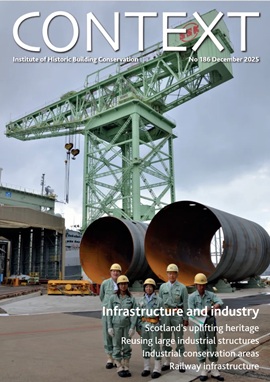
IHBC's members' journal reports on the challenges of conserving infrastructure
Book now for IHBC Annual School 2026
IHBC Annual School is taking place 18-20 June 2026 in Newcastle
RICHeS Research Infrastructure offers ‘Full Access Fund Call’
RICHeS offers a ‘Help’ webinar on 11 March
Latest IHBC Issue of Context features Roofing
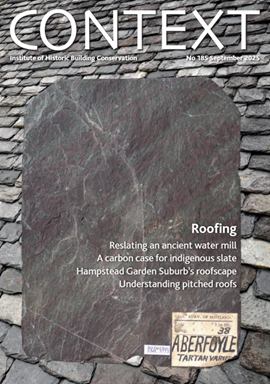
Articles range from slate to pitched roofs, and carbon impact to solar generation to roofscapes
Three reasons not to demolish Edinburgh’s Argyle House

Should 'Edinburgh's ugliest building' be saved?
IHBC’s 2025 Parliamentary Briefing...from Crafts in Crisis to Rubbish Retrofit
IHBC launches research-led ‘5 Commitments to Help Heritage Skills in Conservation’
How RDSAP 10.2 impacts EPC assessments in traditional buildings

Energy performance certificates (EPCs) tell us how energy efficient our buildings are, but the way these certificates are generated has changed.