





Insourcing in the construction industry

Contents |
[edit] Introduction
Insourcing (or self-sourcing) is the practice of using in-house staff to provide services that are not necessarily related to the primary activities or core competencies of their organisation. This practice may require external input to cross train staff, enabling them to undertake new tasks.
This is the reverse of outsourcing, which involves the contracting of non-primary business activities and functions to a third-party service provider.
[edit] Insourcing services
Insourcing services might include IT, security, facilities management, landscaping, accounting and other administrative functions. Some of these tasks are commonly associated with soft facilities management.
Within the construction industry, insourcing services may also include CAD/BIM, project management, preparation of documentation, human resource administration, energy management and other activities associated with operations.
When insourcing is applied to in-house facilities management departments, it may be beneficial to incorporate a charge-back scheme. This allows departments to be treated as an ‘in-house’ outsourced service with the ability to report tangible data.
[edit] A return to insourcing
In the last few years, many local authorities and other public sector entities have begun to review their policies around competitive tendering associated with outsourcing and to reconsider insourcing as a method for encouraging cost containment and accountability.
Competitive tendering became increasingly common in the UK in the 1980s, when it was seen as a way of making public organisations open themselves up to bids from private firms. This was intended to increase transparency, drive down costs and improve the efficiency of central and local government departments. However, it was criticised for placing too much emphasis on cost rather than value, and is now sometimes seen as a 'race to the bottom'. As a result, many organisations have made the decision to move away from long-term outsourcing contracts.
[edit] Benefits of insourcing
Insourcing can:
- Expand the skills of employees and provide them with a better understanding of different aspects of the organisation and an increased sense of ownership.
- Improve the organisation’s ability to respond rapidly to changes in the business environment by redeploying cross-trained employees when necessary.
- Establish cost projections (and possibly cut labour costs) by reducing the organisation’s dependence on external resources.
- Protect proprietary information about the organisation and its clients, staff and other personnel.
- Deliver realistic, reliable services from a flexible, integrated workforce.
[edit] Drawbacks of insourcing
Potential negative aspects of insourcing include:
- Cross training employees is an investment that will require time and resources. It can also take staff members away from their original roles.
- Employees may leave the organisation once they benefit from the cross training they receive.
- Employees may not wish to participate in insourcing initiatives and can push back against training and re-allocation of roles.
- Employees may require additional continuing education or training to stay current in roles outside their primary skillsets.
- Outsourced tasks requirements may be extremely specialised.
- It may be difficult to introduce an element of competition, and so services can become inefficient.
[edit] Related articles on Designing Buildings Wiki
- Business administration.
- Business process outsourcing (BPO).
- Competitive tender.
- Consultancy playbook.
- Facilities management.
- General Data Protection Regulations (GDPR).
- Hard facilities management.
- Mixed economy.
- Outsourcing playbook.
- Soft facilities management.
- Sourcing playbook.
- Vested outsourcing.
[edit] External reference
- APSE (Association for Public Service Excellence) - File:Rebuilding Capacity The Case For Insourcing Public Contracts.pdf (PDF), May 2019.
Featured articles and news

We're expanding our collaborative mission by launching DB Intelligence, an exclusive market research advisory panel. Built environment professionals can now get paid to share their expertise on industry trends, products and services.
Panel members receive direct financial incentives for participating in research projects like short surveys, 1-2-1 interviews and focus groups. Register today to shape the future of the construction sector.
Planning condition discharge in England and Wales

A brief exoplanation from a building compliance expert, with further links.
Overheating guidance and tools for building designers

Guidance for dealing with element of building fabric control that have increasing importance.
Shading for housing, a design guide

From the Good Homes Alliance and British Blind and Shutter Association.
UK Standard Skills Classification (SSC)

A shared framework for describing skills needs.
Social media ban consultation comes to close

CIOB urges UK Government to consider social media’s role in careers guidance in ban debate.
The latest of eight Skills England apprenticeship units

The addition of battery manufacturing welcomed by ECA with a warning about the risks of fast-tracked apprenticeship units.
Building Control Independent Panel final report

A precis of a key report led by Dame Hackitt with full recommendations and link to the government response.
Guide to ISO 19650 for Architecture Firms (2026)
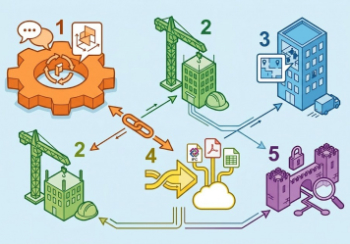
A user gives their low down.

A UK training and membership provider for mould remediation professionals.
Building Safety recap April, 2026

A short and longer run-through of the month, with links to further information and sources.

CIAT May 2026 briefing.

Independent NSI and BAFE study exploring how organisations are changing the way they buy fire safety services.

From medieval scribes to modern word art.

ECA welcomes crackdown on late payment and push for clean energy, whilst CIOB seek fixed cladding removal timeframes.
Cyber Security in the Built Environment
Protecting projects, data, and digital assets: A CIOB Academy TIS.
Managing competence in the built environment
ITFG publishes new industry guide on how to meet the ICC principles.

The UK's campaign to reduce noise pollution: Mythbusting, articles and topic guides.