





Completion of construction contracts
Contents |
[edit] Introduction
The completion of construction projects is generally not a single event but takes place in stages. This is necessary to ensure that all the works described in the contract documents have been carried out as specified, that all appropriate payments have been made, that there are no defects and that an appropriate handover has taken place.
This process centres on a series of inspections and certifications, and is described In outline below so that the key principles and the sequences are understood. The exact details may vary depending on the form of contract used, and more detailed, step-by step descriptions are provided in our project plans.
[edit] As the construction period nears completion
If they have not already done so, the client should prepare an operational policy and migration strategy setting out how they will manage the transition into and the operation of the new facility.
The client may need to arrange for the delivery and installation of equipment and fixtures and furniture, sometimes from other premises. They may also pick up small changes to the building works that they consider would be too costly to be instructed under the main contract.
The lead consultant, contractor and client (generally representatives of the client’s facilities management department) should agree procedures for inspections, commissioning, testing and client training. The client may need to appoint an in-house or outsourced engineering team to witness testing and commissioning and to take over the running of services when practical completion is certified.
The client should ensure they have sufficient funds to release 50% of the retention upon certification of practical completion.
[edit] Practical completion (or substantial completion)
The contractor confirms to the contract administrator that the works are complete.
If, following inspections, the contract administrator is satisfied that the works are complete, they should issue a certificate of practical completion (or 'substantial completion' depending on the form of contract used).
Certifying practical completion; ends the contractor's liability for liquidated and ascertained damages, releases 50% of the retention and signifies the beginning of the defects liability period.
If practical completion is not certified by the completion date, the contractor may be liable to pay the client liquidated and ascertained damages.
It is important to note that the defects liability period, which follows certification of practical completion, is not a chance to correct problems apparent at practical completion, it is the period during which the contractor may be recalled to rectify defects which appear. If there are defects apparent before practical completion, then these should be rectified before a certificate of practical completion is issued. There is some debate about whether practical completion should be certified where there are very minor (de minimis) items 'not affecting beneficial occupancy' of the development that remain incomplete. See practical completion for more information.
[edit] Defects liability period (or rectification period)
The client takes possession of the development.
The defects liability period typically lasts six to twelve months. During this period, the client reports any defects that emerge in the works to the contract administrator and the contractor rectifies those defects.
At the end of the defects liability period the contract administrator arranges inspections of the works and prepares a schedule of remaining defects which is issued to the contractor. The contract administrator agrees a programme for the rectification of those items with the client and contractor.
The contract administrator arranges final inspections of the works and if satisfied issues the certificate of making good defects.
The cost consultant prepares the final account in consultation with the contractor and issues it to the contract administrator. The contract administrator checks the preparation of the final account and issues the final certificate, this result in the release of any remaining retention.
This signifies the end of the construction contract. It will normally also signify the end of the consultant teams appointments.
NB The process can be more complicated if the works are completed in stages. See partial possession and sectional completion for more information.
[edit] After the end of the construction contract
It is the nature of construction projects that faults and defects caused by failures in design, workmanship or materials, may not become apparent until many years after completion of the project, long after the end of the defects liability period. Such defects are known as latent defects (as opposed to patent defects which are apparent during the construction contract).
However, after the end of the defects liability period the client does not have a contractual right to insist the contractor rectifies those defects. They must instead seek redress in an action for damages, for breach of contract, or for negligence. In the case of dwellings there is a statutory remedy provided by the Defective Premises Act.
Commercial fixes for latent defects for clients (and successive owners) include, collateral warranties, guarantees, building warranty schemes and latent defects insurance.
NB The term ‘soft landings’ refers to a strategy adopted to ensure the transition from construction to occupation is ‘bump-free’ and that operational performance is optimised. See Soft landings for more information.
[edit] Find out more
[edit] Related articles on Designing Buildings Wiki
Featured articles and news

We're expanding our collaborative mission by launching DB Intelligence, an exclusive market research advisory panel. Built environment professionals can now get paid to share their expertise on industry trends, products and services.
Panel members receive direct financial incentives for participating in research projects like short surveys, 1-2-1 interviews and focus groups. Register today to shape the future of the construction sector.
Planning condition discharge in England and Wales

A brief exoplanation from a building compliance expert, with further links.
Overheating guidance and tools for building designers

Guidance for dealing with element of building fabric control that have increasing importance.
Shading for housing, a design guide

From the Good Homes Alliance and British Blind and Shutter Association.
UK Standard Skills Classification (SSC)

A shared framework for describing skills needs.
Social media ban consultation comes to close

CIOB urges UK Government to consider social media’s role in careers guidance in ban debate.
The latest of eight Skills England apprenticeship units

The addition of battery manufacturing welcomed by ECA with a warning about the risks of fast-tracked apprenticeship units.
Building Control Independent Panel final report
A precis of a key report led by Dame Hackitt with full recommendations and link to the government response.
Guide to ISO 19650 for Architecture Firms (2026)
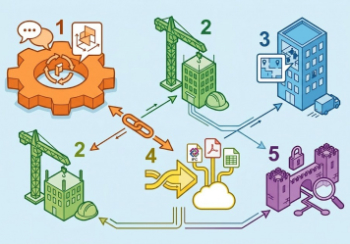
A user gives their low down.

A UK training and membership provider for mould remediation professionals.
Building Safety recap April, 2026
A short and longer run-through of the month, with links to further information and sources.

CIAT May 2026 briefing.

Independent NSI and BAFE study exploring how organisations are changing the way they buy fire safety services.

From medieval scribes to modern word art.

ECA welcomes crackdown on late payment and push for clean energy, whilst CIOB seek fixed cladding removal timeframes.
Cyber Security in the Built Environment
Protecting projects, data, and digital assets: A CIOB Academy TIS.
Managing competence in the built environment

ITFG publishes new industry guide on how to meet the ICC principles.

The UK's campaign to reduce noise pollution: Mythbusting, articles and topic guides.