




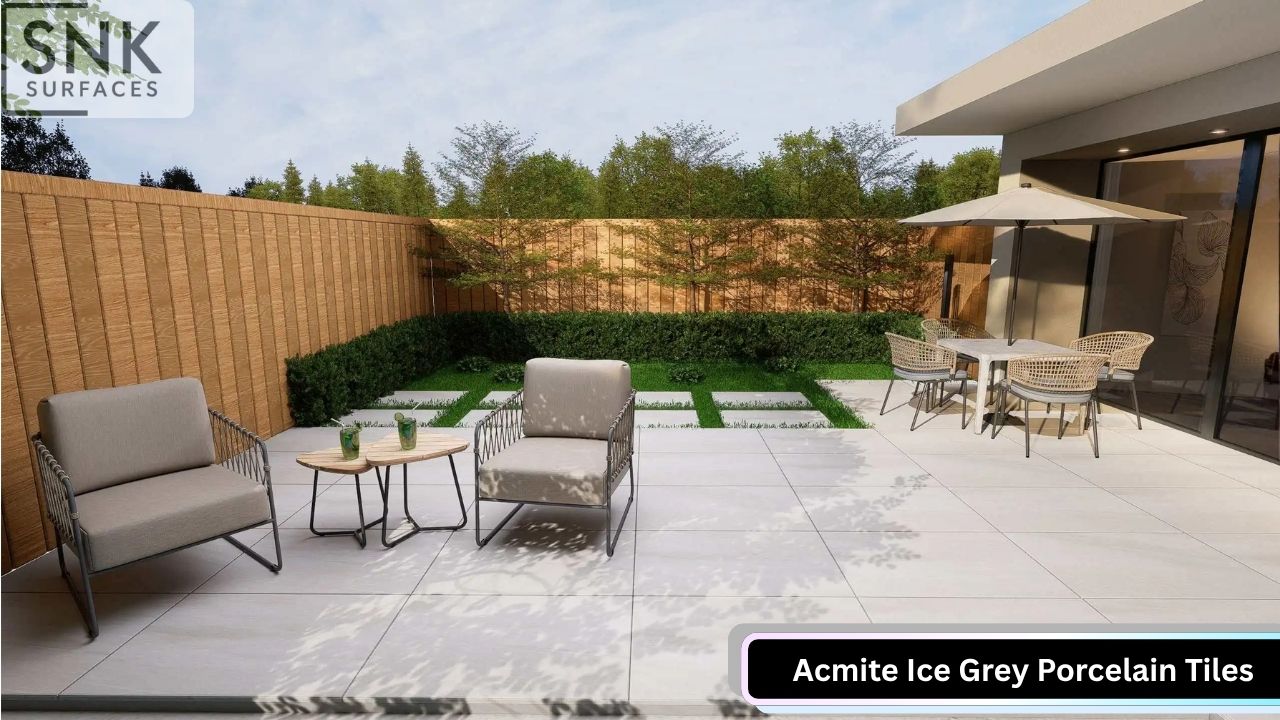
Acmite Ice Grey Porcelain Tiles
Contents |
[edit] Introduction
Porcelain paving tiles, typically 20 mm thick, are widely used for external paving such as patios, terraces, paths and courtyards. Light grey is one of the most common colours, giving a clean, contemporary appearance that suits both modern architecture and landscaped gardens. When selecting outdoor tiles, size, thickness and slip resistance are as important as colour, since they affect the appearance, safety and long-term performance of the paved area.
[edit] Properties of porcelain paving
Porcelain is a dense, fully vitrified ceramic material made from refined clays, feldspar and other minerals fired at high temperature. Under BS EN 14411, porcelain tiles fall within group BIa, with water absorption of 0.5% or less. This very low absorption gives good frost resistance, and porcelain is also resistant to staining, fading, abrasion and most chemicals, making it suitable for external areas exposed to changing weather. Unlike most natural stones, porcelain does not normally need to be sealed, and routine maintenance is generally limited to cleaning with suitable products.
The 20 mm thickness used for external paving gives much greater strength and load-bearing capacity than standard 8–10 mm internal floor tiles, allowing the tiles to be used on a rigid mortar bed, on adjustable pedestals or, for lightly trafficked areas, on a compacted bed of gravel or sand.
[edit] Tile sizes
Outdoor porcelain paving is produced in a range of standard formats. The most common include:
| Format (mm) | Shape | Typical applications |
| 600 x 600 | Square | Smaller patios, courtyards and paths, and areas with many corners, narrow sections or detailed features |
| 600 x 900 | Rectangular | Patios, terraces, seating areas and walkways; suits a range of laying patterns |
| 800 x 800 | Square | Larger patios, terraces and courtyards where an open layout with fewer joints is wanted |
Larger formats reduce the number of visible joints and give a more continuous appearance, but they are heavier to handle, require a flatter and more carefully prepared substrate, and need more attention to falls and drainage. When rectangular tiles are laid in a staggered or running bond pattern, the offset is usually limited to around a third of the tile length to minimise lippage caused by slight bowing of the tiles.
The choice of format depends on the size, shape and use of the space. Before ordering, the area should be measured accurately, with an allowance for cutting, wastage and future replacements, and the laying pattern should be checked against the chosen format. For large projects, tiles should be ordered from a single production batch to ensure consistent colour and size.
[edit] Installation
The installation method should be selected to suit the expected traffic and the substrate. For rigid installations on a mortar bed, the low porosity of porcelain means that a bonding slurry or primer must be applied to the back of each tile to achieve adequate adhesion; tiles laid without one are prone to becoming loose. Pedestal systems are often used on roof terraces and balconies, as they allow water to drain freely beneath the paving and can accommodate falls in the deck below. Joints are typically at least 3–5 mm wide and are filled with a cementitious or resin-based jointing compound suitable for external use. Paving should be laid with adequate falls to shed surface water, and the manufacturer's technical guidance should be followed.
[edit] Slip resistance
Slip resistance is a key consideration for external paving, since rain, cleaning water and contamination can make smooth surfaces hazardous. Outdoor porcelain is usually given a textured or anti-slip surface to improve grip underfoot, but anti-slip does not mean slip-proof. Actual performance depends on surface texture, contamination, wear, cleaning regime, footwear and the conditions of use.
Slip resistance is commonly described using the R rating system, based on the German ramp test (DIN 51130), in which a person wearing safety footwear walks on an oil-contaminated sample on an inclined ramp. Ratings range from R9 (lowest) to R13 (highest), and R11 is frequently specified for external paving. A separate barefoot ramp test (DIN 51097) classifies surfaces as A, B or C, and class B or C is usually required for pool surrounds and other barefoot wet areas.
In the UK, the Health and Safety Executive and the UK Slip Resistance Group recommend the pendulum test (now covered by BS EN 16165), which measures slip resistance in wet conditions and can be carried out on site as well as in the laboratory. A pendulum test value (PTV) of 36 or above indicates low slip potential. Because ramp test results are not directly comparable with wet pendulum values, specifiers should request the relevant test certificates rather than relying on general descriptions such as anti-slip, and should not assume that a particular tile carries a given rating without documentary evidence.
[edit] Applications
Light grey 20 mm porcelain paving can be used for residential patios, garden paths, terraces, balconies and roof terraces, and commercial hard landscaping. Its neutral colour complements outdoor furniture, timber, natural stone and planting. For commercial projects, the format, installation method and slip-resistance documentation should be checked against the project specification and the expected level of pedestrian or vehicle traffic.
Porcelain paving may also be used around swimming pools, but these areas require particular attention to barefoot slip resistance, constant water exposure, drainage and resistance to pool chemicals, and the appropriate barefoot classification should be confirmed before installation.
[edit] Related articles on Designing Buildings
Featured articles
Check out some of the best features and news from Designing Buildings as well as key stories from around the web.

More of England’s ‘hidden heroes’ will be celebrated.

CIAT calls for retrofit to be a priority.

Version 6 is now available, along with guidance for ECA members.

Post-War Homes: mid-century British architecture. Book review.

CIAT reflects on the party conferences.

CIOB announce the winners of the Art of Building photography competition.

National Scheme of Delegation introduced.

The cost of employing people remains a concern.
Code of Practice for Electrical Energy Storage Systems.

ECA calls on members to comment on draft 4th edition.

Bringing together expertise and creating cultural benefits.

CIOB celebrates positive Ofsted report.

The Building Safety Regulator announces a call for evidence.