






Work platform safety, new British Standards published

Contents |
[edit] Two new Standards Publications
Two new BSI Standards Publications have been published - BS 8460:2025 Safe use of mobile elevating work platforms (MEWPs) - Code of practice and BS 7981:2025 Mast climbing work platforms (MCWPs) – Selection, configuration, installation, maintenance, thorough examination and safe use – Code of practice.
[edit] BS 8460:2025
This revised British Standard replaces BS 8460:2017 and has been fully updated to reflect BS EN 280-1:2022 and BS EN 280-2:2022. The document has been completely restructured, introducing a new process-based structure to help users plan, manage, and operate MEWPs more effectively.
Key developments include:
- A new end-to-end process map for MEWP safe use and a full reorganisation of the document around that workflow.
- Updated and expanded guidance on risk assessment, wind considerations, use of MEWPs with fall-arrest equipment, and the addition of load-handling devices or accessories.
- More detailed advice on choosing MEWPs equipped for integrated load handling, and new requirements for how such appliances should be operated and what training is needed.
- Additional content covering machines with zone or motion-control features and clearer expectations for the competence of platform occupants and supervisors.
- An added planning stage, plus enhanced recommendations to prevent trapping/crushing, ensure effective secondary guarding, and manage pedestrians while the MEWP is travelling.
- Procedures for reinstating MEWPs that have been unused for a period.
- Introduction of several new definitions relating to lifting equipment, rescue roles, pedestrian management, and temporary works.
- Clarification on specific scenarios such as confined spaces, work near or over water, and keeping MEWPs separated from pedestrians and other workers.
- Two new annexes: one setting limits for hoist lift heights, and another explaining wind-speed considerations at height.
[edit] BS 7981:2025
BS 7981:2025 provides recommendations and guidance for the installation, maintenance, thorough examination, and safe use of mast climbing work platforms (MCWPs). These platforms are temporarily installed, powered, and designed to allow people to carry out work at height.
The standard aims to ensure that MCWPs are used safely and effectively, reducing the risk of accidents and improving operational efficiency.
This standard is intended for a wide range of stakeholders, including:
- Construction industry professionals
- Certification and inspection bodies
- Owners and hire companies
- Training companies
- Regulators
- Users of MCWPs.
- Employers, dutyholders, and anyone responsible for the supply, installation, use, inspection, servicing, maintenance, and examination of MCWPs.
This article appears on the ECA news and blog site as "New British Standards on work platform safety published" dated 2 December 2025.
--ECA
ECA Members are eligible for a BSI Online Standards Library subscription that costs only £100 + VAT annually for 80+ standards with access for up to five users. This potentially saves ECA Members up to £18,000 per year.
[edit] Related articles on Designing Buildings
- Construction plant.
- How to remove scaffolding.
- How to use a ladder.
- Lift table.
- Lifting device.
- Lifting platform.
- Mast climbing work platforms MCWP.
- Mobile elevating work platforms (MEWPs).
- Piling mat.
- Post lift.
- Scaffolding.
- Scissor lift.
- Types of crane.
- Types of scaffolding.
- Work at height.
- Working at height - our duty to prevent harm and protect each other.
- Work at height checklist for managers.
- Work at height regulations.
- Working platform.
- Working platforms for tracked plant: good practice guide to the design, installation, maintenance and repair of ground-supported working platforms.
Featured articles and news

We're expanding our collaborative mission by launching DB Intelligence, an exclusive market research advisory panel. Built environment professionals can now get paid to share their expertise on industry trends, products and services.
Panel members receive direct financial incentives for participating in research projects like short surveys, 1-2-1 interviews and focus groups. Register today to shape the future of the construction sector.
Planning condition discharge in England and Wales

A brief exoplanation from a building compliance expert, with further links.
Overheating guidance and tools for building designers

Guidance for dealing with element of building fabric control that have increasing importance.
Shading for housing, a design guide

From the Good Homes Alliance and British Blind and Shutter Association.
UK Standard Skills Classification (SSC)

A shared framework for describing skills needs.
Social media ban consultation comes to close

CIOB urges UK Government to consider social media’s role in careers guidance in ban debate.
The latest of eight Skills England apprenticeship units

The addition of battery manufacturing welcomed by ECA with a warning about the risks of fast-tracked apprenticeship units.
Building Control Independent Panel final report
A precis of a key report led by Dame Hackitt with full recommendations and link to the government response.
Building Safety recap April, 2026
A short and longer run-through of the month, with links to further information and sources.

CIAT May 2026 briefing.
From medieval scribes to modern word art.

ECA welcomes crackdown on late payment and push for clean energy, whilst CIOB seek fixed cladding removal timeframes.
Cyber Security in the Built Environment
Protecting projects, data, and digital assets: A CIOB Academy TIS.
Managing competence in the built environment
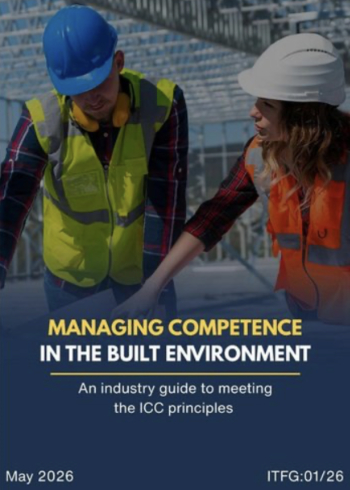
ITFG publishes new industry guide on how to meet the ICC principles.
The UK's campaign to reduce noise pollution: Mythbusting, articles and topic guides.