






Sustainable water management

[edit] Introduction
How should we understand water management in our age when humanity itself is now a powerful force on the Earth’s geology and ecosystems (aka ‘the Anthropocene era’)? Do we understand the most critical factors in building a resilient water infrastructure? What technologies do civil engineers need to use?
Four ahead-of-print articles about water engineering help us answer these important questions.
In 'Sustainable water management in the Anthropocene', Muller (2015) argues that the scale of the demands now being placed on the global water resource will inevitably change the aquatic environment, and that water management paradigms therefore need to change.
Muller differentiates between hydro-centric and hydro-supportive water management. In hydro-centric water management, the aim is to preserve 'natural environments'. However, Muller argues that conserving a natural environment ignores the dynamic nature of ecosystems and is an unreachable goal in the context of growing economies.
In hydro-supportive approaches, the aim is to manage water systems to 'contribute to a more sustainable organisation of human society and its activities', including new equilibria, based on 'a careful and unsentimental reflection about the nature of Nature'. Muller concludes with five cases studies in South Africa show the benefits of a hydro-supportive approach.
[edit] Even different water resource models show lower demand is needed
Predicting the impact of climate change on water resources is important to help us better for the future. However, this type of modelling is challenging and different methods can produce very different results. In 'Water resource vulnerability: simulation and optimisation models', Hoang and Desai (2016) compare the results of a simulation model and an optimisation model, using Sussex (south-east England) as a case study area.
Despite some differences in results, both methods showed a gradual increasing risk of supply deficit in the 2020s and 2030s. Avoiding frequent supply failures in the 2050s required a reduction in demand. The results suggested that demand reduction would occur under only two of four possible socio-economic scenarios: 'sustainability-led governance' or 'socially responsible consumerism', while the 'business-as-usual' scenario was found to cause future water failure risks.
[edit] Drier summers in eastern England will have a significant impact on agriculture
In order to provide the most effective infrastructure we need to understand the largest sources of water deficit: evaporation.
In 'The threat of drier summers to agriculture and the environment in eastern England', Evans draws attention to a number of frequently overlooked issues:
- The scale of likely future summer desiccation.
- 'Consumptive' water use (e.g. evaporation in agriculture).
- Evaporation from agriculture will increase under climate change.
- Increasing global food prices will make it more likely that at least some water irrigation in the UK can be provided economically.
- Relying on historic irrigation data will underestimate the impact of climate change and future irrigation need.
Evans evaluates a broad range of adaptation options, finding the provision of large reservoirs to be the most important at delivering sufficient water during the growing season. Unfortunately, current debates about water demand management are inappropriately focused on ineffective responses such as abstraction licenses, demand management and farm reservoirs.
Evans concludes by arguing that integrated planning could meet the needs of agriculture, conservation, water suppliers and others for water storage, especially if this work includes innovative financial models, a national focus to work 'at scale' and contingency planning.
[edit] Will smart technology in sub-Saharan African enable reliable and safe universal drinking water?
The innovative use of digital technology may also enable sustainable infrastructure in low and middle income countries.
In 'Using smart pumps to help deliver universal access to safe and affordable drinking water', Swan et al (2016) describe the very low maintenance rates of remote water projects in sub-Saharan Africa; in this region, 30-40% of standard rural water systems fail prematurely.
They describe pilot projects using 'smart pumps' in several African countries. The use of SMS messaging can enable faults to be reported to maintenance teams earlier and more often. If pump repair teams for remote regions exist, smart pumps can help maintain universal access to clean drinking water.
A number of obstacles still need to be addressed. Power supplies and mobile network coverage may not be reliable; smart pumps also need to be affordable, secure and acceptable to users. Most importantly, however, data from smart pumps offer some promising new opportunities.
Potentially, the provision of accurate, accessible information could enable greater community management of water resources. In order to assess this, future projects should explore the human management of smart pumps rather than focus only on the technology.
[edit] Summary
These papers show how civil engineering is vital for the design and maintenance of sustainable water infrastructure, and that increasingly, it needs to work with other built environment and human sciences professions.
From recognising the need for hydro-supportive water management in the Anthropocene era, to modelling future water availability, to the scale of evaporation impact, to seizing the opportunities of smart pumps to enable community water management in sub-Saharan Africa: engineering works with other professions at the heart of water sustainability.
This article was originally published here on 20 July 2017 by ICE. It was written by Judith Sykes, editor, Engineering Sustainability journal.
--The Institution of Civil Engineers
[edit] Related articles on Designing Buildings Wiki
Featured articles and news

We're expanding our collaborative mission by launching DB Intelligence, an exclusive market research advisory panel. Built environment professionals can now get paid to share their expertise on industry trends, products and services.
Panel members receive direct financial incentives for participating in research projects like short surveys, 1-2-1 interviews and focus groups. Register today to shape the future of the construction sector.
Building Safety Wiki Interviews

Chief executive of the British Woodworking Federation.
Planning condition discharge in England and Wales

A brief exoplanation from a building compliance expert, with further links.
Overheating guidance and tools for building designers

Guidance for dealing with element of building fabric control that have increasing importance.
Shading for housing, a design guide

From the Good Homes Alliance and British Blind and Shutter Association.
UK Standard Skills Classification (SSC)

A shared framework for describing skills needs.
Social media ban consultation comes to close

CIOB urges UK Government to consider social media’s role in careers guidance in ban debate.
The latest of eight Skills England apprenticeship units

The addition of battery manufacturing welcomed by ECA with a warning about the risks of fast-tracked apprenticeship units.
Building Control Independent Panel final report
A precis of a key report led by Dame Hackitt with full recommendations and link to the government response.
Building Safety recap April, 2026
A short and longer run-through of the month, with links to further information and sources.
CIAT May 2026 briefing.

From medieval scribes to modern word art.

ECA welcomes crackdown on late payment and push for clean energy, whilst CIOB seek fixed cladding removal timeframes.
Cyber Security in the Built Environment

Protecting projects, data, and digital assets: A CIOB Academy TIS.
Managing competence in the built environment
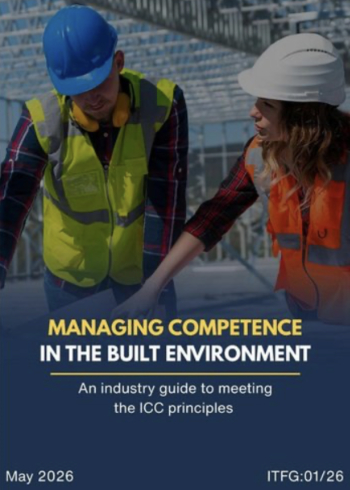
ITFG publishes new industry guide on how to meet the ICC principles.