




Residual Service Life Assessment for Existing Structures
Contents |
[edit] Introduction
A residual service life assessment is an engineering evaluation undertaken to estimate how long an existing structure or structural element can continue to perform its intended function safely and reliably, provided that appropriate maintenance and repairs are carried out where necessary. Such assessments are commonly undertaken for ageing buildings, bridges, industrial facilities and reinforced concrete structures that have been subjected to deterioration, corrosion, repeated loading or aggressive environmental conditions.
Residual service life assessments support informed decision-making regarding maintenance, repair, strengthening, refurbishment or replacement. They form an important part of asset management by helping owners and operators prioritise investment and reduce the risk of unexpected structural failures.
[edit] Assessment process
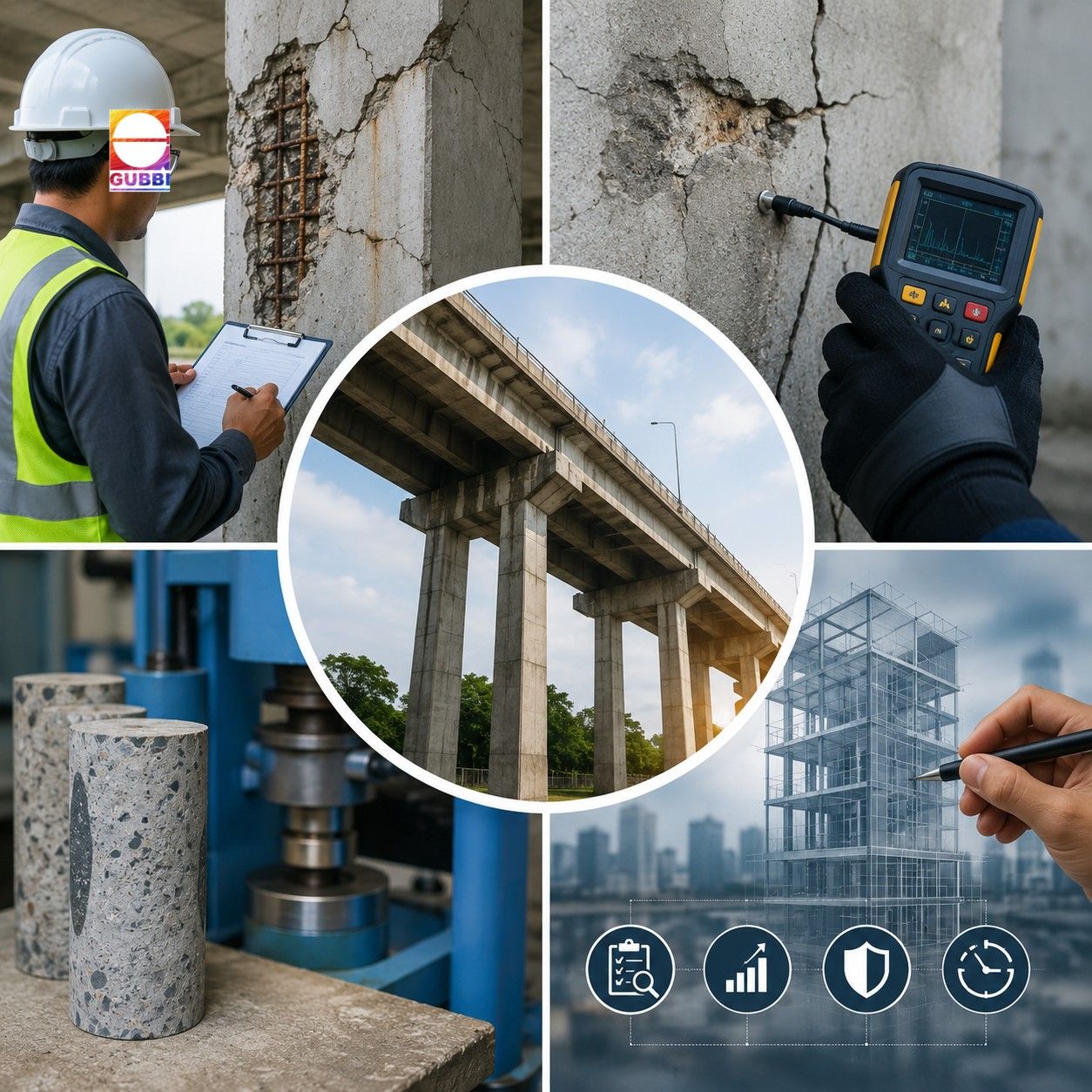
A residual service life assessment typically begins with a detailed visual inspection to identify signs of deterioration or structural distress. Common indicators include cracking, concrete spalling, water ingress, exposed or corroded reinforcement, excessive deflection, deformation and other visible defects.
The inspection is normally supplemented by non-destructive testing, material sampling and laboratory testing where appropriate. Techniques may include rebound hammer testing, ultrasonic pulse velocity testing, cover meter surveys, half-cell potential measurements, carbonation depth testing, chloride analysis and concrete core testing. The selection of test methods depends on the type of structure, its condition and the deterioration mechanisms under investigation.
Structural analysis is then undertaken to assess the load-carrying capacity of the structure, taking account of the measured material properties, observed defects and any changes in loading or use since the structure was originally designed.
[edit] Factors influencing residual service life
The estimated residual service life of a structure depends on a range of factors, including:
- the condition of structural elements
- the extent of corrosion of reinforcement or structural steel
- concrete strength and durability
- exposure conditions, including marine, industrial or freeze-thaw environments
- structural loading and fatigue
- maintenance history
- previous repairs or alterations
- compliance with current performance requirements where relevant.
The assessment may also consider the likely rate of future deterioration and the effects of planned maintenance or repair interventions.
[edit] Applications
Residual service life assessments are widely used to support the management of existing infrastructure and buildings. Typical applications include:
- determining whether a structure remains fit for continued use
- planning maintenance and inspection programmes
- prioritising repair and rehabilitation works
- assessing structures before refurbishment, extension or change of use
- supporting whole-life asset management strategies
- informing decisions on replacement where repair is no longer economically or technically viable.
Such assessments are particularly valuable for reinforced concrete structures, where corrosion of embedded reinforcement can progressively reduce durability and structural capacity if left untreated.
[edit] Repair and strengthening
The findings of a residual service life assessment provide the technical basis for selecting appropriate repair or strengthening measures. Depending on the nature and severity of the deterioration, these may include concrete repair, corrosion mitigation, reinforcement replacement, structural jacketing, externally bonded fibre-reinforced polymer composites, steel strengthening, cathodic protection or other rehabilitation techniques.
Following repair or strengthening, the residual service life may be reassessed to determine the anticipated extension to the structure's operational life and to establish future inspection and maintenance requirements.
[edit] Conclusion
Residual service life assessment is an important engineering process for evaluating the condition and future performance of existing structures. By combining detailed inspection, testing, durability assessment and structural analysis, it provides an evidence-based estimate of remaining service life and supports decisions on maintenance, repair, strengthening and asset management. When undertaken as part of a planned inspection regime, it can help improve safety, optimise maintenance expenditure and extend the operational life of buildings and infrastructure.
[edit] Related articles on Designing Buildings
Featured articles
Check out some of the best features and news from Designing Buildings as well as key stories from around the web.

Bringing together expertise and creating cultural benefits.

CIOB celebrates positive Ofsted report.

The Building Safety Regulator announces a call for evidence.

Government approach could undermine delivery and regeneration.
World's first mass timber data centre.

The overlooked environmental aspect of data centre development.
Introduction to radon awareness

New technical information sheet published by CIOB.

Updated supplier guide can help electrical contractors engage with NHP.

CIAT confirm the winners of the 2026 architectural technology awards.

Government launches a one stop shop for flood preparedness.

Sir Edwin Lutyens: Britain's greatest architect? Book review.

CIOB publishes free template to help assess and manage risks.
ECA's reflections on Party Conference season

Burnham wants to be confident of winning before asking for a fresh mandate.