






Dove Stone Hydropower

Contents |
[edit] Introduction
The story of a small-scale community enterprise tucked away in the Peak District shows what can be achieved by working together, and how we can take little steps to reduce our reliance on fossil fuels and combat climate change.
Dove Stone Reservoir is in the parish of Saddleworth, on the edge of the Peak District national park. The team at Saddleworth Community Hydro has invested in retrofitting an existing 30m high head dam at the reservoir site. The £½ million scheme generates 46kW of hydro-electricity continuously, distributed via the National Grid.
With a population of 25,000 scattered across eight villages, Saddleworth has a strong community spirit. In 2008, local activists arranged a showing of the Al Gore film An Inconvenient Truth. This sparked interest in harnessing water power in the Pennine valley. Previously, a proposed windfarm project had met opposition, and for some, hydropower was seen as a less obtrusive alternative.
[edit] Getting started
United Utilities (UU), the reservoir owners, had a legal duty to release 16Ml/d to maintain the river, so they were approached for permission to use this to generate electricity. This was the first time UU had worked with a community group in this way – the project’s 25-year payback period would be far too long for many commercial enterprises.
An Industrial and Provident Society was formed with directors Bill Edwards (a retired BT engineer), Tony Bywater (a retired paper mill manager) and Andrew Thorne (a solicitor). Their determination, enthusiasm and unpaid hard work guided the society through the long process of obtaining Defra funding and permissions and investments from 167 shareholders. They also had the backing of local supporters including Oldham Borough Council and champions at Defra and UU.
Additional funding came from the European Agricultural Funding for Rural Development. Through the required EU tendering processes, Renewables First were appointed, not only because they had expertise in hydro schemes, but also because they were up front about their limitations. This was the first project of its kind in England requiring new infrastructure to divert the water through a new turbine house.
[edit] Construction
Construction started in December 2013. A mild winter thankfully enabled Defra’s completion deadline to be met at the end of March 2014. It was very fortunate that the civil subcontractors, CT Construction, did such a thorough job and were willing to deal with site visits from the society as relatively ignorant customers.
Commissioning took longer than expected. Whatever the depth of water in a reservoir, the legal requirement is to maintain a constant 185 l/sec of water flowing back into the river. This proved to be an interesting challenge in designing and implementing the control system, which would normally cope with constant head and variable flow.
[edit] Completion
Generation started in earnest in August 2014. Since then there has been a nearly continuous output of 40-50kW and a total of about 350MWh has been generated. Income will initially repay some short-term loans and thereafter will pay investors a modest annual return and provide a fund for local environmental and educational projects.
The project won the ICE North West Community Award for 2015 for its innovative design and community involvement.
This has been an interesting association between a large commercial enterprise (UU), Defra, the installation contractors and a small community group. What began as a new experience and a considerable challenge for all parties has delivered great rewards in terms of understanding and co-ordinating different outlooks and requirements. It is hoped that such co-operative efforts will become increasingly common leading to more local ownership of energy sources.
For further information on the Dove Stone hydro project, or the work of Saddleworth Community Hydro, please visit www.saddleworthhydro.co.uk
This article originally appeared as Small enterprise, great inspiration: Dove Stone Hydropower, published by the Institution of Civil Engineers on 11 August 2015. It was written by Alison Brittle, Board Member, Saddleworth Community Hydro.
--The Institution of Civil Engineers
[edit] Related articles on Designing Buildings
- Articles by ICE on Designing Buildings Wiki.
- Cardiff tidal lagoon.
- Dual purpose reservoirs.
- Hydroelectricity.
- Hydropower.
- Institution of Civil Engineers.
- Marine energy.
- Passive water efficiency measures.
- Reservoir construction.
- River engineering.
- Sustainable water.
- Thames barrier.
- The Trabocchi.
- Tidal lagoon power.
- Water conservation.
- Water engineering.
- Water transfers and interconnections.
Featured articles and news

ECA, JIB and JTL back Fabian Society call to invest in skills for a stronger built environment workforce.
Women's Contributions to the Built Environment.
Calls for the delayed Circular Economy Strategy

Over 50 leading businesses, trade associations and professional bodies, including CIAT, and UKGBC sign open letter.
The future workforce: culture change and skill

Under the spotlight at UK Construction Week London.
A landmark moment for postmodern heritage.
A safe energy transition – ECA launches a new Charter

Practical policy actions to speed up low carbon adoption while maintaining installation safety and competency.
Frank Duffy: Researcher and Practitioner

Reflections on achievements and relevance to the wider research and practice communities.
The 2026 Compliance Landscape: Fire doors

Why 'Business as Usual' is a Liability.
Cutting construction carbon footprint by caring for soil

Is construction neglecting one of the planet’s most powerful carbon stores and one of our greatest natural climate allies.
ARCHITECTURE: How's it progressing?

Archiblogger posing questions of a historical and contextual nature.
The roofscape of Hampstead Garden Suburb
Residents, architects and roofers need to understand detailing.
Homes, landlords. tenants and the new housing standards

What will it all mean?
The Architectural Technology podcast: Where it's AT

Catch-up on the latest episodes.
Edmundson Apprentice of the Year award 2026

Entries now open for this Electrical Contractors' Association award.

Traditional blue-grey slate from one of the oldest and largest UK slate quarries down in Cornwall.
There are plenty of sources with the potential to be redeveloped.
Change of use legislation breaths new life into buildings

A run down on Class MA of the General Permitted Development Order.
Solar generation in the historic environment
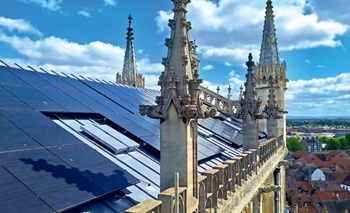
Success requires understanding each site in detail.