





Sourcing Scottish slate in the 21st century
Slate quarrying in Scotland did not cease due to a lack of available material: there are plenty of suitable sources for roofing slate with the potential to be redeveloped today.

|
| One of the now disused Cullipool slate quarries on the Isle of Luing (Photo: Imogen Shaw) |
Contents |
Introduction
Scottish slate is a quintessential part of Scotland’s traditional built environment, once widely used for roofing due to its durability and ready availability in many locations. Typically smaller in size, thicker and more variable in colour than slates found in England and Wales, the prevalent use of Scottish slate imparts a unique character to traditional roofs throughout Scotland. At the industry’s peak in the 19th century, these slates were exported as far afield as the USA, Australia and New Zealand.
Despite this pedigree, no roofing slate has been quarried in Scotland since 1965. The Scottish slate roofs that remain are increasingly in need of partial or full replacement as the slates reach the end of their lifespan. As such, the dearth of supply of new Scottish roofing slates, and the dwindling availability of reclaimed slates from re-roofed or demolished buildings, poses an ever-increasing threat to Scotland’s built heritage. Recent work by the British Geological Survey (BGS) and Historic Environment Scotland (HES) seeks to tackle this problem, finding that several disused historic slate quarries in Scotland have the potential to supply roofing slate once more [1].
Types of Scottish slate
Geologically speaking, three different types of slate have been quarried for roofing in Scotland: West Highland Slate, Highland Border Slate and Macduff Slate. Other stones, including the greywackes of the Scottish Borders, and the flagstones of Angus, Caithness and Orkney, were also quarried for roofing tiles, but these are not ‘true slates’ in the geological sense. Slates are often known by the name of the local area from which they were sourced (such as Ballachulish, Aberfoyle and Foudland Slates).
West Highland Slate is the most famous of the Scottish slates, used internationally. The West Highland Slate islands of Seil, Easdale, Belnahua and Luing are known as ‘the islands that roofed the world’ for their history of global export. In all, West Highland Slate was produced from at least 64 separate quarries in Argyllshire and Inverness-shire, mainly centred around the villages of Ballachulish, Easdale, Cullipool and Tayvallich [2]. It is the darkest Scottish slate, typically dark grey to dark blue-black, and displays a distinctive crenulation (rippling) on the surface. Small iron pyrite (‘fool’s gold’) cubes up to 1 cm in size are common.
Highland Border Slate was worked at around 80 or so quarries, all located within a narrow swathe of ground that extends from the Isle of Bute up to Dunkeld in Perthshire, along the boundary of the highlands. Although not as widely exported as West Highland Slate, Highland Border Slate was a regionally significant roofing material. Ranging in colour from reddish/purplish grey to grey and greenish grey, it can appear striped across the face of the slate if the original bedding of the rock is oblique to the cleavage. This gives rise to the particularly distinctive ‘tartan’ slates of Aberfoyle, which are striped in alternating red and green.
Macduff Slate was sourced from a few hundred, often comparatively small quarries clustered around the Hills of Kirkney and Tillymorgan (the ‘slate hills’) in Aberdeenshire and some other quarries in Banffshire, and it is a significant traditional roofing material in this corner of Scotland. Macduff Slate is typically grey in colour and has a slightly rough but generally flat, non-rippled surface.
The current Scottish slate market
The only way to obtain genuine Scottish slate for roof repairs today is by reclaiming slates from older buildings when they are re-roofed or demolished. This finite resource is rapidly dwindling. Slates from England and Wales can be used for replacement in some cases but are rarely a satisfactory match.
Instead, the vast majority of slate used nowadays in Scotland is imported from outside the UK, most significantly from Spain. This not only threatens the character of many culturally significant buildings and areas, but also results in around £120 million per year exiting the UK’s economy. If this instead went to local quarrying enterprises, it would create and sustain much-needed skilled jobs in rural areas. Furthermore, over the last decade, the price of imported slate has increased at more than twice the rate of inflation. The inability to meet demand with our own roofing slate therefore leaves Scotland, and the UK as a whole, increasingly vulnerable to erratic and rapidly increasing import prices, with limited alternatives.
Prospects for the industry
The good news is that slate quarrying in Scotland did not cease due to a lack of available material. There are plenty of geologically suitable sources for roofing slate with the potential to be redeveloped today. All three Scottish slate types are historically significant and unique, and may have potential to become the focus of feasible modern enterprises, filling a significant gap in the current market for roofing materials. A recent report published by British Geological Survey (BGS), funded by HES, found that 32 historic sources of Scottish roofing slate still have ‘development potential’, based on the historic significance of the stone and other factors, such as quarry accessibility and local environmental protections.
Cullipool, Isle of Luing
One of the sources of slate with development potential is at Cullipool on the Isle of Luing. Situated just north of the conservation village of Cullipool lie six disused West Highland Slate quarries, the last of which was worked until 1965. The slate resource at these quarries remains relatively well exposed and is not situated in statutorily protected land. The resumption of quarrying activity at Cullipool also has the potential to directly address two pressing issues the islanders currently face: population decline and coastal erosion.
At its height, the slate quarrying industry on Luing employed 170 men and sustained a thriving island population of 600 people. Today, the population of Cullipool is approximately one-quarter of its peak size, and around two thirds of the inhabitants are over the age of 65. Limited opportunities for training and employment on the island make it difficult for young people and families to remain on or move to the island, even if they wish to do so. The resumption of a small-scale slate quarrying enterprise on the island would create much-needed employment opportunities beyond the limitations of the highly seasonal and weather-dependent tourism sector.
The ground beneath the village of Cullipool was built up with the waste rock that was in continual supply as a by-product of slate quarrying. Historically, the tipping of slate waste from the quarries on to the fronting beach has protected the village from the impact of coastal erosion. The cessation of quarrying and the resultant shortage of waste being supplied to the beach has allowed the coastline to progressively advance towards the village. Wave overwash during Storm Aiden in 2019 flooded homes in the village and destroyed part of the stone garden wall of one of the most seaward properties. Without intervention, it is likely that similar storm events will continue to threaten the historic village.
Following a successful application for minerals planning consent in 2024, the Isle of Luing Community Trust (ILCT), supported by HES and Highlands and Islands Enterprise, has recently secured £1.75 million funding from the Scottish Government for the renewed extraction of roofing slate. This initiative plans not only to produce the first new West Highland Slate in 60 years, but also to create between four and seven jobs on the island. It will provide around 30,000 m3 of waste rock for nourishing the slate beach, moving the shoreline back to 1990s levels.
This exciting project seeks to demonstrate that a renewed quarrying industry can deliver multi-faceted benefits, and it will re-establish a supply of a crucial material for the conservation of traditional roofs in Scotland. The project aims to begin test production of roofing slate in summer 2026. Interested parties should monitor the ILCT social media pages (@luingtrust on Instagram, Isle of Luing Community Trust on Facebook and LinkedIn).
References
- [1] Everett, PA and Shaw IR (2024) ‘Development potential for building stone resources in Scotland’, British Geological Survey Open Report, OR/24/020. Available at nora.nerc.ac.uk/id/eprint/537904/
- [2] The Building Stone Database for Scotland. Available at webservices.bgs.ac.uk/buildingstone
This article originally appeared in the Institute of Historic Building Conservation’s (IHBC’s) Context 184, published in September 2025. It was written by Imogen Shaw and Graham Briggs. Imogen Shaw is building stone scientist at the British Geological Survey. Graham Briggs is project manager at Historic Environment Scotland.
--Institute of Historic Building Conservation
Related articles on Designing Buildings Conservation.
- A code of practice for slate and stone roofing.
- Conical roof slating.
- Conservation area.
- Conservation.
- Heritage.
- Historic environment.
- IHBC articles.
- IHBC.
- Photovoltaics.
- Reslating an ancient water mill.
- Roofing.
- Slate.
- Solar panels.
- Stone.
- Successful solar generation in the historic environment.
- Tiles.
- Types of roof.
- Understanding pitched roofs.
IHBC NewsBlog
IHBC sponsors Gardens Trust event 23-4 Sept 2026
.jpeg)
'Learning from the Past, Shaping the Future’ takes place in Milton Keynes
Renovations to Frank Lloyd Wright's Fallingwater complete
.jpg)
World Heritage Preserved project opens house for tours again
Shakespeare Birthplace Trust places Hall's Croft on HAR Register
Stratford-upon-Avon home of Shakespeare's daughter is 'At Risk'
Lady Grange’s House repaired on St Kilda
.jpg)
National Trust for Scotland repairs stone cleit with link to famous island resident
Griff Rhys Jones on BBC Radio 4 Today programme
,_Green_Lane,_Derby.jpg)
The Victorian Society’s President unveiled its latest Top Ten Endangered Buildings 2026.
Need a MATE? Book your place now.

IHBC offers free webinars on applying for IHBC accreditation (Full & Associate).
UK Stained Glass Repository finds windows new homes

How are stained glass windows are rescued, stored and repurposed?
APPGEBE report sets high aims for quality
'Government must not sacrifice quality in drive to build 1.5m homes'
New measures protect Historic Shipwrecks from heritage crime

Underwater cultural heritage benefits from new HE guidance
How could the City of London skyline look in 6 years' time?

Visualisation shows approved planning applications as completed buildings
National Trust for Scotland calls for VAT cuts

Heritage neglect is encouraged by current policies
IHBC's 'Context' Issue 186 features Industrial Heritage

IHBC's members' journal reports on the challenges of conserving infrastructure
Book now for IHBC Annual School 2026

IHBC Annual School is taking place 18-20 June 2026 in Newcastle
RICHeS Research Infrastructure offers ‘Full Access Fund Call’
RICHeS offers a ‘Help’ webinar on 11 March
Latest IHBC Issue of Context features Roofing
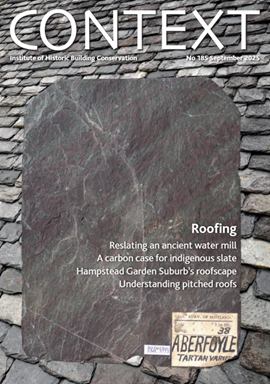
Articles range from slate to pitched roofs, and carbon impact to solar generation to roofscapes
Three reasons not to demolish Edinburgh’s Argyle House

Should 'Edinburgh's ugliest building' be saved?
IHBC’s 2025 Parliamentary Briefing...from Crafts in Crisis to Rubbish Retrofit
IHBC launches research-led ‘5 Commitments to Help Heritage Skills in Conservation’
How RDSAP 10.2 impacts EPC assessments in traditional buildings

Energy performance certificates (EPCs) tell us how energy efficient our buildings are, but the way these certificates are generated has changed.