





Wind turbine
Contents |
[edit] Introduction
People have harnessed the power of the wind for thousands of years, and with the ever-increasing pressure to reduce greenhouse gas emissions, wind energy is becoming a more important part of our generating mix.
Wind turbines convert the kinetic energy they harnesses from the wind and turn it into electrical energy. They are typically installed onshore, however increasingly they are also being installed offshore, where there is more frequent and powerful wind. The size of developments vary from generating power for individual households, farms or local communities, right up to large, commercial wind farms.
[edit] Components
A commercial wind turbine will typically include the following components:
- Tower: The main body of the turbine, which is typically cylindrical, and can be up to 75 metres tall.
- Rotor blades: Usually a turbine will have between one and three blades made from fibreglass-reinforced polyester or wood-epoxy. They can be up to 80 metres in diameter and rotate between 10-30 times per minute.
- Yaw mechanism: This will rotate the turbine to face the direction of the wind.
- Wind speed and direction monitor: The wind direction is monitored with sensors and the tower head is turned to face the wind. At very high wind speeds, the turbines will be stopped to protect them from damage.
- Gear box: The majority of turbines are fitted with gear boxes but some now have direct drives.
[edit] Small wind turbines
There are a variety of small and medium-sized turbines for household installations. The exact specification will depend on the individual’s requirements.
A small wind turbine will usually suit an individual household or smallholding and can generate up to 50kW. They are usually up to 35 metres in height, depending on the siting.
A medium turbine would be suitable for an individual with more land, such as a large farm, community or business. They can range from 50 to 500kW in power and may be between 25 and 55 metres tall.
[edit] Financial incentives
The generation of power through the installation of a wind turbine can help reduce electricity bills and the need for power station generation, and in some situations can qualify for the feed-in tariff scheme, under which consumers who generate their own electricity from a renewable or low-carbon source can qualify for a payment for each unit of electricity generated. Other applicable schemes include the Energy Efficiency Financing scheme, and previously, the Green Deal (cancelled in 2015).
[edit] Planning permission
In some situations, it is possible to install wind turbines at a property without the requirement for planning permission, as long as certain conditions are adhered to. This varies depending on factors including location, siting, type and so on. It is advisable to consult local authority to confirm the requirements. Further information can be found on the Planning Portal website.
See also research briefing guidance 17 May 2024 'Planning onshore wind'
[edit] Building regulations
Typically, for the installation of a turbine onto a property, the building regulations will apply.
For the installation of a standalone turbine, the electrical works will fall under the regulations, but the actual installation may not.
Under the competent person scheme, it may be possible for an installer to certify the works without the requirement for local authority building control consent.
[edit] Policy
In March 2019, Energy and Clean Growth Minister Claire Perry announced the launch of a new joint government-industry Offshore Wind Sector Deal intended to supply a third of all UK electricity by 2030. Ref https://www.gov.uk/government/news/offshore-wind-energy-revolution-to-provide-a-third-of-all-uk-electricity-by-2030
[edit] Related articles on Designing Buildings Wiki.
- Allowable solutions.
- Biomass.
- CHP.
- Domestic micro-generation.
- Earth-to-air heat exchangers.
- Energy storage.
- Feed in tariff.
- Fuel cell.
- Geothermal energy.
- Geothermal piles
- Ground energy options.
- Ground pre-conditioning of supply air.
- Ground source heat pumps.
- Hydroelectricity.
- Large scale solar thermal energy.
- Renewable energy.
- Renewable heat incentive.
- Solar photovoltaics
- Solar thermal systems.
- Sustainability.
- Sustainable development: energy challenge.
- The Future of Electricity in Domestic Buildings.
- Thermal labyrinths.
- Tidal lagoon power.
- Wind Energy in the United Kingdom.
- Wind farm.
- Windmill.
- World leaders urged to embrace wind energy.
- Zero carbon homes.
- Zero carbon non-domestic buildings.
[edit] External references
Featured articles
Check out some of the best features and news from Designing Buildings as well as key stories from around the web.
Bridging the gap between clients and contractors

Concerns remain around contractor quality, capability, and delivery.
Construction Management, 10 June.
Heat pumps beat boilers in new home tests.
Building Safety Act implementation in Wales

CIAT to host industry panel on 26 June.

New and updated CLC building safety guidance.
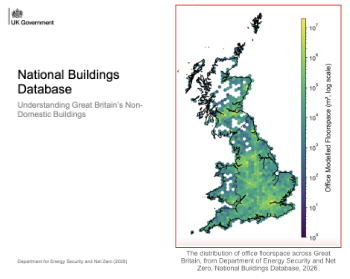
New UK National Buildings Database.
Building Safety Wiki Interviews

Chief executive of the British Woodworking Federation.
Planning condition discharge in England and Wales

A brief explanation from a building compliance expert, with further links.
Overheating guidance and tools for building designers

Guidance for dealing with element of building fabric control that have increasing importance.
Shading for housing, a design guide

From the Good Homes Alliance and British Blind and Shutter Association.
UK Standard Skills Classification (SSC)

A shared framework for describing skills needs.
Social media ban consultation comes to close

CIOB urges UK Government to consider social media’s role in careers guidance in ban debate.