




UK Research and Innovation UKRI
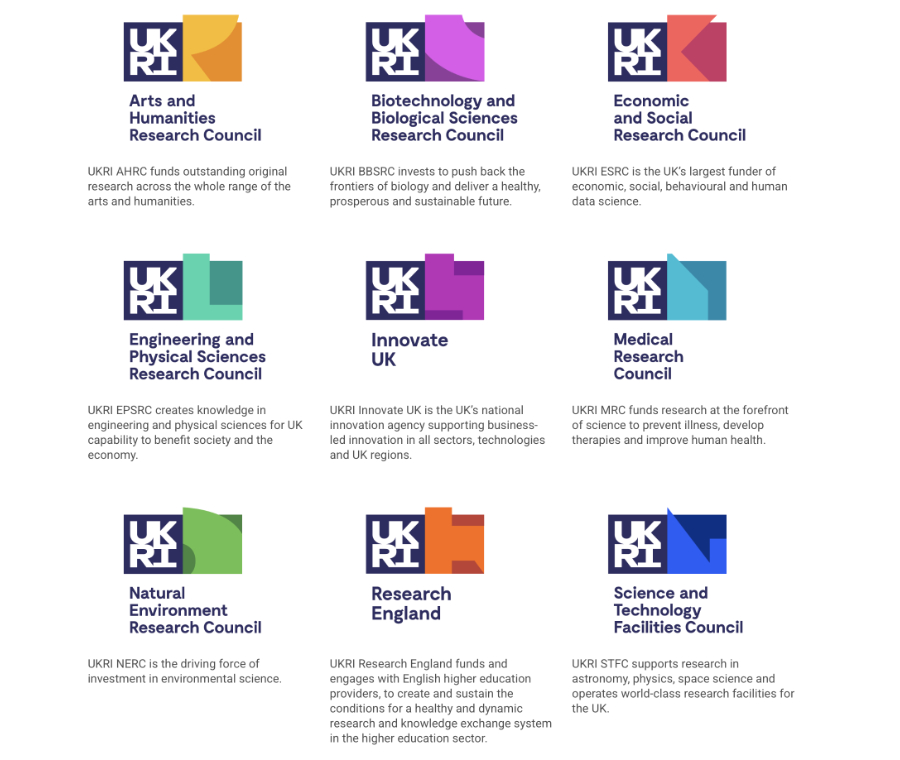
UK Research and Innovation (UKRI) is a non-departmental public body sponsored by the Department for Science, Innovation and Technology (DSIT) as the national funding agency investing in science and research in the UK. UKRI is made up of nine councils that spanning all disciplines and sectors, working collectively and individually to foster world-class research and innovation. The nine Councils and who they support are:
- The Arts and Humanities Research Council (AHRC) supports: Creative Arts Research Infrastructure (legally independent of UKRI), Convergent Screen Technologies and Performance in (embedded in a university), Creative Industries Policy & Evidence Centre (embedded in a university), Design Council (legally independent of UKRI), Modern Slavery Policy and Evidence Centre (embedded in a university), and Research Infrastructure for Conservation and Heritage Science (wholly owned by UKRI).
- The Biotechnology and Biological Sciences Research Council (BBSRC) supports: Babraham Institute (legally independent of UKRI), Earlham Institute (legally independent of UKRI), IBERS (embedded in a university), John Innes Centre (legally independent of UKRI), Quadram Institute (legally independent of UKRI), Rothamsted Research (legally independent of UKRI), The Roslin Institute (embedded in a university), The Pirbright Institute (legally independent of UKRI)
- The Engineering and Physical Sciences Research Council (EPSRC) supports: Alan Turing Institute (legally independent of UKRI), Henry Royce Institute (embedded in a university), Rosalind Franklin Institute (legally independent of UKRI). EPSRC and the Science and Technology Facilities Council (STFC) jointly support: National Quantum Computing Centre (wholly owned by UKRI)
- The Economic and Social Research Council (ESRC) supports: ADR-UK (wholly owned by UKRI), Centre for Economic Performance (embedded in a university), Cohort for Longitudinal Studies Enhancement Resources (embedded in a university), Institute for Fiscal Studies (legally independent of UKRI), The Productivity Institute (embedded in a university), SDR-UK (wholly owned by UKRI) and UK Data Service (legally independent of UKRI).
- Innovate UK supports: Cell & Gene Therapy Catapult (legally independent of UKRI), Connected Places Catapult (legally independent of UKRI), Compound Semiconductor Applications Catapult (legally independent of UKRI), Digital Catapult (legally independent of UKRI), Energy Systems Catapult (legally independent of UKRI), High Value Manufacturing Catapult (legally independent of UKRI), Medicines Discovery Catapult (legally independent of UKRI), Offshore Renewable Energy Catapult (legally independent of UKRI), Satellite Applications Catapult (legally independent of UKRI), and UK Agri-Tech Centre (legally independent of UKRI).
- Medical Research Council (MRC) supports: Centre for Macaques (wholly owned by UKRI), Francis Crick Institute (legally independent of UKRI), Health Data Research UK (legally independent of UKRI), Mary Lyon Centre (wholly owned by UKRI), MRC Laboratory of Molecular Biology (wholly owned by UKRI), MRC Laboratory of Medical Sciences (wholly owned by UKRI), Nucleic Acid Therapy Accelerator Hub (wholly owned by UKRI), UK Research Complex at Harwell (wholly owned by UKRI), UK Biobank (legally independent of UKRI), and UK Dementia Research Institute (legally independent of UKRI)
- Natural Environment Research Council (NERC) supports: British Antarctic Survey (wholly owned by UKRI), British Geological Survey (wholly owned by UKRI), National Centre for Atmospheric Science (embedded in a university), National Centre for Earth Observation (embedded in a university), National Oceanography Centre (legally independent of UKRI), and UK Centre for Ecology and Hydrology (legally independent of UKRI)
- Research England supports: The Institute of Zoology (legally independent of UKRI) and The School of Advanced Study (embedded in a university)
- Science and Technology Facilities Council (STFC) supports: Boulby Underground Laboratory (wholly owned by UKRI), Central Laser Facility, including EPAC (wholly owned by UKRI), Chilbolton Observatory (wholly owned by UKRI), ASTeC (wholly owned by UKRI), Diamond Light Source (legally independent of UKRI), ISIS Neutron and Muon Source (wholly owned by UKRI), National Quantum Computing Centre (wholly owned by UKRI), RAL Space, including NSTF (wholly owned by UKRI), The Hartree Centre (wholly owned by UKRI), and The UK Astronomy Technology Centre (wholly owned by UKRI)
- Cross-UKRI: The Faraday Institution (legally independent of UKRI)
Bringing together the domain expertise of each council allows UKRI to create an aligned portfolio of council-specific and collective activities that support a thriving research and innovation system. It facilitates healthy disciplines and sectors that are fully connected and empowered to tackle interdisciplinary and cross-sector challenges and opportunities of the present and the future.
To achieve this, some of UKRI’s activities are managed at individual council level, while others are managed collectively, across councils. Good examples are the UKRI strategic themes which UK Research and Innovation (UKRI) has placed at the heart of its five-year strategy these are:
- build a green future
- build a secure and resilient world
- create opportunities and improve outcomes in communities across the country
- secure better health, ageing and wellbeing for everyone
- tackle infections
These aim to harness the collective expertise and investments of the councils to address major challenges such as tackling infection or building a green future. Council investments are leveraged with a collectively held budget invested to bridge gaps, create synergies and build partnerships with other funders, nationally and globally.
For more information about UKRI, its councils, themes, funding opportunities and work visit https://www.ukri.org/
[edit] Related articles on Designing Buildings
- Arm's length body ALB.
- Construction 2025.
- Construction Innovation Hub.
- Digital Built Britain.
- Future building, The Low Impact Building Innovation Platform.
- Government Construction Strategy.
- i3P
- Improving health and safety using BIM.
- Innovate UK
- Infrastructure Exports: UK (IE:UK).
- Low Impact Building Innovation Platform.
- Manufacturing Technology Centre.
- Modern Built Environment Knowledge Transfer Network.
- National Platform for the Built Environment.
- Technology Strategy Board
- Transforming Construction Alliance.
Featured articles
Check out some of the best features and news from Designing Buildings as well as key stories from around the web.

The Building Safety Regulator announces a call for evidence.

Government approach could undermine delivery and regeneration.
World's first mass timber data centre.

The overlooked environmental aspect of data centre development.
Introduction to radon awareness

New technical information sheet published by CIOB.

Updated supplier guide can help electrical contractors engage with NHP.

CIAT confirm the winners of the 2026 architectural technology awards.

Government launches a one stop shop for flood preparedness.

Sir Edwin Lutyens: Britain's greatest architect? Book review.

CIOB publishes free template to help assess and manage risks.
ECA's reflections on Party Conference season

Burnham wants to be confident of winning before asking for a fresh mandate.
New Chief Construction and Scientific Adviser

Sergio Cavalaro, Professor of Infrastructure Systems at Loughborough University.
Building safety levy for England

CIAT publish estimator tool for members.