






Types of lift doors

Contents |
Introduction
There are many different types of doors that can be installed in lifts, all of which can be divided into manual and automatic. Manual doors are usually opened and closed manually by the user, while automatic ones are powered by a door operator. Both manual and automatic doors can be further subdivided into different categories.
Manual doors
Typically found in older buildings, these lift doors are normally operated by the user, although some close automatically. They are most common in older and small European lifts dating back to the 1950s and 1970s.
In some cases, the door can be spring-loaded, meaning the gate cannot be left open, or the gate might close automatically when the user presses the button and partially or fully open when the lift arrives at a floor.
Automatic doors
These types of lift doors are considered the standard in modern buildings. Nearly all automatic doors are powered by a door operator in the cabin and can be found in a wide variety of locations, such as retail stores, schools, hospitals, airports, and shopping centres. Automatic doors offer many different features that manual doors do not, including traffic sensors, pressure sensors, speed controls, and obstacle detection.
They can also have different types of opening. Single opening refers to a single panel door the width of the doorway that opens to the left or the right. It is popular in older buildings across North America. Centre opening doors are common in many buildings; they have two panels that meet in the middle and slide open to the side. These types of doors are highly efficient but do not allow for the full use of the door width.
Swing doors
Swing doors are commonly installed for pedestrian use. They can open and close automatically and are easily installed in residences and other similar buildings. Swing doors come in a variety of styles:
- Solid doors.
- Vision panel doors.
- Glass doors.
- Aluminium doors.
- Stainless steel doors.
- Fire rated doors.
- Eco bus folding doors.
Telescopic sliding doors
Telescopic doors are usually found in small spaces, as their opening mechanism does not require the doors to slide all the way through the side walls. The doors open and retract, requiring less interior wall space and providing a larger automatic opening than traditional lift doors. Telescoping swing doors can have different styles:
- Sliding doors.
- Central opening or panel opening.
- Stainless steel doors.
- Glass doors.
- Fire rated doors.
Eco bus folding doors
These doors are typically installed when both weight and space are limited. Eco bus folding doors do not change the weight of a lift or its cabin structure, due to their reduced dimensions and folder opening. An integrated mechanical release system is also available for swing landing doors.
Just like other types of lift doors, eco bus folding doors are present in a wide range of styles, shapes and finishes:
- Oval shaped vision panel.
- Stainless steel doors.
- Aluminium doors.
- Car door lock.
- Painted doors.
Bespoke
Bespoke doors are also available and can be swing, telescopic or eco bus folding doors.
Find out more
Related articles on Designing Buildings Wiki
- Considerations When Installing a Residential Lift.
- Counterweights.
- Firefighting lift.
- Landings in buildings.
- Lifting device.
- Lifting platform.
- Lift motor room.
- Lifts and Escalators: A Quality Perspective.
- Lifts and Their Special Operating Modes.
- Lifts for office buildings.
- Smart elevators.
- The importance of service lifts.
- The science of lifts.
- Wheelchair platform stairlifts.
--Nathan Massey 14:30, 11 Jul 2017 (BST)
Featured articles and news

We're expanding our collaborative mission by launching DB Intelligence, an exclusive market research advisory panel. Built environment professionals can now get paid to share their expertise on industry trends, products and services.
Panel members receive direct financial incentives for participating in research projects like short surveys, 1-2-1 interviews and focus groups. Register today to shape the future of the construction sector.
Building Safety Wiki Interviews

Chief executive of the British Woodworking Federation.
Planning condition discharge in England and Wales

A brief exoplanation from a building compliance expert, with further links.
Overheating guidance and tools for building designers

Guidance for dealing with element of building fabric control that have increasing importance.
Shading for housing, a design guide

From the Good Homes Alliance and British Blind and Shutter Association.
UK Standard Skills Classification (SSC)

A shared framework for describing skills needs.
Social media ban consultation comes to close

CIOB urges UK Government to consider social media’s role in careers guidance in ban debate.
The latest of eight Skills England apprenticeship units

The addition of battery manufacturing welcomed by ECA with a warning about the risks of fast-tracked apprenticeship units.
Building Control Independent Panel final report

A precis of a key report led by Dame Hackitt with full recommendations and link to the government response.
Building Safety recap April, 2026
A short and longer run-through of the month, with links to further information and sources.
CIAT May 2026 briefing.

From medieval scribes to modern word art.

ECA welcomes crackdown on late payment and push for clean energy, whilst CIOB seek fixed cladding removal timeframes.
Cyber Security in the Built Environment
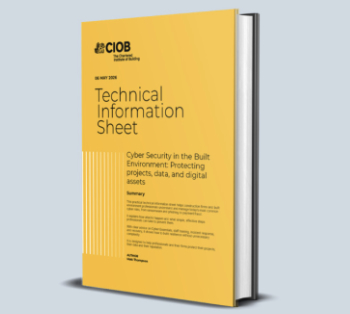
Protecting projects, data, and digital assets: A CIOB Academy TIS.
Managing competence in the built environment
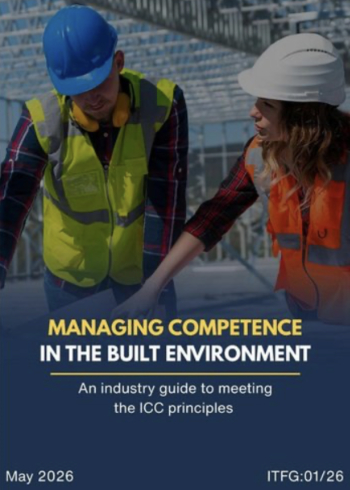
ITFG publishes new industry guide on how to meet the ICC principles.
Comments