




Reform of the fire engineering profession

Contents |
[edit] Nature of the reform
The government committed to implementing the Grenfell Tower Inquiry Phase 2 Report recommendations on 26 February 2025, some of these related to fire engineers, with the aim of improving public safety by developing a 'highly skilled, sustainable profession underpinned by strong professional accountability'. In response to the Inquiry’s request for clarity on professional standards, the Fire Engineers Advisory Panel was formed in April 2025 and subsequently issued an Authoritative Statement defining the knowledge and competencies expected of a competent fire engineer. The Policy paper: Fire Engineers Advisory Panel: Authoritative Statement was published 17 December, 2025 along with a separate next steps statement that outlines how the government intends to put both the Inquiry’s recommendations and the Panel’s advice into effect.
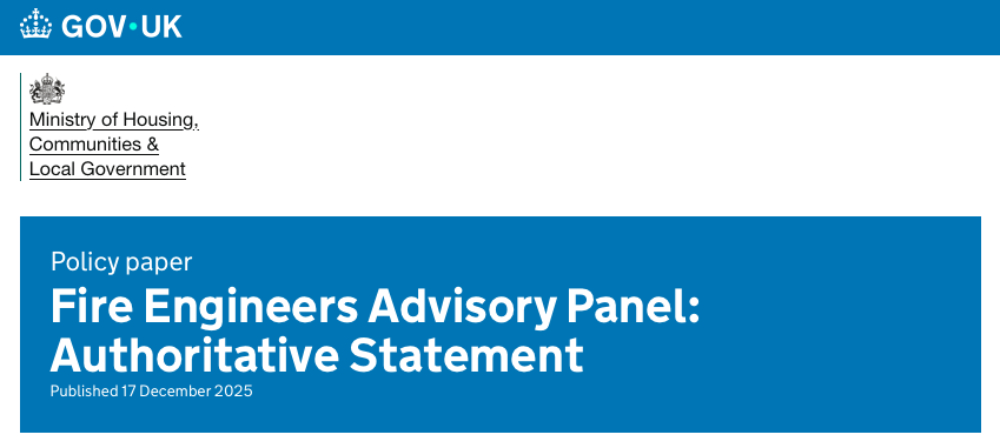
In the introduction to the paper the panel states: "In producing this statement, the Panel has grounded its work in a respectful acknowledgement of the devastating loss of life at Grenfell Tower and the profound societal impact that the tragedy continues to have. It does not prescribe a competency framework or detailed standards but aims to:
- present a coherent and positive vision for the future state of the regulated fire engineering profession and those who work in it
- provide a guide for any future regulatory body, education institution delivering accredited fire engineering qualifications and other stakeholders in the fire safety sector
- steer the fire engineering profession to take proactive steps to consider and strengthen its own competencies and ethics ahead of the introduction of legal requirements, including the regulation of title and function
"Through the Panel’s research and engagement with stakeholders, there has been broad consensus that the approach set out is sensible, urgently required and challenging to achieve. The Panel recognises that delivering the intent set out within this statement, alongside the wider recommendations of the Inquiry, is a long-term endeavour that requires careful phasing and prioritisation. The government’s plans to achieve this are set out in the Next Steps document which accompanies this statement."
[edit] Reactions to the statement
[edit] Institution for Fire Engineers welcomes statement
The Institution for Fire Engineers said: "Having actively contributed to its development, the IFE welcomes this important publication which provides much needed clarity.
"As the global body for fire engineers, the IFE recognises the significance of this statement in shaping best practice and supporting the safety of communities. We will now consider the publication and review its content in light of our responsibilities as a Professional Engineering Institution.
"Our commitment remains to uphold the highest standards of competence and ethics within the fire engineering profession, ensuring that guidance and policy continue to reflect the needs of society and the built environment."
[edit] Government response in next steps on fire engineering profession reform
In response to the statement the Government also published its Next steps on fire engineering profession reform, which went through the points of the statement responding to items such discussing how to regulate and build the profession along with announcing the formation of the Fire Engineers Transitional Board. The statement concluded that
"The government is committed to delivering a clear, robust and modernised regulatory framework for fire engineering that strengthens public safety, supports a highly skilled profession, and responds to the lessons of the Grenfell Tower tragedy.
"The Authoritative Statement and this document mark the beginning of a partnership between government, industry, regulators, and higher education to build a profession equipped for the future."
[edit] Problem Statement
The Grenfell Tower fire exposed deep systemic failures in the building safety regime, including deficiencies in professional competence, ethical standards, and regulatory oversight. Unclear accountabilities, inconsistent standards, and weak assurance mechanisms enabled unsafe practices, resulting in catastrophic loss of life and long-term societal harm. The Inquiry highlighted how these structural weaknesses left residents inadequately protected.
Particular concern was raised about fire engineering as a high-risk profession lacking a coherent educational framework and consistent entry requirements. There is no single recognised pathway into practice, accredited programmes and chartership uptake are uneven, and ethical formation is insufficiently embedded. This fragmentation, combined with over-specialisation and limited capacity, has produced significant variability in competence and undermined confidence in the profession’s ability to support an effective regulatory system.
To address these failings, fire engineering must become a properly regulated profession delivering clear public safety outcomes. This requires enforceable standards for entry and practice, a nationally recognised competency framework, mandatory accreditation of education routes, and robust oversight of professional and ethical conduct. The objective is a resilient, accountable workforce capable of consistently delivering safe buildings, protecting vulnerable people, and restoring public trust.
The inquiry's recommendation and he government’s plan is to regulate both the title and function of fire engineers, emphasising public safety and professional integrity. A protected title will be established, legally restricting its use to those who meet defined education, ethical, and competency standards, preventing misrepresentation and ensuring consumer confidence. Statutory regulation will also define the specific functions that only registered fire engineers can perform, including responsibility for developing and managing fire safety strategies. By codifying these responsibilities, the regulation aims to eliminate ambiguity, uphold high standards of practice, and ensure that fire engineering work is carried out by qualified professionals the public can trust.
[edit] Fire safety strategy as core function
The Panel emphasises that the core, protected function of a fire engineer is the development, delivery, and periodic review of a building’s fire safety strategy throughout its entire lifecycle—from design and construction to occupation, ongoing use, and decommissioning. The strategy should comprehensively describe all building features related to fire, demonstrate expected fire performance, explain the interaction and reliability of safety systems, detail measures for occupant safety—including vulnerable groups—and outline plans for fire service intervention and long-term maintenance. Central to this role is integration: the fire engineer coordinates the contributions of architects, structural engineers, and MEP specialists, ensuring that individual technical decisions collectively form an effective, whole-building fire safety solution that prevents fire where possible, limits its spread, and enables safe evacuation and operational response.
The Panel supports making the production of the fire safety strategy a restricted function for registered fire engineers, initially focusing on higher-risk buildings as recommended by Inquiry Recommendation 10, while advising government to consider a phased expansion to other buildings and critical infrastructure where the potential consequences of failure are greatest. It also emphasises the importance of the fire engineer’s role during a building’s occupation, ensuring periodic review of the strategy and clarifying interactions with other professionals, such as fire risk assessors, to maintain safety as use and maintenance evolve. Beyond strategy development, fire engineers also operate in regulatory, enforcement, operational, and advisory roles—including product testing, certification, and evaluation of new materials—where the Panel recommends applying comparable standards of qualification, competence, ethics, and oversight to uphold consistent, high-quality fire safety practice across all aspects of the built environment.
[edit] Professional, legal and contractual responsibilities
Fire engineers play a pivotal role in ensuring compliance with statutory fire safety duties, either acting as duty holders or supporting them, while collaborating with other disciplines. Their responsibilities go beyond minimum legal requirements, encompassing professional duties to the public, clients, and the broader construction and safety system. Regulation should reflect a social contract: fire engineers are entrusted to prioritise public safety, advise clients on legal obligations, and uphold ethical standards, while clients and collaborators must integrate fire engineering guidance where functions are formally reserved to the profession. The Panel highlights that effective fire safety delivery relies on the competence, cooperation, and coordination of all disciplines, and clearer regulation will define these interfaces, standardise responsibilities, and support consistently high standards essential for safe buildings and critical infrastructure.
[edit] Attributes and next steps
The panel goes on to describe the attributes or skills, knowledge, experience and behaviours required by fire engineers to fulfil the functions it has set out. Thus a competent fire engineer needs strong technical knowledge and the ability to work across disciplines, including an understanding of core architectural and engineering principles:
- fire dynamics
- prevention
- human behaviour
- building structures, systems and operations
- fire-fighting needs, alongside good analytical and communication skills
Building on the Fire Engineers Advisory Panel’s work, the next phase involves government and the sector advancing the remaining inquiry recommendations, including establishing statutory regulation for fire engineers. Achieving these outcomes will require a phased, carefully managed transition, with detailed implementation guided by further consultation as outlined in the accompanying Next Steps document. This statement marks a major step toward a regulated, accountable fire engineering profession, setting a clear direction for cultural and professional change that prioritises public safety and wellbeing, fosters collaboration and competence, and supports a built environment that consistently delivers fire-safe outcomes.
[edit] Related articles on Designing Buildings
- Accountable Person
- BSI Built Environment Competence Standards
- Building a Safer Future - Independent Review of Building Regulations and Fire Safety (Hackitt Review)
- Building Regulations – Part B
- Building Safety Act 2022
- Building Safety Regulator
- Building Safety recap January, 2026
- Building Safety wiki
- Engineer.
- Fire and rescue service.
- Fire authority.
- Fire detection and alarm system FDAS.
- Fire engineer
- Fire inspector.
- Fire safety design.
- Fire safety information.
- Fire safety officer.
- Fire safety strategy
- Golden thread
- Grenfell articles.
- Grenfell Tower fire.
- Higher Risk Buildings
- Regulator of Construction Products
- Regulatory Reform (Fire Safety) Order 2005
- The Fire Safety Act 2021
Quick links
[edit] Legislation and standards
Fire Safety (England) Regulations 2022
Regulatory Reform (Fire Safety) Order 2005
Secondary legislation linked to the Building Safety Act
Building safety in Northern Ireland
[edit] Dutyholders and competencies
BSI Built Environment Competence Standards
Competence standards (PAS 8671, 8672, 8673)
Industry Competence Steering Group
[edit] Regulators
National Regulator of Construction Products
[edit] Fire safety
Independent Grenfell Tower Inquiry