





Data and technology: Strengthening understanding for better retrofit outcomes
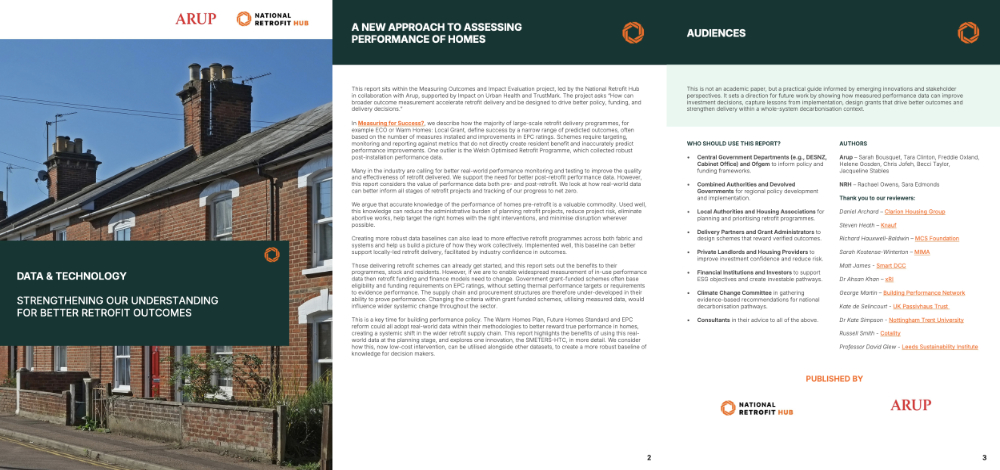
This report sits within the National Retrofit Hub’s Measuring Outcomes and Impact Evaluation project, delivered with Arup and supported by Impact on Urban Health and TrustMark. It explores how real-world performance data, including SMETER-HTC, can support better planning, design and delivery of retrofit.
Many schemes still rely on predicted performance and EPC ratings, which often fail to reflect how homes actually perform. Our report highlights how pre-retrofit measured data can reduce risk, avoid abortive works, target the right homes and improve resident experience. Stronger baselines can also support more confident, locally-led delivery.
Wider use of measured data will require updates to funding and policy frameworks. Current grant schemes often use EPC ratings alone, without asking for thermal performance evidence. Aligning eligibility criteria with measured data would help drive systemic change across the supply chain.
This is a key moment for building performance policy. The Warm Homes Plan, Future Homes Standard and EPC reform could all adopt real-world data to reward true performance.
Our report explores how SMETER-HTC, combined with other datasets, can create a more accurate baseline for decision makers at every stage of retrofit.
Recommended next steps include:
- Further research in combining different forms of measured data with SMETER-HTC
- Setting minimum data standards for portfolio decisions
- Embedding performance-based approaches in funding frameworks
- Providing guidance for landlords on using calculated HTC data
- Improving validation support for interpreting outputs
- Continuing sector dialogue on consistent measurement standards
- Download the full report to explore the findings and recommendations.
This report sits within the Measuring Outcomes and Impact Evaluation project, led by the National Retrofit Hub in collaboration with Arup, supported by Impact on Urban Health and TrustMark. The project asks "How can broader outcome measurement accelerate retrofit delivery and be designed to drive better policy, funding, and delivery decisions."
To download the full report follow this link
"In Measuring for Success?, we describe how the majority of large-scale retrofit delivery programmes, for example ECO or Warm Homes: Local Grant, define success by a narrow range of predicted outcomes, often based on the number of measures installed and improvements in EPC ratings. Schemes require targeting, monitoring and reporting against metrics that do not directly create resident benefit and inaccurately predict performance improvements. One outlier is the Welsh Optimised Retrofit Programme, which collected robust post-installation performance data.
"Many in the industry are calling for better real-world performance monitoring and testing to improve the quality and effectiveness of retrofit delivered. We support the need for better post-retrofit performance data. However, this report considers the value of performance data both pre-and post-retrofit. We look at how real-world data can better inform all stages of retrofit projects and tracking of our progress to net zero.
"We argue that accurate knowledge of the performance of homes pre-retrofit is a valuable commodity. Used well, this knowledge can reduce the administrative burden of planning retrofit projects, reduce project risk, eliminate abortive works, help target the right homes with the right interventions, and minimise disruption wherever possible.
"Creating more robust data baselines can also lead to more effective retrofit programmes across both fabric and systems and help us build a picture of how they work collectively. Implemented well, this baseline can better support locally-led retrofit delivery, facilitated by industry confidence in outcomes.
"Those delivering retrofit schemes can already get started, and this report sets out the benefits to their programmes, stock and residents. However, if we are to enable widespread measurement of in-use performance data then retrofit funding and finance models need to change. Government grant-funded schemes often base eligibility and funding requirements on EPC ratings, without setting thermal performance targets or requirements to evidence performance. The supply chain and procurement structures are therefore under-developed in their ability to prove performance. Changing the criteria within grant funded schemes, utilising measured data, would influence wider systemic change throughout the sector.
"This is a key time for building performance policy. The Warm Homes Plan, Future Homes Standard and EPC reform could all adopt real-world data within their methodologies to better reward true performance in homes, creating a systemic shift in the wider retrofit supply chain. This report highlights the benefits of using this real-world data at the planning stage, and explores one innovation, the SMETERS-HTC, in more detail. We consider how this, now low-cost intervention, can be utilised alongside other datasets, to create a more robust baseline of knowledge for decision makers."
[edit] Related articles on Designing Buildings
- Alterations to existing buildings.
- Building performance evaluation.
- Building performance evaluation in non-domestic buildings guide – an introduction to the tests and methods in non-domestic buildings
- Building performance metrics.
- Building use studies (BUS).
- Change of use class.
- Closing the gap between design and as-built performance.
- Defects liability period.
- Design quality indicator DQI.
- Do the building regulations apply to works to existing buildings?
- Demolition.
- End of contract report.
- Energy performance certificates.
- Extended aftercare.
- Initial aftercare.
- Maintenance.
- Material amendment.
- Material change of use.
- Minor material amendment.
- Migration strategy.
- Non material amendment.
- Occupation.
- PAS 2038:2021 Retrofitting non-domestic buildings for improved energy efficiency.
- Performance gap.
- Performance in use.
- Planning permission.
- Permitted development.
- Post occupancy evaluation process.
- Post opening project evaluation.
- Post project review.
- Principal designer.
- Renovation v refurbishment v retrofit.
- Retrofit.
- Retrofit projects and roles.
- Soft landings
- Types of work to existing buildings.
Featured articles
Check out some of the best features and news from Designing Buildings as well as key stories from around the web.

The Building Safety Regulator announces a call for evidence.

Government approach could undermine delivery and regeneration.
World's first mass timber data centre.

The overlooked environmental aspect of data centre development.
Introduction to radon awareness

New technical information sheet published by CIOB.

Updated supplier guide can help electrical contractors engage with NHP.

CIAT confirm the winners of the 2026 architectural technology awards.

Government launches a one stop shop for flood preparedness.

Sir Edwin Lutyens: Britain's greatest architect? Book review.

CIOB publishes free template to help assess and manage risks.
ECA's reflections on Party Conference season

Burnham wants to be confident of winning before asking for a fresh mandate.
New Chief Construction and Scientific Adviser

Sergio Cavalaro, Professor of Infrastructure Systems at Loughborough University.
Building safety levy for England

CIAT publish estimator tool for members.