




Elements of classical columns

Contents |
[edit] Introduction
A column is a structural element that transmits load from above to a supporting structure below. The word ‘column’ is associated in particular with elements that have a central shaft that is round in section.
Classical columns were generally constructed from stone. There are five basic styles of architecture that determine the form and decoration of classical columns;
[edit] Greek orders


For more information, see Greek Classical orders in architecture.

[edit] Roman orders
- Tuscan
- Composite
For more information, see Roman Classical orders in architecture.
Traditionally, a column is made up of a base, a shaft and a capital.
[edit] Base
The base is the lowest part or division of a column. Egyptian and Greek Doric columns were typically placed directly on the floor without a base. In contrast to this, Ionic columns had an elaborate base made up of groups of mouldings (decorative strips) and fillets (narrow bands with vertical faces).
An attic base for example is made up of:
- Lower torus (a semi-circular convex moulding).
- Scotia (a concave moulding between two fillets).
- Upper torus.
Columns may sit on a more complex pedestal, usually having a die (a square block between the column and base), a base and cornice. This may sit on a plinth giving a more even distribution of the column weight.
[edit] Shaft
The shaft is the portion of a column between the base and the capital:
- The Doric order is usually identified by its stout columns compared to the other orders. In Greece, Doric columns rested directly on the floor without a pedestal or base moulding. Roman Doric columns tend to be slimmer and sit on an Attic base.
- Ionic are generally thinner, and generally fluted.
- Corinthian columns are typically slender and fluted.
- Tuscan columns are unfluted with a simple base and unadorned capital and entablature.
The term ‘drum’ is used to describe the individual circular sections places, one on top of another, to construct the shaft of the column.
The ‘entasis’ describes the subtle curved profile of classical columns.
[edit] Capital
The capital comprises the uppermost elements of a column. While capitals differ according to the classical order, they usually include the following elements:
- Astragal. A small convex moulding around the bottom of the capital and the top of the shaft, below the necking layer.
- Necking: On a Doric column, the necking appears as a plain section beneath the capital and above the astragal.
- Bell: This is common to Corinthian columns and is the part of the capital between the neck moulding and the abacus that is shaped like a bell. It is usually decorated with acanthus leaves.
- Echinus: The decorative moulding that sits below the abacus and above the necking.
- Abacus: A square slab that sits on top of the column's capital and supports the architrave or arch. The function of an abacus is to broaden the support provided by the column.
- Volutes: A spiral form which is a distinctive element of the Ionic capitals.

[edit] Related articles on Designing Buildings
- Anta.
- Antiquities.
- Arcade.
- Architrave.
- Barrel vault.
- Bas-relief.
- Classical architecture
- Classical orders in architecture.
- Colonnade.
- Cornice.
- Cornice coving and architrave definitions.
- Difference between pillars and columns.
- Entablature.
- Entasis.
- Etruscan architecture.
- Fillet.
- Fluting.
- Flying buttress.
- Frieze.
- Herm.
- Knotted column.
- Moulding.
- Parthenon.
- Pedestal.
- Pediment.
- Pilaster.
- Pinnacle.
- Pteron.
- Roman Classical orders in architecture.
- Running dog pattern.
- Soffit.
- Trompe l’oeil.
- Types of column.
- Xystus.
[edit] External references
IHBC NewsBlog
Busaries open for IHBC's Annual School 10-12 June 2027

Apply for funded places for #IHBCBristolBath2027 until 1 February 2027
London's oldest restaurant given to National Trust

Rules will continue to open and income will fund conservation
No right to cross-pavment charging in England's conservation areas

Residents excluded from new permitted development rights
Save the Date for #IHBCBristolBath2027 on 'Climate Change & Significance'

Register now for updates on IHBC's Annual School 10-12 June 2027
Bath could pause UNESCO World Heritage Site status
Consultation on scheme to hit housing targets runs until 30 October 2026
Canals offer increasing innovation opportunities
Canal & River Trust sees canals playing role in UK's water security
IHBC sponsors Gardens Trust event 23-4 Sept 2026
.jpeg)
'Learning from the Past, Shaping the Future’ takes place in Milton Keynes
Renovations to Frank Lloyd Wright's Fallingwater complete
.jpg)
World Heritage Preserved project opens house for tours again
Shakespeare Birthplace Trust places Hall's Croft on HAR Register
Stratford-upon-Avon home of Shakespeare's daughter is 'At Risk'
Lady Grange’s House repaired on St Kilda
.jpg)
National Trust for Scotland repairs stone cleit with link to famous island resident
Griff Rhys Jones on BBC Radio 4 Today programme
,_Green_Lane,_Derby.jpg)
The Victorian Society’s President unveiled its latest Top Ten Endangered Buildings 2026.
Need a MATE? Book your place now.
IHBC offers free webinars on applying for IHBC accreditation (Full & Associate).
UK Stained Glass Repository finds windows new homes
How are stained glass windows are rescued, stored and repurposed?
APPGEBE report sets high aims for quality
'Government must not sacrifice quality in drive to build 1.5m homes'
New measures protect Historic Shipwrecks from heritage crime

Underwater cultural heritage benefits from new HE guidance
How could the City of London skyline look in 6 years' time?

Visualisation shows approved planning applications as completed buildings
National Trust for Scotland calls for VAT cuts
Heritage neglect is encouraged by current policies
IHBC's 'Context' Issue 186 features Industrial Heritage
IHBC's members' journal reports on the challenges of conserving infrastructure
Book now for IHBC Annual School 2026

IHBC Annual School is taking place 18-20 June 2026 in Newcastle
RICHeS Research Infrastructure offers ‘Full Access Fund Call’
RICHeS offers a ‘Help’ webinar on 11 March
Latest IHBC Issue of Context features Roofing
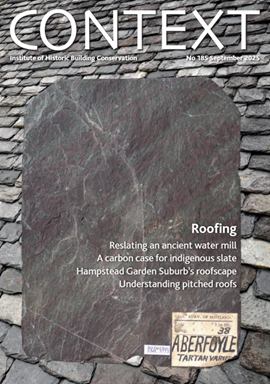
Articles range from slate to pitched roofs, and carbon impact to solar generation to roofscapes
Three reasons not to demolish Edinburgh’s Argyle House

Should 'Edinburgh's ugliest building' be saved?
IHBC’s 2025 Parliamentary Briefing...from Crafts in Crisis to Rubbish Retrofit
IHBC launches research-led ‘5 Commitments to Help Heritage Skills in Conservation’
How RDSAP 10.2 impacts EPC assessments in traditional buildings

Energy performance certificates (EPCs) tell us how energy efficient our buildings are, but the way these certificates are generated has changed.
Comments