





Building integrated windpower

Building integrated wind power refers to buildings designed to harness wind energy on site, as opposed to wind turbines that harness energy off-site and then transmit that energy for use in the building or via the national grid.
This type of building often incorporates micro-wind turbines at the roofline of a building but may also incorporate larger wind turbines and aerodynamic forms to direct wind towards the turbines. Whilst the traditional windmill is the clearest example of a building designing to harness the power of wind, there have been many conceptual and some built modern examples where whole structures relate to, or are dictated by, the forces of wind.
The benefits of localised wind power include a reduction in transmission losses and reduced financial and carbon operational costs, some of the issues relate to dealing with noise and wildlife concerns as well as balancing installation costs verses the benefits.
Contents |
[edit] Building mounted turbines
As wind speeds generally increase with height, roof mounted turbines are theoretically good solutions. Both vertical axis and horizontal axis turbines have been proposed, designed and in some cases installed on buildings with varying dgrees of success.
Vertical-axis wind turbines consist of two types, the Savonius and the Darrieus. A Savonius turbine is S shaped whilst the Darrieus turbine looks like a whisk with curved vertical blades. The advantage of vertical axis wind turbines is that they can benefit from wind coming in any direction, but there are some arguments to say they are less efficient because of their swept area. Research suggest vertical wind turbines are significantly quieter because of the reduction in swept area and they can sometimes be seen in urban locations on public facilities such bus-stops.
The horizontal-axis turbine is the more commonly seen turbine. Its production capability will depend on the swept area of the blades. It deals with wind direction by the inclusion of a tail that rotates the blades according to the wind direction. There are different design variations of horizontal turbines but they generally look very similar and can be easily installed on roof tops, mounted high on poles.
A further type of horizontal axis turbine, but not so common is the helical rotor blade, which is similar to an open tube shape with a number of horizontal blades that turn in a similar way to a water wheel.
[edit] Building integrated turbines
Whilst a variety of experimental turbines were developed in the 1970's and adaptations of these continue to appear as new products on the market today, their integration into architectural form has been relatively slow and to some extent problematic.
In 1993, the Tomigaya Turbine Tower Project by the Richard Rogers Partnership investigated building integrated turbines as the form was modified to increase the speed of prevailing winds through a space between the building and the lift tower. Turbines were placed in this space to generate electricity for the building and wind tunnel tests suggested, that on an average day 130 kilowatts per hour could be produced by the turbine system. The building was never built.
In 2010 the Strata tower building nicknamed the Razor was built, a 148 metre tower in Elephant and Castle, London with three large wind turbines at its head. The three turbines on the 42nd floor were estimated to provide 8% of the buildings electrical needs. Designed by Hamilton Architects the developer made a 'conscious decision to experiment' noting that the entire southern facade of the building would have had to be covered in solar photo-voltaics to generate the same amount of energy. However in the same year the building was nominated for the carbuncle cup and came under much criticism not only because the turbine seemed to spin rarely but also because of its level of social housing provision.
The Phare tower or lighthouse tower in Paris’ La Defense district was planned to be 71 floor green building which would have 18 large wind turbines at it top. Designed by architect Thom Mayne, it would have been completed in 2018 and would have been the tallest skyscraper in Paris and one of the tallest in the European Union, but the project was cancelled.
Whilst the initial plans for New York’s Freedom Tower, or One World Trade Centre had significant wind power installation, it was built without it. As too was the Liverpool Edge building and the Spiracle Tower by Make Architects.
The Bahrain World Trade Center (Bahrain WTC or BWTC) is a 240-metre-high completed building that houses 3 x 225 kW wind turbines at it centre. The two towers are designed to funnel wind from the Persian Gulf in the north through the gap to provide accelerated wind over the turbines. The wind turbines were expected to provide 11% to 15% of the towers' total power consumption. The three turbines were turned on for the first time on 8 April 2008.
A professor of Building Physics at TU/e, Bert Blocken, noted however “Ideas about wind flows are often based on intuition, but that leads to suboptimal designs.” Using precise wind tunnel measurements and computer simulations on a model of the Bahrain WTC, Blocken calculated that the towers would actually produce 14 percent more wind energy if they were positioned the other way round. Or better still, suspending the wind turbines further back would have given a 31% higher energy output per year. But that is no fair comparison, says the researcher. “Because of constructive and financial reasons this option isn’t realistic.”
[edit] Building integrated micro-turbines
The RidgeBlade® Wind Turbine is an combination of microgeneration and building integration as it is a horizontal wind turbine system that can be installed within the ridge line of a roof.
The company states: "Using the existing surface area of a pitched roof, the RidgeBlade® collects and focuses the prevailing wind harnessing the Aeolian wind focus effect. This is where the wind is forced to travel over the roof surface and forms a pinch point at the roof ridge, accelerating the airflow through the turbine. As a result, measured wind speed around the ridge can be just over three times the actual wind speed. Placing the turbine in this high flow area means that up to nine times the energy is available to it compared to a HAWT (Horizontal Axis Wind Turbine) system."
For further information visit: https://thepowercollective.ca/how-it-works/
[edit] Related articles on Designing Buildings
Featured articles and news
Cyber Security in the Built Environment
Protecting projects, data, and digital assets: A CIOB Academy TIS.
The UK's campaign to reduce noise pollution: Mythbusting, articles and topic guides.
Setting Expectations on Competence Management
Industry Competence Committee.
New Scottish and Welsh governments
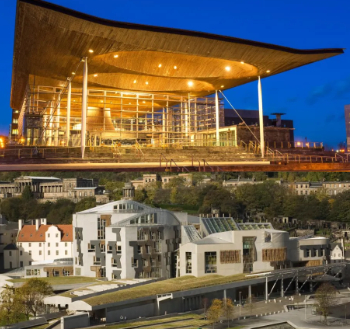
CIOB stresses importance of construction after new parliament elections.
The sad story of Derby Hippodrome
An historic building left to decay.

ECA, JIB and JTL back Fabian Society call to invest in skills for a stronger built environment workforce.
Women's Contributions to the Built Environment.
Calls for the delayed Circular Economy Strategy
Over 50 leading businesses, trade associations and professional bodies, including CIAT, and UKGBC sign open letter.
The future workforce: culture change and skill

Under the spotlight at UK Construction Week London.
A landmark moment for postmodern heritage.
A safe energy transition – ECA launches a new Charter
Practical policy actions to speed up low carbon adoption while maintaining installation safety and competency.
Frank Duffy: Researcher and Practitioner
Reflections on achievements and relevance to the wider research and practice communities.
The 2026 Compliance Landscape: Fire doors

Why 'Business as Usual' is a Liability.
Cutting construction carbon footprint by caring for soil

Is construction neglecting one of the planet’s most powerful carbon stores and one of our greatest natural climate allies.
ARCHITECTURE: How's it progressing?
Archiblogger posing questions of a historical and contextual nature.