





A carbon case for indigenous slate
The fact that UK slate can offer clear embodied carbon advantages, primarily due to lower transport emissions, will influence the choice of roofing material for historic buildings.

|
| Kirkby quarry, Kirkby-in-Furness, Burlington Stone Limited, Cumbria (Photo: Historic England). |
Contents |
Introduction
Natural slate has long been the roofing material of choice for many of the UK’s historic buildings, prized for its longevity, weather resistance and continuity with local building traditions. Yet the domestic slate industry has experienced a dramatic decline since the 19th century, with most slate used in the UK today now imported, primarily from Spain. This downturn has been driven by competition from cheaper imports, the closure of local quarries, loss of craft skills, changing construction practices favouring lighter and lower-cost modern alternatives, and regulatory challenges that limit the reopening or expansion of extraction sites.
While the idea of conserving historic fabric using traditional materials is well established, the environmental case for those materials has become increasingly important. As awareness grows around the climate impacts of construction, embodied carbon (the emissions associated with extracting, processing, transporting and disposing of building materials) has become a key consideration, particularly in the retrofit and repair of existing buildings.
In response, Historic England and Historic Environment Scotland commissioned a study to examine the embodied carbon of roofing slate, with the primary aim of supporting the case for using indigenous slate for repair of historic buildings. The motivation was that if UK slate could be shown to offer environmental as well as heritage benefits, this could strengthen demand and help sustain a struggling but culturally important industry.
The study set out to explore how UK slate compared to imported slate and alternatives to indigenous slate in terms of embodied carbon. It looked at both production and transport emissions, and factors such as lifespan, reuse potential and installation practices.
Domestic production of slate has declined significantly from 450,000 tonnes in the 1890s to less than a tenth of that in recent years. Today, most roofing slate used in the UK is imported, predominantly from Spain, which accounts for around 70 per cent, followed by Brazil and China.
Methodology and data
The study adopted a cradle-to-site perspective, covering production (extraction and manufacturing, often referred to as cradle to gate) followed by transport to the site where the slate is ultimately used, but excluded construction, use and end-of-life stages. While a full life-cycle assessment would offer a more complete view, this scope supported the goal of comparing products on a consistent basis. Production emissions are reported in all environmental product declarations (EPDs, one of the key data sources for the study), while transport can be reasonably estimated using known production locations and simplified site-delivery assumptions.
In contrast, construction and downstream stages rely heavily on variable assumptions – particularly around installation, maintenance, replacement, and disposal – which differ across EPDs for reasons that are often unclear or poorly documented. These inconsistencies limit comparability, so focusing on cradle-to-site emissions enable a more robust and fairer assessment. The analysis was based primarily on published EPDs for imported slate and on modelled transport scenarios. In the absence of EPDs for UK slate, production data was drawn from Crishna (2010 and 2011), which remains the most detailed UK-specific assessment available. All slate figures were normalised to a consistent roof coverage of 39 kg/m² to allow comparison between products of varying thickness. Alternative roofing materials were also assessed using available EPDs. At the time of carrying out the research no UK EPDs were available for alternative materials.
Transport emissions were modelled separately using UK government greenhouse gas conversion factors (2023). These covered road haulage from quarry to port, maritime shipping to the UK and final road delivery to three representative UK cities – London, Leeds and Glasgow. While not tailored to specific projects, the transport scenarios reflect realistic distribution routes, offering a reasonable estimate of the relative carbon impacts associated with imported versus domestic slate.

|
| Lifecycle stages, adapted from BS EN 15804:2012+ A2:2019 (BSI, 2021). |
Transport emissions
One of the clearest findings of the study is that transport emissions can significantly outweigh production emissions, especially for imported slate. While the production impacts of slate products are often within a similar range, the carbon impact of moving them from quarry to site is not. UK slate, typically transported domestically by road, has transport emissions of less than 0.5 kgCO₂e/m².[1] By comparison, modelled emissions for imported slate reveal striking differences based on distance and mode of transport:
- Spanish slate: sea freight ~1.5 to 3.0 kgCO₂e/m²; overland routes ~4.9 to 8.1 kgCO₂e/m²
- Brazilian slate: ~9.6 to 11.1 kgCO₂e/m²
- Chinese slate: ~20.9 to 22.4 kgCO₂e/m²
These estimates are derived from realistic transport scenarios (although potentially neglecting intermediate steps in the logistics chain) to three major UK locations: London, Leeds and Glasgow.
The transport emissions diagram illustrates that, for imports from the most distant countries, transport emissions alone can exceed the total production emissions typically associated with slate products. This finding reinforces the strong environmental case for using UK slate, particularly when specifying materials for conservation or sustainability-driven projects. While imported slates may compete on price or availability, their carbon cost, especially when transported intercontinentally, is significantly higher. Local sourcing offers not just heritage compatibility but also meaningful reductions in embodied carbon.

|
| Calculated transport emissions from quarry region to construction site. |
Production emissions
The production emissions for roofing slate vary significantly across sources, but interpreting these values requires caution, making direct comparisons between imported and indigenous slate problematic. EPDs for Spanish slate, which dominate the dataset, report production emissions (normalised to a standard thickness and coverage of 39 kg of slate/m² of roof) ranging from 3.0 to 11.1 kgCO₂e/m², although most were in the region of 4 kg kgCO₂e/m². For UK natural slate, estimated emissions are towards the upper end of this range, at 9.0 kgCO₂e/m² for slate of comparable thickness. The UK estimate is based primarily on data from Crishna et al (2010 and 2011), now over a decade old, and may not reflect improvement in quarrying practices, energy efficiency or grid decarbonisation. A more recent assessment could be expected to yield a lower figure.
An advantage of UK slate that still needs to be evaluated relates to co-product utilisation. The EPDs for Spanish slate imply that the extracted slate that does not meet the specification for roofing slate is returned to the quarry as waste. In the UK, anecdotal evidence suggests that a large proportion of quarried material is used for other valuable purposes, such as walling stone, paving or aggregates.[2] This means that in the UK, part of the environmental burdens associated with the initial steps of extraction and manufacturing can be allocated to the co-products, thereby reducing the share of embodied carbon attributed specifically to the roofing slate. These issues highlight the need for UK-specific EPDs, allowing better-informed material choices. Without them, the comparison remains uncertain, and UK slate may be unfairly represented in carbon assessments despite its low transport emissions.
Alternatives
The study also reviewed EPDs for concrete, fibre cement and clay tiles. These were from European sources, as no UK-specific EPDs for these materials were identified at the time the research was carried out. Reported production emissions (per m² of roof coverage) are:
- Fibre cement tiles from Belgium and Ireland: 6.8 and 16.2 kgCO₂e/m2 respectively
- Concrete tiles: 9.1 kgCO₂e/m², with significantly higher transport emissions (1.5–7.5kgCO₂e/m²) due to weight and distance from Denmark
- Clay tiles from Germany: 7.2 kgCO₂e/m²
These alternatives have somewhat higher production emissions than those shown in most of the slate EPDs. Transport comparisons are less useful here, as in practice at least some of these materials may be sourced more locally.
Durability and replacement
The need to replace a roofing material during a building’s lifetime can substantially increase its total embodied carbon, which is assessed over both 60-year and 120-year periods according to RICS guidance (2023). A single complete replacement of the roof in the study period would result, approximately, in a doubling of embodied carbon, with further replacements increasing it still further. A full assessment also needs to cover any maintenance and repair requirements.
This is a key issue for less durable roofing materials, but UK slates – such as those from Wales and Cumbria – may avoid the need for replacement altogether even over a 120-year period, providing a clear carbon benefit. While data on durability is not formally recorded, UK slates are considered more durable than imported alternatives, with anecdotal evidence from historic buildings suggesting lifespans exceeding a century.[3] By contrast, many imported slates and alternative products have been in widespread use only for a few decades, and their long-term durability in the UK climate remains less proven. However, there is insufficient information on the relative life spans of different roofing materials to draw clear conclusions. In such cases, it is often the fixings that fail rather than the slate itself.

|
| Total cradle-to-site embodied carbon (A1–A4) for roofing slates and alternatives. |

|
| Indicative scaling factors for B4 estimation, over a 120-year reference study period. |
While many EPDs do not include values for replacement, estimates can be made using scaling factors based on guidance from the RICS (2023) whole-life carbon methodology. The table presents indicative values for a 120- year building life, showing how replacement frequency affects emissions. Bringing production and transport stages together, the table showing total cradle-to-site embodied carbon compares the cradle-to-site embodied carbon of natural slates and alternative roofing materials. While production impacts are broadly similar across most products, total embodied carbon is strongly shaped by transport. Imported slates, particularly those from Brazil and China, and some alternatives show markedly higher totals due to long-distance shipping, whereas UK slate benefits from minimal transport impacts.
It is important to note that these comparisons draw on mixed data sources. UK figures rely on a single, older dataset (Crishna et al, 2010 and 2011) for production impacts, whereas Spanish values represent a range of environmental product declarations (EPDs). For Brazil and China, no direct production data exists, so indicative ranges are inferred from EPDs of other slates and combined with modelled transport impacts. For alternatives, transport estimates combine reported and modelled values, introducing some additional uncertainty.
Even with these limitations, the table provides a useful indication of relative carbon performance and highlights the benefits of local sourcing. The results should be viewed as indicative, highlighting broad trends rather than exact figures.
This study highlights that UK slate can offer clear embodied carbon advantages, primarily due to lower transport emissions. As sustainability becomes embedded in conservation practice, material choices must increasingly consider both environmental impact and heritage compatibility. Key factors include sourcing, expected lifespan, and suitability for traditional construction methods. However, several limitations in assessing embodied carbon remain. These include the absence of UK EPDs, variations in methodology across data sources, and limited evidence on product durability and real-world transport distances.
Further research is needed to support more informed decision-making. Priorities include the development of UK EPDs, improved data on co-product allocation and construction processes, refined modelling of transport impacts and better understanding of product lifespans. A market study would also be valuable in assessing the capacity of the UK slate industry to meet future demand sustainably.
Notes
- [1] The unit represents kilograms of carbon dioxide equivalents per square metre of roof installed.
- [2] Private conversations with Ian Ramsey of Burlington Stone.
- [3] Opinions gathered from practitioners, experts and industry, such as Terry Hughes, Ian Ramsey and Alison Henry
References
- BSI (2021) BS EN 15804:2012+A2:2019, Sustainability of construction works – Environmental product declarations – Core rules for the product category of construction products. Crishna, N, Goodsir, S, Banfill, P and Baker, KJ (2010) Historic Scotland Technical Paper 7: Embodied carbon in natural building stone in Scotland.
- Crishna, N, Banfill, P. F. G. and Goodsir, S (2011) ‘Embodied energy and CO2 in UK dimension stone’, Resources, Conservation and Recycling, 55.
- Royal Institution of Chartered Surveyors (2023) Whole life carbon assessment for the built environment (2nd edition). UK Government (2023) UK Government GHG Conversion Factors for Company Reporting.
This article originally appeared in the Institute of Historic Building Conservation’s (IHBC’s) Context 184, published in September 2025. It was written by Soki Rhee-Duverne and Jim Hart. Soki Rhee-Duverne is researcher, technical conservation teams, policy and evidence (national specialist services) at Historic England. Jim Hart is researcher and sustainability consultant at JH Sustainability.
--Institute of Historic Building Conservation
Related articles on Designing Buildings Conservation.
IHBC NewsBlog
IHBC sponsors Gardens Trust event 23-4 Sept 2026
.jpeg)
'Learning from the Past, Shaping the Future’ takes place in Milton Keynes
Renovations to Frank Lloyd Wright's Fallingwater complete
.jpg)
World Heritage Preserved project opens house for tours again
Shakespeare Birthplace Trust places Hall's Croft on HAR Register
Stratford-upon-Avon home of Shakespeare's daughter is 'At Risk'
Lady Grange’s House repaired on St Kilda
.jpg)
National Trust for Scotland repairs stone cleit with link to famous island resident
Griff Rhys Jones on BBC Radio 4 Today programme
,_Green_Lane,_Derby.jpg)
The Victorian Society’s President unveiled its latest Top Ten Endangered Buildings 2026.
Need a MATE? Book your place now.

IHBC offers free webinars on applying for IHBC accreditation (Full & Associate).
UK Stained Glass Repository finds windows new homes

How are stained glass windows are rescued, stored and repurposed?
APPGEBE report sets high aims for quality
'Government must not sacrifice quality in drive to build 1.5m homes'
New measures protect Historic Shipwrecks from heritage crime

Underwater cultural heritage benefits from new HE guidance
How could the City of London skyline look in 6 years' time?

Visualisation shows approved planning applications as completed buildings
National Trust for Scotland calls for VAT cuts
Heritage neglect is encouraged by current policies
IHBC's 'Context' Issue 186 features Industrial Heritage

IHBC's members' journal reports on the challenges of conserving infrastructure
Book now for IHBC Annual School 2026

IHBC Annual School is taking place 18-20 June 2026 in Newcastle
RICHeS Research Infrastructure offers ‘Full Access Fund Call’

RICHeS offers a ‘Help’ webinar on 11 March
Latest IHBC Issue of Context features Roofing
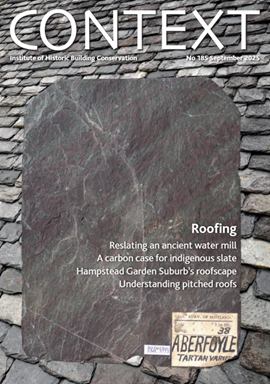
Articles range from slate to pitched roofs, and carbon impact to solar generation to roofscapes
Three reasons not to demolish Edinburgh’s Argyle House

Should 'Edinburgh's ugliest building' be saved?
IHBC’s 2025 Parliamentary Briefing...from Crafts in Crisis to Rubbish Retrofit

IHBC launches research-led ‘5 Commitments to Help Heritage Skills in Conservation’
How RDSAP 10.2 impacts EPC assessments in traditional buildings

Energy performance certificates (EPCs) tell us how energy efficient our buildings are, but the way these certificates are generated has changed.