





Water tank

Contents |
[edit] Introduction
In the construction industry, the word 'tank' typically refers to a large container used to store substances including gasses and liquids.
According to the Water Supply (Water Fittings) Regulations 1999, a water tank can be defined ‘as a non-cylindrical closed vessel capable of containing water under pressure greater than atmospheric’.
[edit] History
Water tanks have been used since early civilisations in different parts of the world as a method of storing water. These containers have been made from various natural materials such as wood, ceramic, plastic, metal and stone.
Early storage tanks were commonly used in conjunction with agricultural activities, holding water for crop irrigation. Some were also used for military purposes, with storage tanks being used to provide water for soldiers, animals, vehicles and so on.
[edit] Purpose
In addition to farming and human use, modern day water tanks are also used to store water for purposes such as fire suppression, chemical processing, food preparation, rainwater collection and so on. Tanks make it possible to collect water from a source, store it and then distribute it when required.
By supporting a regulated water supply, tanks can help to prevent irregular distribution when levels are affected by user demand or unforeseen factors such as weather related events. Tanks can also help to regulate water pressure, since the tanks are able to adjust water flow to suit demand.
[edit] Types of water tanks
Water tanks are often made from materials such as plastic, concete, fibreglass, steel, clay and so on. Materials used for each type vary based on how the tank will be used. For instance, food industry water tanks are often made from stainless steel. When the proper material is used, the tank itself should have no impact on the quality of the water it is storing.
Undesirable materials (including naturally occurring contaminants such as algae, animal waste matter, bacteria and so on) inherently exist in water and can collect in the tank. This makes it necessary to clean tanks on a regular basis.
The purpose of the tank tends to determine its size. Smaller tanks are predominantly used for domestic purposes and hold about 140 litres or more. Commercial tanks can hold very large amounts of water - sometimes as much as 30,000 litres or more.

There are three main positions for water tanks: Elevated (or overhead), ground and underground.
- Elevated water tanks, also sometimes referred to as water towers, generally hold large quantities of water and use natural forces to create enough pressure to deliver that water efficiently. Elevated tanks can be either vertically or horizontally positioned. Elevated tanks are often made from concrete, metal or various types of plastic including glass reinforced plastic (GRP).
- Ground tanks are stored above ground and are easy to install. While access and maintenance are fairly straightforward with ground tanks, they can also be easily damaged due to vandalism, weather or other factors. Ground tanks are generally made from the same materials as elevated tanks.
- Underground tanks or below ground tanks are installed underground and are protected from damage caused by the factors associated with above ground tanks. However, they are more difficult to install and maintain. Underground tanks are often made from reinforced concrete.
[edit] Regulations
Regulations associated with the manufacture, construction and installation of water storage tanks in the UK are found in The Water Supply (Water Fittings) Regulations 1999. Specifications for certain types of water tanks are also covered by several British Standards.
[edit] Water tanks v cisterns
Water tanks are sometimes referred to as cisterns, although strictly speaking the two terms are not interchangeable. A water tank is a closed container while a cistern is a type of water tank that is not entirely closed or sealed. A cistern may be covered with a lid so it can be easily accessed for purposes such as cleaning.
According to the Water Supply (Water Fittings) Regulations 1999, a cistern ‘means a fixed container for holding water at not greater than atmospheric pressure’.
For domestic purposes, cisterns may be placed at the top of a dwelling (in an attic, roof space or loft, for instance), where they are used to store and deliver water throughout the structure. Cisterns can be used to capture and store rainwater for domestic or commercial purposes. Some large scale cisterns have the capacity to capture thousands of litres of water.
For more information, see Cistern.
[edit] Related articles on Designing Buildings
- Cistern.
- Hot water.
- Mains water.
- Primary pipework.
- Rainwater harvesting.
- Tank.
- Types of showers.
- Water consumption.
- Water pressure.
- Water Supply (Water Fittings) Regulations 1999.
[edit] External resources
Featured articles and news

We're expanding our collaborative mission by launching DB Intelligence, an exclusive market research advisory panel. Built environment professionals can now get paid to share their expertise on industry trends, products and services.
Panel members receive direct financial incentives for participating in research projects like short surveys, 1-2-1 interviews and focus groups. Register today to shape the future of the construction sector.
Planning condition discharge in England and Wales

A brief exoplanation from a building compliance expert, with further links.
Overheating guidance and tools for building designers

Guidance for dealing with element of building fabric control that have increasing importance.
Shading for housing, a design guide

From the Good Homes Alliance and British Blind and Shutter Association.
UK Standard Skills Classification (SSC)

A shared framework for describing skills needs.
Social media ban consultation comes to close

CIOB urges UK Government to consider social media’s role in careers guidance in ban debate.
The latest of eight Skills England apprenticeship units

The addition of battery manufacturing welcomed by ECA with a warning about the risks of fast-tracked apprenticeship units.
Building Control Independent Panel final report
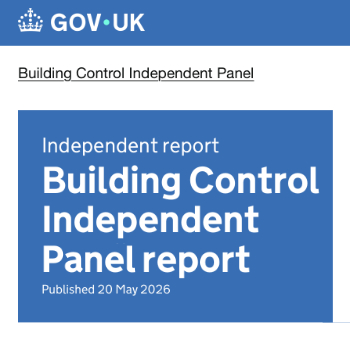
A precis of a key report led by Dame Hackitt with full recommendations and link to the government response.
Building Safety recap April, 2026

A short and longer run-through of the month, with links to further information and sources.

CIAT May 2026 briefing.

From medieval scribes to modern word art.

ECA welcomes crackdown on late payment and push for clean energy, whilst CIOB seek fixed cladding removal timeframes.
Cyber Security in the Built Environment
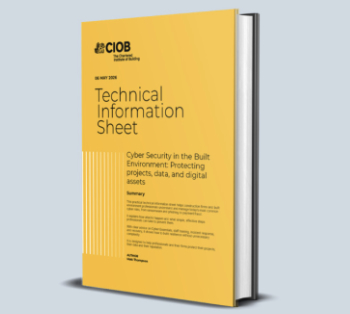
Protecting projects, data, and digital assets: A CIOB Academy TIS.
Managing competence in the built environment
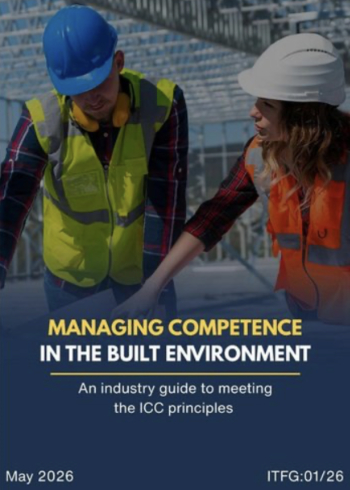
ITFG publishes new industry guide on how to meet the ICC principles.

The UK's campaign to reduce noise pollution: Mythbusting, articles and topic guides.