




Net zero strategy: build back greener
Contents |
[edit] Introduction
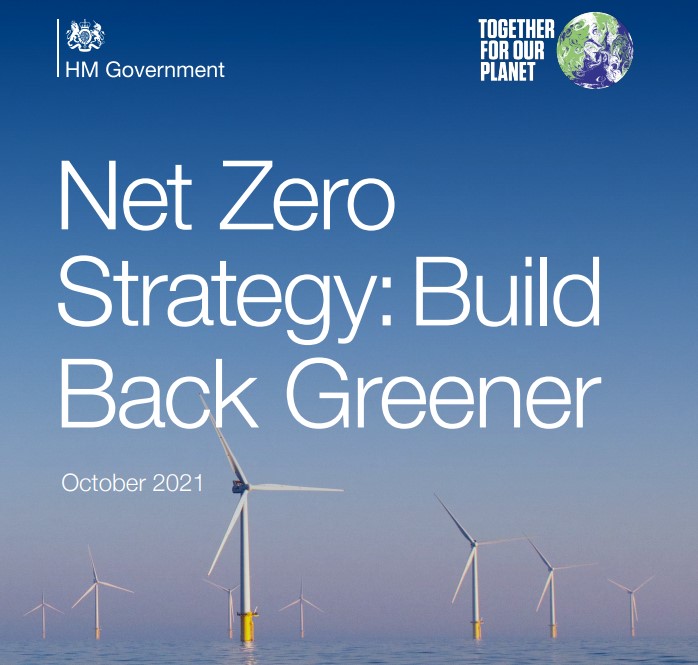
On 19 October 2021, the Government published Net Zero Strategy: Build Back Greener. The strategy builds on existing policies, including the Prime Minister’s 10-Point Plan for a Green Industrial Revolution, the Energy White Paper, the Industrial Decarbonisation Strategy, the Transport Decarbonisation Plan and the Hydrogen Strategy. It also supports the Government’s commitment to decarbonise the UK’s electricity system by 2035. Ref https://www.gov.uk/government/publications/net-zero-strategy
The strategy sets out approaches to keep the country on the path to achieving net zero by 2050. It will be submitted on behalf of the UK to the United Nations Framework Convention on Climate Change (UNFCCC) as its second greenhouse gas emission strategy under the Paris Agreement.
[edit] Announcements
The strategy pledges investment across several areas, including:
- £350 million to support the electrification of UK vehicles and their supply chains.
- £620 million for targeted electric vehicle grants and infrastructure.
- £140 million Industrial and Hydrogen Revenue Support scheme to accelerate industrial carbon capture and hydrogen.
- £3.9 billion for decarbonising heat and buildings, including the £450 million three-year Boiler Upgrade Scheme.
- More than £5.8 billion of foreign investment in green projects.
Other announcements included:
- An ambition that by 2035, no new gas boilers will be sold.
- Consultation on phasing out the installation of new oil, coal, and LPG heating, and replacing them with low carbon alternatives such as heat pumps in off gas grid non-domestic buildings from 2024 and homes from 2026.
- Introducing regulations from 2025 through the Future Homes Standard to ensure all new homes in England are ready for net zero by having a high standard of energy efficiency and low carbon heating installed as standard.
- Consulting on the case for enabling or requiring new gas boilers to be readily convertible to use hydrogen (‘hydrogen-ready’) by 2026.
- Proposals to introduce a market-based mechanism to support the development of the UK market for low-carbon electric heat pumps. Ref https://www.gov.uk/government/consultations/market-based-mechanism-for-low-carbon-heat
The Government’s Net Zero Research and Innovation Framework was published in conjunction with the two strategies. This analytical report explores issues and opportunities that could occur during the country’s decarbonisation process. It also sets out future innovation priority areas for the country.
[edit] Reaction
David Wright, Chief Engineer at National Grid said, “We’re at a critical stage in the journey where net zero is possible with the technologies and opportunities we have today and, in order to deliver on this, we have to accelerate and ramp up efforts to deploy long-term solutions at scale.”
Emma Pinchbeck, Chief Executive, Energy UK said, “We will play a central role in the drive to reach net zero, and by committing to have a decarbonised power system in place in the 2030s, our sector will also be providing the clean power needed to transform other sectors like housing and transport.”
Julie Hirigoyen, UKGBC Chief Executive said, "The Net Zero Strategy clearly acknowledges the scale of the challenge ahead, and the significant emissions reductions required from our sector in particular. As distinct from the Heat and Buildings Strategy, we welcome the inclusion of further information on plans to support action intended to improve reporting on embodied carbon in buildings and infrastructure, with a view to exploring a maximum level for new builds in the future."
Regarding the Heat and Buildings Strategy, Hirigoyen said, “households must be helped to make the transition to clean electric heating. However, phasing out gas boilers from 2035 is not ambitious enough – there needs to be a clear cut-off date from 2030 to put us on track to meet net zero….Worse still, there’s no targeted financial help at all for low income households to embark on the journey to clean electric heating – meaning that the gap between rich and poor will widen, not close.
“It's nothing short of shocking to see no reference to a successor for the ill-fated Green Homes Grant voucher scheme, and a huge missed opportunity to not introduce long-term structural drivers of consumer demand like Green Stamp Duty or 0% VAT on renovations. Equally disturbing to see no firm new proposals on ratcheting up minimum standards for privately rented homes or regulations to improve the energy performance of owner-occupied homes. We need all of these policies – and more – if our built environment is to stand any chance at all of getting to net zero.”
Eddie Tuttle, Director of Policy, Public Affairs and Research at CIOB, said, “While we’re glad to see that the Government has published a substantial strategy at a crucial time, there is much left wanting in this publication. It is concerning to see that there is no clear timeline nor sufficient funding for such an undertaking, and the role of retrofitting as a solution is significantly undermined. The Government must pursue a coordinated approach alongside the construction industry and professional bodies to encourage consumer confidence in the grant scheme.
“As it stands, the listed incentives will not cover the full cost of heat pump installations and many new, large scale housing developments have not been required to provide heat pumps as standard. Without greater clarity on how these key concerns will be addressed to ensure that new and existing policy works cohesively, the Government risks poor consumer take-up as many will not be willing to sign up to receive incentives. A lack of consumer confidence and take-up of schemes will lead to crucial net zero targets being missed.”
[edit] Related articles on Designing Buildings
- Aligning net zero with the levelling-up agenda.
- CIOB holds net zero event with industry experts and UK Government.
- COP21 Paris 2015.
- ECA backs Government plans for low-carbon heat.
- Electric vehicles.
- Energy White Paper presents Government plans to build back greener.
- Fabric first will safeguard heat decarbonisation.
- Get ready for green jobs and upgrade projects
- Green Homes Grant vouchers extended.
- Greenhouse gases.
- Heat pumps.
- Net zero carbon 2050.
- Smoothing the path to net zero.
- What's missing from The Government's 10-point plan?
[edit] External resources
- Gov.uk, Heat and Buildings Strategy.
- Gov.uk, UK Net Zero Research and Innovation Framework.
- Gov.uk, Net Zero Strategy: Build Back Greener.
Featured articles
Check out some of the best features and news from Designing Buildings as well as key stories from around the web.
Code of Practice for Electrical Energy Storage Systems.

ECA calls on members to comment on draft 4th edition.
Bringing together expertise and creating cultural benefits.

CIOB celebrates positive Ofsted report.

The Building Safety Regulator announces a call for evidence.

Government approach could undermine delivery and regeneration.
World's first mass timber data centre.

The overlooked environmental aspect of data centre development.
Introduction to radon awareness

New technical information sheet published by CIOB.

Updated supplier guide can help electrical contractors engage with NHP.

CIAT confirm the winners of the 2026 architectural technology awards.

Government launches a one stop shop for flood preparedness.

Sir Edwin Lutyens: Britain's greatest architect? Book review.

CIOB publishes free template to help assess and manage risks.