






Making MEES work: New report sets out pathways to deliver fairer, healthier, more resilient homes

Contents |
[edit] Critical timing
On 16 October, 2025, The National Retrofit Hub, supported by Impact on Urban Health, published Improving Health and Housing Outcomes in the Private Rental Sector. The report explores how proposed changes to housing regulations, including updates to Minimum Energy Efficiency Standards (MEES), can deliver housing equity, quality, affordability, and resilience.
The publication comes at a critical moment. The Renters Rights Bill, due to come into force later in 2025, alongside Awaab’s Law and proposed EPC reforms, will reshape the private rental sector. MEES has the potential to be a cornerstone of this transformation but only if policy, funding, enforcement, and tenant protections work in tandem.
“MEES must be more than a target on paper,” said Rachael Owens, Co-director at the National Retrofit Hub. “We’ve seen too many well-intentioned reforms falter because the systems around them weren’t strong enough. This is a chance to get it right by creating housing policy that is enforceable, fair, and properly supported. If we miss it, we risk deepening housing inequality and undermining trust in the UK’s Net Zero transition.”
[edit] The stakes are high
The UK cannot afford the human or financial cost of failing to implement and enforce stronger Minimum Energy Efficiency Standards.
- 1 in 10 private rented homes currently has a Category 1 health hazard, meaning occupants are likely to need medical assistance within a year because of the conditions they live in. (MHCLG, English Housing Survey Chapter 1, January 2025)
- 9% of private rented homes have problems with damp, often made worse by high energy costs and underheating. (MHCLG, English Housing Survey Chapter 1, January 2025)
- More than 1 in 5 private renters live in fuel poverty.( DESNZ, Annual Fuel Poverty Statistics in England, March 2025).
Poor-quality homes also create risks for landlords, including higher maintenance costs and the growing risk of uninsurability as climate change increases exposure to flooding, droughts and subsidence.
[edit] Five conditions for success
The report identifies five conditions that must be met if MEES is to deliver meaningful change:
- Rental affordability and security
- Better treatment of, and support for, tenants
- Effective housing standards enforcement and high levels of compliance
- High-quality work and effective redress routes
- Stable housing supply, across tenures
For each, it sets out:
- Context: The current state, including the existing issues and what risks will be created through poor regulation implementation.
- Progress: Existing and emerging policy protections and how components of the existing system help to achieve the outcomes we need to see.
- Recommendations: A set of solution pathways that should be implemented to ensure that the outcomes we need to see are delivered.
These include fairer financial models to prevent rent increases, guidance to limit disruption for tenants, stronger enforcement capacity for councils, outcomes monitoring embedded in legislation, and measures to support stable and affordable housing supply.
“Cold, damp homes are making renters ill, but the burden is not felt equally, with low-income and minoritised residents living with the worst housing conditions,” said Robin Minchom, Portfolio Manager, Impact on Urban Health. “MEES could have a transformative effect on the quality of privately rented homes and deliver significant health benefits. But it will only realise that potential if it has sufficient tenant protections, robust enforcement mechanisms and equitable funding.”
[edit] A coordinated approach
The report, Improving Health and Housing Outcomes in the Private Rental Sector: Minimum Energy Efficiency Standards and a Pathway to Affordable, Healthy and Robust Homes, calls for MEES to be implemented as part of a wider housing and Net Zero strategy, aligning policy, funding, enforcement, and tenant protections to achieve healthier, more affordable, and climate-resilient homes.
It builds on the National Retrofit Hub’s previous work on the private rental sector, including Raising Standards in the Private Rental Sector, the MEES Consultation Response, and Delivering for Tenants. The work draws on extensive input from NRH working groups and collaborators across housing, retrofit, enforcement, finance, and tenant advocacy.
This article was issued via press release as "Making MEES work: New report sets out pathways to deliver fairer, healthier, more resilient homes" dated 15 October, 2025.
[edit] Related articles on Designing Buildings
- Are Energy Performance Certificates accurate?.
- Building energy models.
- Display energy certificate DEC.
- Energy certificates for buildings.
- Energy efficiency regulations: The challenges for landlords.
- Energy performance certificate EPC.
- Future Homes Standard.
- How are EPCs produced?..
- Minimum Energy Efficiency Standard (MEES).
- Minimum energy efficiency standard regulations for domestic and non-domestic buildings.
- Non-domestic Private Rented Property minimum standard.
- Private rented sector regulations and traditional buildings.
- Simplified Building Energy Model.
- Standard Assessment Procedure SAP.
- The EPC consultation in the context of changes to the NCM.
- The Home Energy Model and Future Homes Standard assessment wrapper.
- Updating MEES for privately rented homes in England and Wales by 2030.
Featured articles and news
Building Control Independent Panel final report
A precis of a key report lead by Dame Hackitt with full recomendations and link to the government response.
Guide to ISO 19650 for Architecture Firms (2026)
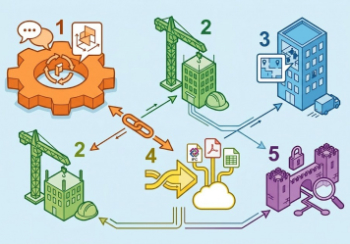
A user gives their low down.

A UK training and membership provider for mould remediation professionals.
Building Safety recap April, 2026
A short and longer run-through of the month, with links to further information and sources.

CIAT May 2026 briefing.

Independent NSI and BAFE study exploring how organisations are changing the way they buy fire safety services.
From medieval scribes to modern word art.

ECA welcomes crackdown on late payment and push for clean energy, whilst CIOB seek fixed cladding removal timeframes.
Cyber Security in the Built Environment
Protecting projects, data, and digital assets: A CIOB Academy TIS.
Managing competence in the built environment

ITFG publishes new industry guide on how to meet the ICC principles.
The UK's campaign to reduce noise pollution: Mythbusting, articles and topic guides.
Setting Expectations on Competence Management
Industry Competence Committee.
New Scottish and Welsh governments

CIOB stresses importance of construction after new parliament elections.
The sad story of Derby Hippodrome

An historic building left to decay.

ECA, JIB and JTL back Fabian Society call to invest in skills for a stronger built environment workforce.