





Facilitation payments

Contents |
[edit] In general
In general facilitation payments are small sums of money or gifts given to public officials to expedite or secure the performance of routine governmental actions. These actions typically involve services the official is already obligated to perform, such as issuing permits, processing visas, or providing utilities. Unlike bribes, which seek to obtain improper advantages or influence decisions, facilitation payments are often framed as 'greasing the wheels' to accelerate standard procedures and speed things up.
[edit] In construction
In construction the term may also be used for example to make sure a contractor team deliver on time or are guaranteed a certain amount of work. Despite their seemingly minor nature, facilitation payments raise significant ethical and legal concerns. They contribute to a culture of corruption, undermine trust in public institutions or fair competition by favouring those who can afford to pay, or by rewarding particular individuals. From a corporate perspective, facilitation payments pose risks including legal penalties, reputational damage, and disruptions to business operations. Many multinational companies adopt zero-tolerance policies against such payments, establishing clear codes of conduct and training programs to help employees navigate ethically challenging situations. Whistleblower mechanisms and internal audits are also used to detect and prevent violations.
[edit] The Bribery Act 2010
In the UK and in many jurisdictions, with increasingly strict anti-bribery laws such as the UK Bribery Act or U.S. Foreign Corrupt Practices Act (FCPA) such facilitation payments are illegal or subject to strict limitations. The UK Bribery Act, for instance, prohibits them outright, treating them the same as any other form of bribery. The Bribery Act 2010. Guidance: about procedures which relevant commercial organisations can put into place to prevent persons associated with them from bribing (section 9 of the Bribery Act 2010 outlines six principles which are not prescriptive but intended as flexible and outcome focussed, allowing for the variety of circumstances commercial organisations find themselves in going into some detail to describe facilitation payments as an example case study to describe the first principle. They are:
- Principle 1. Proportionate procedures: A commercial organisation’s anti-bribery procedures should be proportionate to its risk level and operations, and also be clear, practical, accessible, and effectively enforced.
- Principle 2. Top-level commitment: Top-level management of a commercial organisation is committed to preventing bribery and promoting a culture where bribery is never acceptable.
- Principle 3. Risk Assessment: A commercial organisation periodically conducts informed and documented assessments of its internal and external bribery risks involving associated persons.
- Principle 4. Due diligence: The commercial organisation uses proportionate, risk-based due diligence procedures for those performing services on its behalf to mitigate identified bribery risks.
- Principle 5. Communication (including training): The commercial organisation promotes understanding of its anti-bribery policies through proportionate internal and external communication and training.
- Principle 6. Monitoring and review: The commercial organisation regularly monitors, reviews, and improves its anti-bribery procedures to ensure their effectiveness.
[edit] Definition and description in Bribery Act Guidance
Regarding Facilitation payments the guidance states : "Small bribes paid to facilitate routine Government action – otherwise called ‘facilitation payments’ – could trigger either the section 6 offence or, where there is an intention to induce improper conduct, including where the acceptance of such payments is itself improper, the section 1 offence and therefore potential liability under section 7 (section 44). As was the case under the old law, the Bribery Act does not (unlike US foreign bribery law) provide any exemption for such payments. The 2009 Recommendation of the Organisation for Economic Co-operation and Development recognises the corrosive effect of facilitation payments and asks adhering countries to discourage (section 45)."
Case Study 1. Principle 1 Facilitation payments says "A medium sized company (‘A’) has acquired a new customer in a foreign country (‘B’) where it operates through its agent company (‘C’). Its bribery risk assessment has identified facilitation payments as a significant problem in securing reliable importation into B and transport to its new customer’s manufacturing locations. These sometimes take the form of ‘inspection fees’ required before B’s import inspectors will issue a certificate of inspection and thereby facilitate the clearance of goods."
[edit] Internationally
In countries where facilitation payments are common, eliminating them requires a multi-faceted approach involving legal reform, improved public sector transparency, and education. Governments and international bodies, such as the OECD, have emphasised the need to combat all forms of corruption, including minor payments, to support fair business environments and good governance. Ultimately, while facilitation payments may appear trivial, they erode integrity and accountability, making their eradication a key priority for ethical business and effective governance.
[edit] Related articles on Designing Buildings
Featured articles and news

We're expanding our collaborative mission by launching DB Intelligence, an exclusive market research advisory panel. Built environment professionals can now get paid to share their expertise on industry trends, products and services.
Panel members receive direct financial incentives for participating in research projects like short surveys, 1-2-1 interviews and focus groups. Register today to shape the future of the construction sector.
Building Safety Wiki Interviews

Chief executive of the British Woodworking Federation.
Planning condition discharge in England and Wales

A brief exoplanation from a building compliance expert, with further links.
Overheating guidance and tools for building designers

Guidance for dealing with element of building fabric control that have increasing importance.
Shading for housing, a design guide

From the Good Homes Alliance and British Blind and Shutter Association.
UK Standard Skills Classification (SSC)

A shared framework for describing skills needs.
Social media ban consultation comes to close

CIOB urges UK Government to consider social media’s role in careers guidance in ban debate.
The latest of eight Skills England apprenticeship units

The addition of battery manufacturing welcomed by ECA with a warning about the risks of fast-tracked apprenticeship units.
Building Control Independent Panel final report
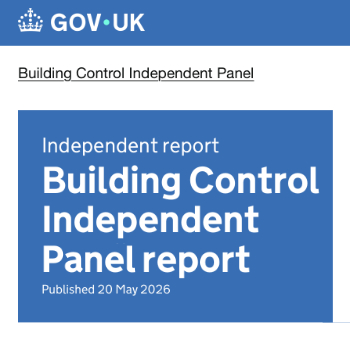
A precis of a key report led by Dame Hackitt with full recommendations and link to the government response.
Building Safety recap April, 2026
A short and longer run-through of the month, with links to further information and sources.

CIAT May 2026 briefing.

From medieval scribes to modern word art.

ECA welcomes crackdown on late payment and push for clean energy, whilst CIOB seek fixed cladding removal timeframes.
Cyber Security in the Built Environment
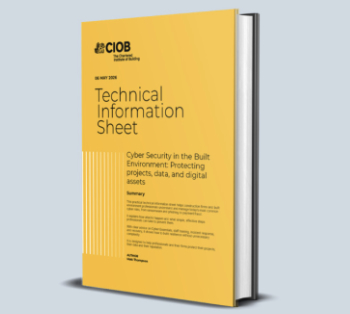
Protecting projects, data, and digital assets: A CIOB Academy TIS.
Managing competence in the built environment
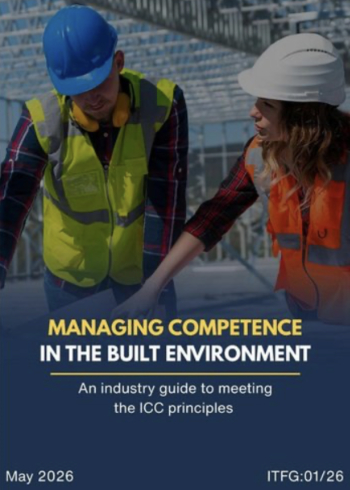
ITFG publishes new industry guide on how to meet the ICC principles.