





Workplace wellbeing in the heritage sector
Concern that many employers do too little to support their employees’ mental health and wellbeing has prompted the IHBC to launch the Heritage Sector Staff Wellbeing Survey.

|
| IHBC delegates visiting the home of Alfred Waterhouse during the 2024 Annual School: feedback from the event illustrates the value of networking opportunities like these to wellbeing. (Photo: Jonathan Taylor). |
It will come as little surprise to most of us working in the sector that heritage makes a positive contribution to overall wellbeing and that a great variety of benefits can be derived from our connection to the historic environment, whether it is through the places where we live, work or visit. But what about the wellbeing of those working in the heritage sector? Recent figures estimate that the heritage sector contributes around £45 billion gross value added to the UK economy, and that heritage is responsible, directly and indirectly, for the employment of over 500,000 staff, with some 201,000 of those being directly employed by the sector.[1]
We are reliant on the many committed staff and volunteers who work across the sector in a variety of different roles, contexts and environments, to help identify, maintain and conserve the historic environment. Yet while this is a hugely rewarding sector to work in, it is not without its challenges and pressures. Mental health awareness and staff wellbeing is receiving greater focus. Recent statistics suggest that mental ill-health costs businesses in the UK £51 billion each year,[2] with work-related stress accounting for over 50 per cent of sick leave recorded in 2024.[3] This is a significant issue for organisations, with 53 per cent of UK employees stating that the demands of their jobs are causing them ‘excessive stress’.[4]
What is wellbeing, and how does the wellbeing of staff working in heritage compare with those in other sectors? As the UK’s leading professional body for conservation of the historic environment, the IHBC caters for a broad membership, covering a variety of roles across the public, private and third sectors, as well as education and, more widely, from students through to retirees. The institute recognises the importance of the wellbeing of its members to the operation of the organisation itself, and to the wider historic environment and heritage sector.
The New Economics Foundation (NEF) definition states that ‘wellbeing comprises two main elements: feeling good and functioning well’.[6] A positive experience of life is likely to be characterised by feelings of happiness, contentment, engagement and curiosity. Meanwhile, our ability to function in the world is considered equally important. It is characterised by our ability to experience positive relationships, and to have a degree of control in our own lives and a sense of purpose.[7]
If we look at these factors in relation to the heritage sector, we can see that employee wellbeing might be impacted in these areas in a variety of ways. When we look at the concept of positive relationships in the context of the heritage sector, for example, it is not only our relationships with colleagues or managers that might impact our wellbeing, but also those with external consultants, political representatives, stakeholders and clients. These relationships might not always be easy to navigate, especially when it comes to negotiating complex or contentious schemes, specifying works, securing permissions or administering enforcement cases, all of which can lead to strained relationships and challenging interactions.
Workplace relationships have also been impacted following a significant shift towards home working following the pandemic. This hybrid, or sometimes entirely home-based, way of working can suit many, and can have the added benefit of more flexible working hours. However, for some people home working can be isolating. For those who live alone, or who depend on interaction with others through work, a lack of regular contact or interaction with colleagues may leave them feeling lonely, disconnected or unsupported. There are also implications for those who are new to a role, either having recently joined an organisation, or those starting out in early career roles.
For those in more established roles, who are used to working within a team structure with regular interaction and engagement, the shift to home working can also be challenging as it becomes increasingly difficult to maintain those relationships. For those who work independently, as self-employed contractors and consultants, the issue might be more pressing still, potentially leading to feelings of loneliness and a lack of support or camaraderie.
Another avenue for forging positive relationships at work is through training events and conferences. Feedback from the IHBC Annual School illustrates the value of networking opportunities as well as learning. However, with training budgets seemingly shrinking for many organisations, and more events being held online, even these opportunities might seem few and far between. Anecdotal evidence suggests that training budgets in local authorities have been affected significantly, making it more challenging to justify attending such events, especially in person.
Figures suggest that the overall number of conservation officers has reduced by about a third over the last ten years.[8] This may have resulted in fewer opportunities for shadowing or collaboration, which might be most keenly felt by those who have recently joined the organisation, or who are new to the profession. For those who find themselves the only conservation officer in a local authority, it might be harder to develop positive working relationships, and the role of regional conservation officer forums and professional networking becomes increasingly important.
The decline in numbers of local authority staff may also have a wider impact in terms of increasing pressures around workload. The IHBC has been made aware in recent years of several examples of local authority staff being faced by excessive workloads, requiring employees to work in excess of their contracted hours in order to keep up with deadlines, including evenings and/or weekends.
This is not a matter confined solely to local authority staff or indeed to the heritage sector. Recent conversations with those with experience of working in adjacent professions, such as architecture or surveying, suggest that some employees may feel the need to work excessively long hours to meet the demands of the role or in order to be considered as committed and team-players. A general survey revealed that 68 per cent of employees reported that they are unable to strike a suitable balance between work and home life.[9] Another report, published in 2024, claims that over half of UK employees state that the demands of their job cause them excessive stress,[10] while a survey by Deloitte revealed that 63 per cent of respondents had experienced at least one symptom of burnout.[11]
Burnout is considered an entirely work-based phenomenon and is believed to be the result of chronic workplace stress that has not been successfully managed.[12] Signs of burnout might include a feeling of exhaustion, experiencing a sense of mental distance from one’s job or a decline in performance at work.[13] Additional signs include emotional symptoms (feeling helpless, cynicism, self-doubt, decreased satisfaction, feeling detached, loss of motivation, and loss of concentration); physical symptoms (headaches, stomach disorders, fatigue, frequent illness, change in sleep, change in appetite, and memory problems); and behavioural symptoms (reduced performance, self-isolation, procrastination, outbursts, use of substances as a coping strategy, and withdrawal).[14]
If we return to the NEF definition of wellness, we can see that changes beyond the employee’s control might also impact negatively on their wellbeing. These might include internal restructures, redundancies and even new working practices imposed by management. Wider policy and legislative changes might also have an impact, although these might sometimes be beneficial, and might have a positive impact on overall wellbeing.
Purpose is also a key element of overall wellness. This is perhaps where the heritage sector might hold a significant advantage over many other sectors, in that many people may derive a genuine sense of purpose from working towards the conservation of the historic environment and subsequently towards larger sustainability goals. This might also have its drawbacks. In a sector where staff are often passionate and deeply invested in the work they do, it can be difficult to keep a sense of healthy detachment when it comes to outcomes, such as witnessing the decline, damage or demolition of heritage assets due to neglect, funding issues, development pressures or other external threats. Such situations can be highly disappointing, leaving us feeling a sense of loss and affecting our sense of motivation.
As we become increasingly aware of the need to take practical steps towards a more sustainable future, it can be challenging to balance competing needs, such as the desire for new interventions and approaches to address sustainability goals, while preserving character and significance. This can be further compounded when new materials and methods are proposed requiring staff to continually remain up to date with new technological advances in the sector, often requiring further CPD and training, in order to make informed recommendations and appropriate specifications. Other factors that impact employee wellbeing in the heritage sector might include the demands of travel to and from work, or to sites, and the physical conditions of working on certain sites, including exposure to uncomfortable and potentially hazardous environments, such as dilapidated buildings and remote sites. Other considerations might include concerns over financial security, particularly for those who are self-employed, or working in roles that are reliant on short-term contacts, external funding and grants.
What is the answer? This is a highly complex and nuanced topic and, as with buildings, there is no one-size-fits-all solution. Every employee is different, and their individual situations and needs will vary. However, it is evident that poor wellbeing and a lack of good mental health can result in significant costs, not solely for individuals but also for organisations, regardless of the sector. It is in the interests of employers, as well as employees, to prioritise this issue and develop effective strategies.
While organisations may well feel that they are taking necessary steps to address this, the experience of employees may be radically different. A recent 2024 study of workplace mental health trends found that 65 per cent of employees did not feel that their employer did enough to support their mental health and wellbeing at work.[15]
As a response to concerns raised by its members in a previous IHBC Council meeting, the institute has decided to launch a heritage staff wellbeing survey to collect data on the general wellbeing of staff across the sector. The aim is to better understand the current picture and highlight areas where more work might be needed. It is hoped that this might point towards further opportunities to work with relevant partners and stakeholders to raise awareness, and to better support our members across the sector.
Those who feel that they might benefit from further support may find it helpful to contact their GP or an organisation which can offer support, such as CALM (Campaign Against Living Miserably, www.thecalmzone.net, phone 0800 58 58 58); Mind (www.mind.org.uk, phone 0300 123 3393); Rethink Mental Illness (phone 0300 5000 927); Samaritans (www.samaritans.org, phone 116 123); and Shout (text SHOUT to 85258).
References
- 1 CEBR (2024) The heritage sector in England and its impact on the economy: an updated report for Historic England; Heritage Alliance (2024) On the brink: heritage in the cost of living crisis.
- 2 Deloitte (2024) Mental health and employers: the case for employers to invest in supporting working parents and a mentally healthy workplace.
- 3 People Insight Workplace mental health trends 2024, https://info.koahealth.com/executive-summary-2024-workplace-mental-wellbeingtrends .
- 4 Great Place To Work, The State of Employee Wellbeing in the Workplace, 2024.
- 5 People Insight (2024) Op. cit.
- 6 Aked, J., Marks, N., Cordon, C., Thompson, S. (2008) Five ways to wellbeing: a report presented to the Foresight Project on communicating the evidence base for improving people’s well-being (New Economics Foundation).
- 7 Huppert, F. (2008) Psychological well-being: evidence regarding its causes and its consequences (London: Foresight Mental Capital and Wellbeing Project 2008) in Aked et al., op. cit.
- 8 Historic Houses (2022) New problems need new solutions: why our places matter.
- 9 People Insight (2024) Op. cit.
- 10 Great Place To Work, The State of Employee Wellbeing in the Workplace, 2024.
- 11 Deloitte (2024) Mental health and employers: the case for employers to invest in supporting working parents and a mentally healthy workplace.
- 12 World Health Organisation, International Classification of Diseases, 11th Revision (ICD-11), https://icd.who.int/en
- 13 Deloitte (2024) Op. cit.
- 14 List of symptoms from Aspire Heritage.
- 15 People Insight (2025) Op. cit.
This article originally appeared in the Institute of Historic Building Conservation’s (IHBC’s) Context 183, published in March 2025. It was written by Angharad Hart, consultant education and application support officer with the IHBC, and a coach and heritage consultant.
--Institute of Historic Building Conservation
Related articles on Designing Buildings Conservation.
- Conservation area.
- Conservation.
- Heritage.
- Historic environment.
- IHBC articles.
- IHBC Stress Awareness Month; Heritage Staff wellbeing at work survey.
- Institute of Historic Building Conservation.
- Listed buildings.
- Mental health.
- Wellbeing and heritage: making a difference.
- Wellbeing.
- The economics of heritage and wellbeing.
IHBC NewsBlog
How could the City of London skyline look in 6 years' time?

Visualisation shows approved planning applications as completed buildings
National Trust for Scotland calls for VAT cuts

Heritage neglect is encouraged by current policies
IHBC's 'Context' Issue 186 features Industrial Heritage
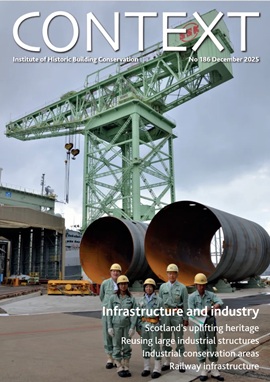
IHBC's members' journal reports on the challenges of conserving infrastructure.
Book now for IHBC Annual School 2026
IHBC Annual School is taking place 18-20 June 2026 in Newcastle.
RICHeS Research Infrastructure offers ‘Full Access Fund Call’
RICHeS offers a ‘Help’ webinar on 11 March
Latest IHBC Issue of Context features Roofing
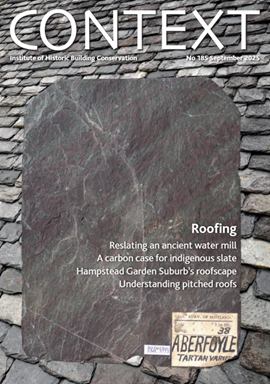
Articles range from slate to pitched roofs, and carbon impact to solar generation to roofscapes.
Three reasons not to demolish Edinburgh’s Argyle House

Should 'Edinburgh's ugliest building' be saved?
IHBC’s 2025 Parliamentary Briefing...from Crafts in Crisis to Rubbish Retrofit
IHBC launches research-led ‘5 Commitments to Help Heritage Skills in Conservation’
How RDSAP 10.2 impacts EPC assessments in traditional buildings

Energy performance certificates (EPCs) tell us how energy efficient our buildings are, but the way these certificates are generated has changed.
700-year-old church tower suspended 45ft

The London church is part of a 'never seen before feat of engineering'.