




Manual for Streets
|
|
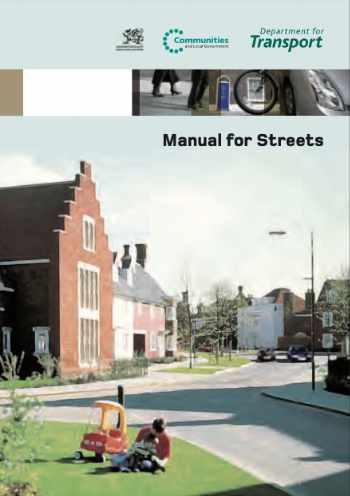
Manual for Streets (MfS) is a design guidance document that updated the link between planning policy and residential street design. The manual refocused the place function of residential streets away from purely the function of traffic movement, which had led to places dominated by motor vehicles, putting well-designed residential streets at the heart of sustainable communities.
Contents |
[edit] Manual for Streets (MfS1)
Manual for Streets (MfS) was produced by a team led by consultants WSP, with Llewelyn Davies Yeang (LDY), Phil Jones Associates (PJA) and TRL Limited on behalf of the Department for Transport, and Communities and Local Government and was first published in 2007. It replaced Design Bulletin 32, which was first published in 1977, and its companion guide Places, Streets and Movement, which are now withdrawn in England and Wales. It also complemented Planning Policy Statement 3: Housing and Planning Policy Wales. The MfS did not apply to the trunk road network, which were set out in the Design Manual for Roads and Bridges (DMRB).
[edit] Manual for Streets 2 (MfS2)
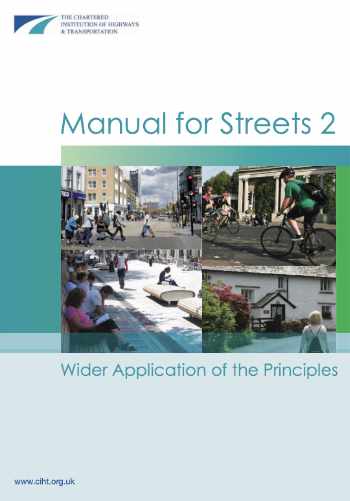
Manual for Streets 2 (MfS2) presented a wider application of the principles in initially set-out Manual for Streets (MfS1) and as represented a companion guide that was the product of collaborative working between the Department for Transport and industry and was published In 2010 by The Chartered Institution of Highways and Transportation (CIHT). Whilst MfS1 focussed on lightly-trafficked residential streets, MfS2 investigates in greater detail how and where the key principles can be applied to busier streets and non-trunk roads, thus helping to fill the perceived gap in design guidance between MfS1 and the Design Manual for Roads and Bridges (DMRB).
Combined these documents help demonstrate the benefits of flow from good design and the assignment of higher priority to pedestrians and cyclists. This helps set out an approach to residential streets that recognises their role in creating places that work for all members of the community to make a positive contribution to the quality of life. Between them, MfS1 nad MfS2 give clearer guidance on how to achieve well-designed streets and spaces that serve a community and in a range of different ways, whilst still functioning as roadways.
[edit] Development
In 2020 The Department for Transport commissioned the Chartered Institution of Highways and Transportation (CIHT) to revise and bring together Manual for Streets (MfS1), and Manual for Streets 2 (MfS2) the finalisation and publication of the revised Manual was taken forward by the Department but no date for publication has yet been announced.
To download the first 2007 Manual for Streets publication (MfS1) click here
To download the second 2010 Manual for Streets publication Manual for Streets 2 (MfS2) click here
[edit] About the Chartered Institution of Highways and Transportation (CIHT)
For further information about the Chartered Institution of Highways and Transportation (CIHT) visit their homepage here:
[edit] Related articles on Designing Buildings
- A vision for digital highways.
- Arterial road.
- Cul-de-sac.
- Design standards for road development and improvement schemes.
- Glossary of paving terms.
- Haul road.
- Hazard warning surfaces.
- High street.
- Highways
- Highways agency
- Highways England
- Highways in England and Wales
- Highways Infrastructure Asset Management Plans
- Hounslow highways pathfinder private finance initiative case study
- How to build a road
- Low emission zone for non-road mobile machinery
- Mews.
- National Highways
- Pathway.
- Pavement.
- Protected street.
- Road
- Road construction
- Road drainage
- Road improvement scheme consultation
- Road investment strategy
- Road joints
- Road kerbs
- Road paving
- Road plant
- Road traffic management.
- Road types
- Roadworks.
- Safe pedestrian route.
- Section 171 of the Highways Act
- Section 278 agreement - works to existing highways
- Section 38 agreement - adoption of highways
- Shared space.
- Strategic route.
- Street hierarchy.
- Streetscape.
- Street works.
- The history of the dimensions and design of roads, streets and carriageways.
- Traffic and transport.
- Trunk road.
- Wireless electric highways
Featured articles
Check out some of the best features and news from Designing Buildings as well as key stories from around the web.

CIOB celebrates positive Ofsted report.

The Building Safety Regulator announces a call for evidence.

Government approach could undermine delivery and regeneration.
World's first mass timber data centre.

The overlooked environmental aspect of data centre development.
Introduction to radon awareness

New technical information sheet published by CIOB.

Updated supplier guide can help electrical contractors engage with NHP.

CIAT confirm the winners of the 2026 architectural technology awards.

Government launches a one stop shop for flood preparedness.

Sir Edwin Lutyens: Britain's greatest architect? Book review.

CIOB publishes free template to help assess and manage risks.
ECA's reflections on Party Conference season

Burnham wants to be confident of winning before asking for a fresh mandate.
New Chief Construction and Scientific Adviser

Sergio Cavalaro, Professor of Infrastructure Systems at Loughborough University.