






Civil engineers must report climate-change risk

|
| Asset owners and contractors must now disclose climate-related financial risks. Madeleine Rawlins of Mott MacDonald says considering emissions and physical resilience has become a professional obligation for civil engineers. |
Contents |
[edit] Introduction
Civil engineers are now professionally obliged to consider climate-change risk in the design, delivery and operation of infrastructure.
In 2015 Mark Carney, governor of the Bank of England and chair of the international Financial Stability Board (FSB), highlighted the risk posed by climate change to insurers, financial stability and the global economy. That risk is now a professional reality for civil engineers.
In response to Carney, the Group of Twenty (G20) countries asked the FSB to address climate-change risks in the global financial system. FSB’s taskforce on climate-related financial disclosures (TCFD) recommended that the financial sector and key infrastructure sectors should report on climate-related risks and set out how it should be done.
By 2018, TCFD supporters numbered over 500 organisations, with a combined market capitalisation of nearly US$8 trillion and responsibility for managing some US$100 trillion of assets – a third of global wealth. This level of commitment is making climate change a mainstream issue.
[edit] Reporting requirements
TCFD supporters and the infrastructure businesses they invest in now need to disclose how they address climate risks in their governance, operations, strategy, financial planning and overall risk management processes. They will also show what metrics and targets are used to assess and manage exposure to risk, and use scenario analysis to assess how their strategy meets the goals of the United Nations 2016 Paris Agreement on climate change.
While the TCFD recommendations are voluntary, they are supported by governments, being integrated by regulators and already adopted by sustainability and reporting standards, such as Equator Principles and CDP. The UK’s Prudential Regulation Authority published a draft supervisory statement in October 2018 for consultation that would require banks and insurers to report on climate-related risks.
[edit] Climate change as a risk
In December 2017, Legal and General Investment Management wrote to ICE and others calling on it to make climate change, ‘an integral part of the professional qualification and practice of members’.
Civil engineers already have a professional duty of care, enshrined in ICE’s code of conduct, to manage risks to their clients and society. TCFD strongly endorses climate change as a new class of risk that must be addressed.
Civil engineers could be held to account if they neglect to address climate change in future infrastructure investments and in managing existing infrastructure. Climate change, like health, safety and wellbeing, is about to become non-negotiable in the design, delivery and operation of infrastructure.
[edit] Understanding the risks
Civil engineers need to start engaging more with academic research, social scientists, policy-makers and the finance community to understand and address the material and financial risks from climate change, and their economic consequences. From a practical perspective, the TCFD knowledge hub provides case studies, shared research and some best practice on assessing climate-related risks.
There are also existing standards such as PAS 2080 for quantification of whole-life emissions in infrastructure as well as initiatives such as Science Based Targets on how to transition to a ‘low-carbon’ economy.
Civil engineers should be implementing climate-risk assessments in infrastructure design, delivery and operation that incorporates both assessment of climate risks and resilience interventions, as well as the monetisation of future economic losses from climate and weather-induced asset failures.
The profession has a real opportunity here for leadership and innovation in delivering more resilient, lower-emissions infrastructure.
[edit] About this article
This article was written by Madeleine Rawlins, Principal Consultant at Mott MacDonald. It was posted on the website of the Institution of Civil Engineers (ICE) on March 4, 2019. Read it here. The article is based on the author's briefing article in the latest issue (172 CE1) of the ICE Civil Engineering journal.
--The Institution of Civil Engineers
[edit] Related articles on Designing Buildings Wiki
- A systems approach to net-zero.
- Biomass.
- BREEAM Adaptation to climate change.
- Carbon emissions.
- Carbon plan.
- Climate Change Act.
- COP21 Paris 2015.
- Emission rates.
- Energy.
- Energy targets.
- Environmental modelling.
- Environmental policy.
- Global warming and the tipping point precipice.
- Globe temperature.
- Green Deal.
- Greenhouse gases.
- Happold lecture on climate change.
- Intergovernmental Panel on Climate Change IPCC.
- Kyoto Protocol.
- Radiation.
- Resilience of UK infrastructure and climate predictions
- Sustainability.
Featured articles and news

We're expanding our collaborative mission by launching DB Intelligence, an exclusive market research advisory panel. Built environment professionals can now get paid to share their expertise on industry trends, products and services.
Panel members receive direct financial incentives for participating in research projects like short surveys, 1-2-1 interviews and focus groups. Register today to shape the future of the construction sector.
Overheating guidance and tools for building designers

Guidance for dealing with element of building fabric control that have increasing importance.
Shading for housing, a design guide

From the Good Homes Alliance and British Blind and Shutter Association.
UK Standard Skills Classification (SSC)

A shared framework for describing skills needs.
Social media ban consultation comes to close

CIOB urges UK Government to consider social media’s role in careers guidance in ban debate.
The latest of eight Skills England apprenticeship units

The addition of battery manufacturing welcomed by ECA with a warning about the risks of fast-tracked apprenticeship units.
Building Control Independent Panel final report
A precis of a key report led by Dame Hackitt with full recommendations and link to the government response.
Guide to ISO 19650 for Architecture Firms (2026)
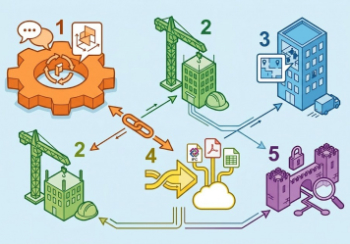
A user gives their low down.

A UK training and membership provider for mould remediation professionals.
Building Safety recap April, 2026

A short and longer run-through of the month, with links to further information and sources.
CIAT May 2026 briefing.

Independent NSI and BAFE study exploring how organisations are changing the way they buy fire safety services.

From medieval scribes to modern word art.

ECA welcomes crackdown on late payment and push for clean energy, whilst CIOB seek fixed cladding removal timeframes.
Cyber Security in the Built Environment
Protecting projects, data, and digital assets: A CIOB Academy TIS.
Managing competence in the built environment
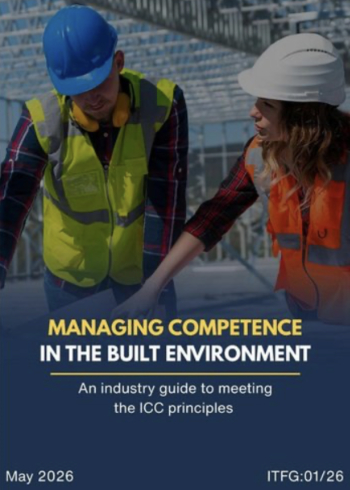
ITFG publishes new industry guide on how to meet the ICC principles.

The UK's campaign to reduce noise pollution: Mythbusting, articles and topic guides.