






Understanding Guniting in Construction

[edit] Durable Concrete Repair
Guniting as a term comes from an original product name known as Gunite, which was a dry-mix pneumatic concrete spraying process trademarked in the early 1900s. Today, the term most commonly used is shotcreting, spray applied concrete or sprayed concrete, but guniting is still used in many parts of the world. Other products can also be spray applied such as gypsum based plaster, lime based plaster, external render, insulation, hemcrete and so on. See articles shotcrete technology, spray foam insulation, thermal spray coating, polyurethane spray foam in structurally insulated panels and composite structures, hemcrete, and prayed in situ concrete.
In structural rehabilitation and specialised concrete works, guniting stands out as a precision-driven technique used to restore, strengthen, and protect deteriorated concrete surfaces. Unlike conventional plastering or casting methods, guniting relies on high-velocity pneumatic placement, which significantly enhances compaction, bond strength, and durability.
For contractors, consultants, and infrastructure owners searching for “guniting process”, “guniting technical details”, or “dry shotcrete method”, this is a guide to share practical engineering insight, not surface-level theory.
[edit] What is Guniting?
Guniting is a dry-mix sprayed concrete process in which a pre-blended mixture of cement and fine aggregates is conveyed through a hose using compressed air, while water is introduced at the nozzle to initiate hydration before impact on the substrate.
Core Technical Principle:
- Kinetic energy + controlled hydration = dense, low-permeability concrete layer
This results in:
- High interfacial bond strength
- Reduced void ratio
- Improved durability under aggressive exposure conditions
[edit] Working Mechanism - How Guniting Achieves Strength?
The performance of guniting is governed by three engineering phenomena:
1. Impact Compaction
Material exits the nozzle at high velocity (~30-100 m/s), creating self-compaction without vibration.
2. Layer-by-Layer Build-Up
Concrete is deposited in thin passes, minimizing:
3. Reduced Water-Cement Ratio
Typical W/C ratio: 0.30-0.40, leading to:
- Higher compressive strength
- Lower permeability
[edit] Guniting Process: Step-by-Step Technical Execution
1. Substrate Preparation
Critical for bond performance:
- Mechanical roughening (≥5 mm amplitude recommended)
- Removal of laitance and contaminants
- Exposure of coarse aggregates for mechanical interlock
2. Pre-Wetting
Surface is brought to SSD (Saturated Surface Dry) condition to prevent:
- Rapid water absorption
- Weak bonding interface
3. Dry Mix Feeding
- Cement:sand ratio typically 1:3 to 1:4
- Uniform grading (Zone II sand preferred)
- Controlled feed rate ensures consistent output
4. Air Conveyance System
- Compressor pressure: 5-7 bar
- Ensures continuous flow and prevents segregation
- Water ring system regulates flow
- Nozzleman adjusts based on:
- Surface absorption
- Ambient temperature
- Desired consistency
6. Spraying Technique
- Nozzle angle: perpendicular (90°) for maximum compaction
- Distance: 0.6-1.2 meters
- Circular motion to avoid shadowing and rebound pockets
7. Rebound Management
8. Curing Regime
[edit] Key Technical Properties of Guniting
| Property | Typical Range |
| Compressive Strength | 30-70 MPa |
| Bond Strength | 1.5-3.0 MPa |
| Density | 2200-2400 kg/m³ |
| Permeability | Very low |
| Rebound Loss | 10-30% |
These properties make guniting suitable for structural-grade applications, not just surface repair.
[edit] Materials and Admixtures in Guniting
[edit] Cementitious System
[edit] Aggregates
- Max size: 4.75-10 mm
- Well-graded to reduce voids
[edit] Chemical Admixtures
- Accelerators → Faster setting in overhead works
- Plasticizers → Improved workability at low W/C ratio
- Silica fume → Enhances density and durability
[edit] Fiber Reinforcement (Advanced Use)
- Steel or polypropylene fibers
- Improves:
[edit] Applications of Guniting
[edit] Structural Repair
- Spalled concrete restoration
- Beam-column strengthening
- Bridge substructure repair
[edit] Underground & Infrastructure
- Tunnel linings
- Mining support systems
- Retaining structures
[edit] Hydraulic Structures
[edit] Geotechnical Engineering
[edit] 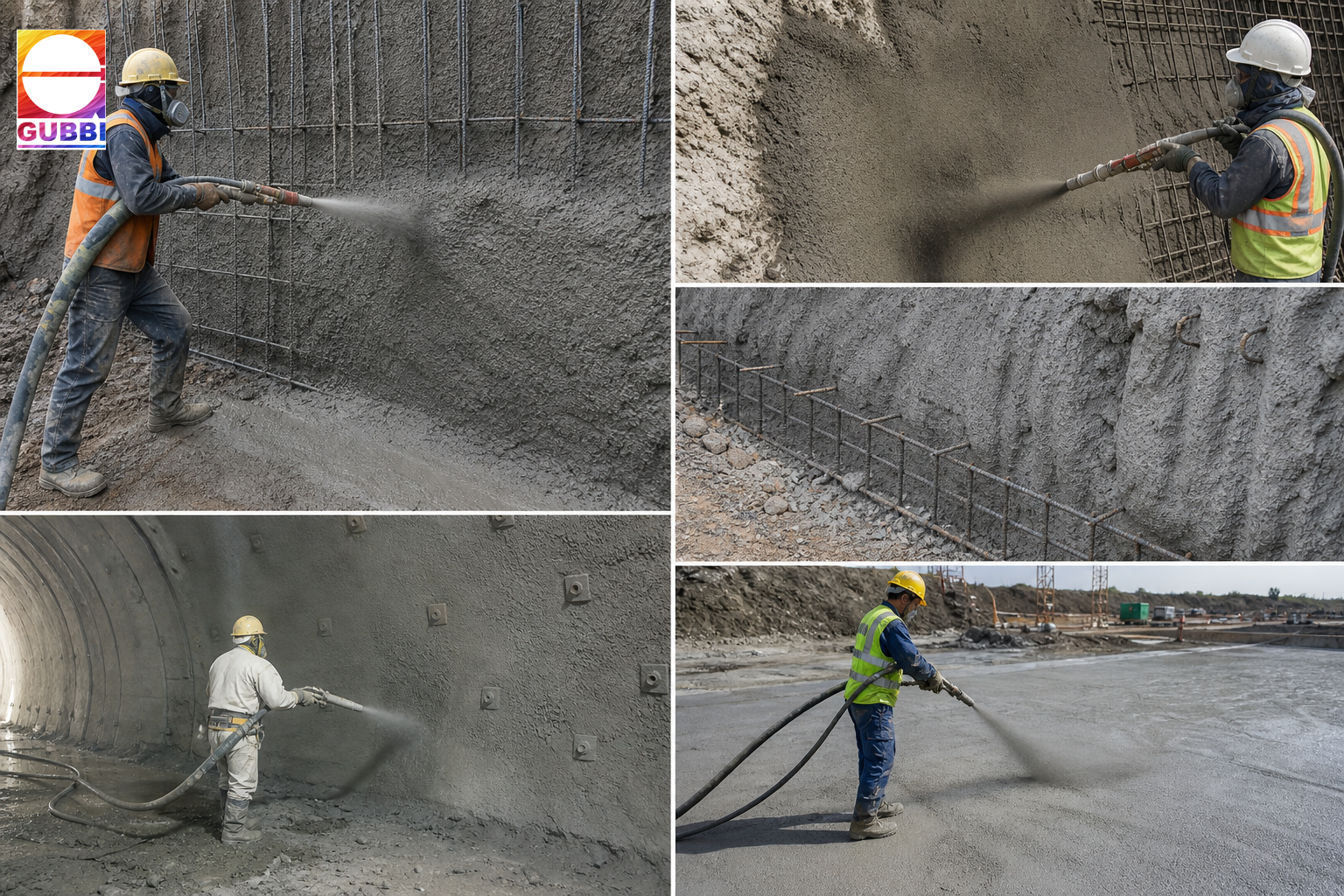
[edit] Advantages of Guniting
1. Superior Bonding Mechanism
High-velocity placement creates strong mechanical interlock + adhesive bond.
2. No Formwork Requirement
Reduces:
- Construction time
- Labor cost
3. High Durability
Low permeability → better resistance to:
- Chloride ingress
- Sulphate attack
4. Adaptability
Effective on:
- Vertical surfaces
- Overhead applications
- Irregular geometries
5. Structural Strengthening Capability
Unlike plastering, guniting contributes to load-bearing capacity.
Limitations and Practical Challenges
- Requires highly skilled nozzleman (critical success factor)
- Dust generation in dry process
- Material rebound → wastage
- Thickness control can be challenging
- Not ideal for very thick sections in one pass
[edit] Quality Control Checklist
To ensure high-performance output:
✔ Check air pressure consistency
✔ Maintain correct W/C ratio at nozzle
✔ Avoid rebound reuse
✔ Ensure proper curing
✔ Conduct:
[edit] When to Choose Guniting Over Other Methods?
Use guniting when:
- Surface is irregular or inaccessible
- Formwork installation is impractical
- Rapid repair is required
- High bond strength is critical
Avoid when:
- Large-volume casting is needed
- Skilled labor is unavailable
[edit] Conclusion
Guniting is not just a repair technique; it is a precision-engineered concrete placement method that delivers high strength, durability, and adaptability in challenging construction scenarios. When executed with proper technical control, it becomes one of the most reliable solutions for structural rehabilitation and protective concrete works.
For modern infrastructure demands, mastering guniting means achieving long-term performance with minimal intervention.
[edit] FAQs
- === What is guniting used for in construction? : It is used for concrete repair, slope stabilization, tunnel lining, and waterproofing applications. ===
- === Is guniting strong enough for structural repair? : Yes, it can achieve compressive strength up to 70 MPa, making it suitable for structural strengthening. ===
- === What is rebound loss in guniting? : Rebound refers to material that bounces off the surface during spraying and should not be reused. ===
- === What is the ideal water-cement ratio in guniting? : Typically between 0.30 to 0.40 for optimal strength and durability. ===
- === Why is skilled labor important in guniting? : Because nozzle control directly affects strength, bonding, and uniformity. ===
[edit] Related articles on Designing Buildings
- Basement waterproofing.
- Cement.
- Concrete superplasticizer.
- Portland cement.
- Precast concrete.
- Prestressed concrete.
- Reinforced concrete.
- Self-compacting concrete.
- Shotcrete global market.
- Shotcrete technology
- Sprayed in situ concrete.
- Tunnelling.
- Understanding Guniting in Construction
Featured articles
Check out some of the best features and news from Designing Buildings as well as key stories from around the web.

Government launches a one stop shop for flood preparedness.

Sir Edwin Lutyens: Britain's greatest architect? Book review.

CIOB publishes free template to help assess and manage risks.
ECA's reflections on Party Conference season

Burnham wants to be confident of winning before asking for a fresh mandate.
New Chief Construction and Scientific Adviser

Sergio Cavalaro, Professor of Infrastructure Systems at Loughborough University.
Building safety levy for England

CIAT publish estimator tool for members.

Water sector faces a growing crisis that could slow the delivery of vital infrastructure.
Undervaluing our industrial past

Heritage value changes as taste for building styles changes.
Changing expectations around competence and compliance

New information sheet from CIAT.
Grenfell investigation files passed to CPS

Angela Rayner apologises on behalf of the British state.

Electrical contractors need to understand the practical implications.

The real barrier to getting more value from digital technology.