





UK Deposit Management Organisation establishes Exchange for Change to manage UK deposit return schemes

Contents |
[edit] About Exchange for Change
On 27 January, 2026 the UK Deposit Management Organisation (UK DMO), the not-for-profit body established by industry to design and deliver the Deposit Return Scheme (DRS) across England, Scotland and Northern Ireland, has unveiled its trading name – Exchange for Change.
This announcement marks another important milestone in the delivery of the UK’s Deposit Return Scheme, which will go live in October 2027. Exchange for Change reflects the scheme’s core purpose: a simple exchange where people return their empty drinks containers to reclaim their deposit, and the wider impact that simple action has in reducing litter and keeping communities clean. It’s a straightforward transaction that leads to meaningful environmental change.
As part of this next phase of development, Exchange for Change has unveiled a new brand icon that will appear on all in-scope bottles, cans and return points associated with the Deposit Return Scheme. The icon has been designed to become the single, recognisable identifier of the scheme – making it easy for people to spot participating containers and return locations at a glance. This consistent visual marker will support correct participation at point of return and enable clear, unified messaging across packaging and infrastructure. The icon visually represents the deposit return process and works consistently across the full range of drinks containers covered by the scheme.
The DMO worked with Uncommon Creative Studio, a global creative agency with experience in major brand projects, on the development of the brand and logo.
[edit] Supporting businesses
Exchange for Change will work closely with drinks producers, retailers, wholesalers and hospitality to support the adoption of the scheme logo on labels and packaging. Formal issuance of the scheme logo and detailed guidance on how and when to apply it – including placement, sizing and approved formats – will be shared in the coming weeks, giving businesses time to prepare artwork updates ahead of the scheme’s introduction.
Under the regulations, the logo will be a required part of container design for drinks included in the scheme (PET plastic, aluminium and steel, 150ml-3l), helping customers recognise in-scope items and understand how to return them
Russell Davies, CEO Exchange for Change, said: “Our new name reflects what this scheme is about: making a simple change that has the power to transform streets, communities and recycling habits across the UK. The brand icon is intended to become synonymous with the scheme itself, providing a consistent visual cue that supports participation and helps drive cleaner streets and communities.
“We’re excited to take this next step and will keep working closely with partners across the UK, supporting them in preparing for the launch of the scheme and making sure that together we deliver real change and a scheme that works for everyone.”
[edit] Deposit Return Scheme announcements for the UK
In January 2026 the government library published an updated overview of forthcoming deposit return schemes (DRS) for drinks containers across the UK, which will start in October 2027, adding the research briefing Deposit return schemes by Louise Smith and Jack Clift to its collection. It starts by saying "All parts of the UK are expected to start operating a deposit return scheme (DRS) for drinks containers from 1 October 2027. A DRS adds a refundable deposit to the price of drinks sold in single-use containers, which consumers reclaim by returning the empty container to a designated point. The schemes aim to reduce litter, increase recycling rates and support a circular economy. A deposit level has not yet been set."
On 27 January 2025 the government announced it was 'to clean up communities with deposit return scheme for plastic bottles and cans' with a Deposit Return Scheme to be introduced in the UK from 1 October 2027. New legislation for England and Northern Ireland to come into force in April 2025 will enable the appointment of Deposit Management Organisations (DMO) to administrator a scheme.
Government steps towards a deposit return scheme for plastic bottles and cans was described by environmental charity Keep Britain Tidy as 'a silver bullet that will get plastic drinks bottles and aluminium cans out of our parks, off our streets and away from our rivers and seas.'
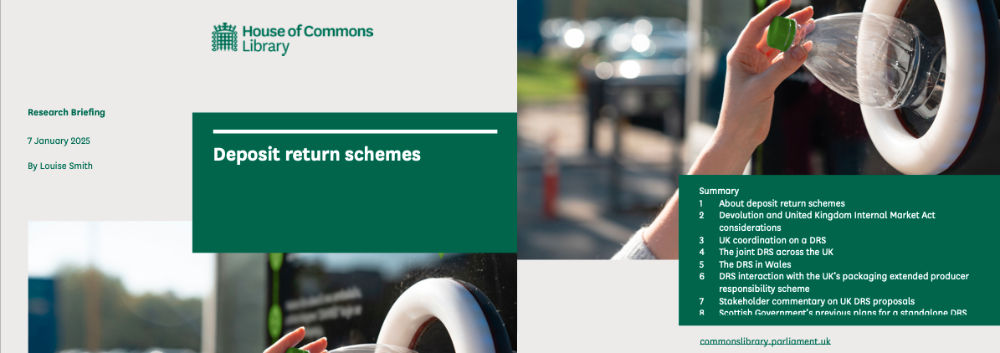
A Government Research Briefing 'Deposit return schemes' by Louise Smith was published 7 January 2025 it noted that UK consumers use around 14 billion plastic drinks bottles and nine billion cans annually, whilst research by the charity Keep Britain Tidy found that small plastic bottles and non-alcoholic cans make up 43% of litter by volume.
The Circular Economy Taskforce was established in November 2024 as an independent expert advisory group to support the government in creating a circular economy strategy for England. In December 2024 it was announced that the chair of the task force would be former Ellen MacArthur Foundation CEO Andrew Morlet, its expertise aimed at enabling the co-design of the first strategy to begin a transition to the circular economy in England. The key objectives of the taskforce being to identify and assess mechanisms that can underpin a Circular Economy Strategy for England; through which the UK government, industry and civil society benefit. (see Terms of Reference: Circular Economy Taskforce)
In July 2024, under the new the Labour government, Mary Creagh MP was appointed as Minister of Nature in the Department for Environment, Food and Rural Affairs with a responsibility for circular economy. In December 2024 the government established the Circular Economy Taskforce, the chair of which was named as former Ellen MacArthur Foundation CEO Andrew Morlet.
In February 2024 under the Conservative government it was reported that the UK was 'to establish world’s first UN-backed centre for circular economy research'. The centre aiming to develop sustainable approaches to the circular economy and resource efficiency to enable carbon reduction and the transition to a greener future, helping countries across the world to maximise the environmental and economic opportunities the circular economy offers. Opening formally in April 2024, the centre comprises of five institutions: University College London (UCL), University of Exeter, Brunel University London, Swansea University and the British Geological Survey.
The UK Circular Economy Task Force (CETF) was originally a business group convened as early as 2018 by the Green Alliance, a forum for policy, innovation and business thinking on resource use in the UK which had significant impact on government policy. For example, Defra’s 2018 resources and waste strategy adopted many of its recommendations, including harmonising recycling services and implementing an extended producer responsibility regime.
[edit] What are Deposit Return Schemes and how do they work?
Deposit Return Schemes (DRS) are circular economy approaches to what might be considered waste products, whereby a financial incentive is offered to return certain products after use to a central collection point, referred to as a reverse vending machine (RVM) or automated deposit machine (ADM). Often the products are empty containers or so-called single-use glass, metal, and plastic products, which can be washed, relabelled, and reused or recycled.
Such scheme are usually run by a Deposit Management Organisation (DMO) who set the deposit amounts, producer registration fees and payments for returns, communicate with customers, supply chain manufacturers and recyclers, and track amounts and targets. DRSs are employed in over 50 countries worldwide as a common-sense means of encouraging people to recycle more single-use bottles and cans. Existing schemes may employ a member of staff to collect the items or have an automated deposit machine at their local supermarket. ADMs read the bar code of the item that will be recycled and calculate a returnamount (usually a few pence). The total amount is then printed to a ticket, which can be spent at the supermarket for a cash equivalent or, in some cases, paid in cash to the customer.
The first sections of this article were issued via press release as "UK DMO becomes Exchange for Change as new identity unveiled for UK’s Deposit Return Scheme" dated 27 January, 20026.
[edit] Related articles on Designing Buildings
- Circular economy.
- Commercial waste.
- Definition of waste: Code of practice.
- Delivering waste efficiency in commercial buildings: A guide for facilities managers.
- Deposit management organisation DMO.
- Disposal.
- Eliminating waste at scale – opportunities for blockchain.
- Fly-tipping.
- Government steps towards a deposit return scheme for plastic bottles and cans.
- Hazardous waste.
- Household waste.
- Industrial waste.
- Landfill tax.
- London plan.
- Our waste, our resources: a strategy for England.
- Recycling.
- The Circular Economy Task Force.
- Site waste management plan.
- Waste and Resources Action Programme WRAP.
- Waste management - explained.
- Waste management process.
- Waste.
- Wishcycling.
About the wiki
You can use and contribute to the wiki in different ways.
[edit] Engaging with the wiki
You can:
- Contribute to existing articles
- Create articles
- Share articles through social media and other channels
[edit] Add your own content
To contribute to or create an article, you can follow these steps:
- Register as a user
- Read through the editorial policy and guidance on writing and contributing to articles
- See the detailed help page on tips on writing wiki articles
- Try editing a test article
- If editing an article, select 'Edit this article' underneath the article title
- If creating a new article, select 'Create an article'. In the 'Select categories' area, expand the 'Industry context' list and tag 'Circular economy' to add your article to this wiki
[edit] Who is this wiki for?
The articles contain information on implementing circular economy approaches in construction that could be relevant to:
- Architects
- Construction contractors
- Designers
- Developers, owners, investors
- Engineers
- Landowners
- Manufacturers and supplier
- Universities and research
- Urban planners